Follow Us on Google
From Adesuwa Tsan, Abuja
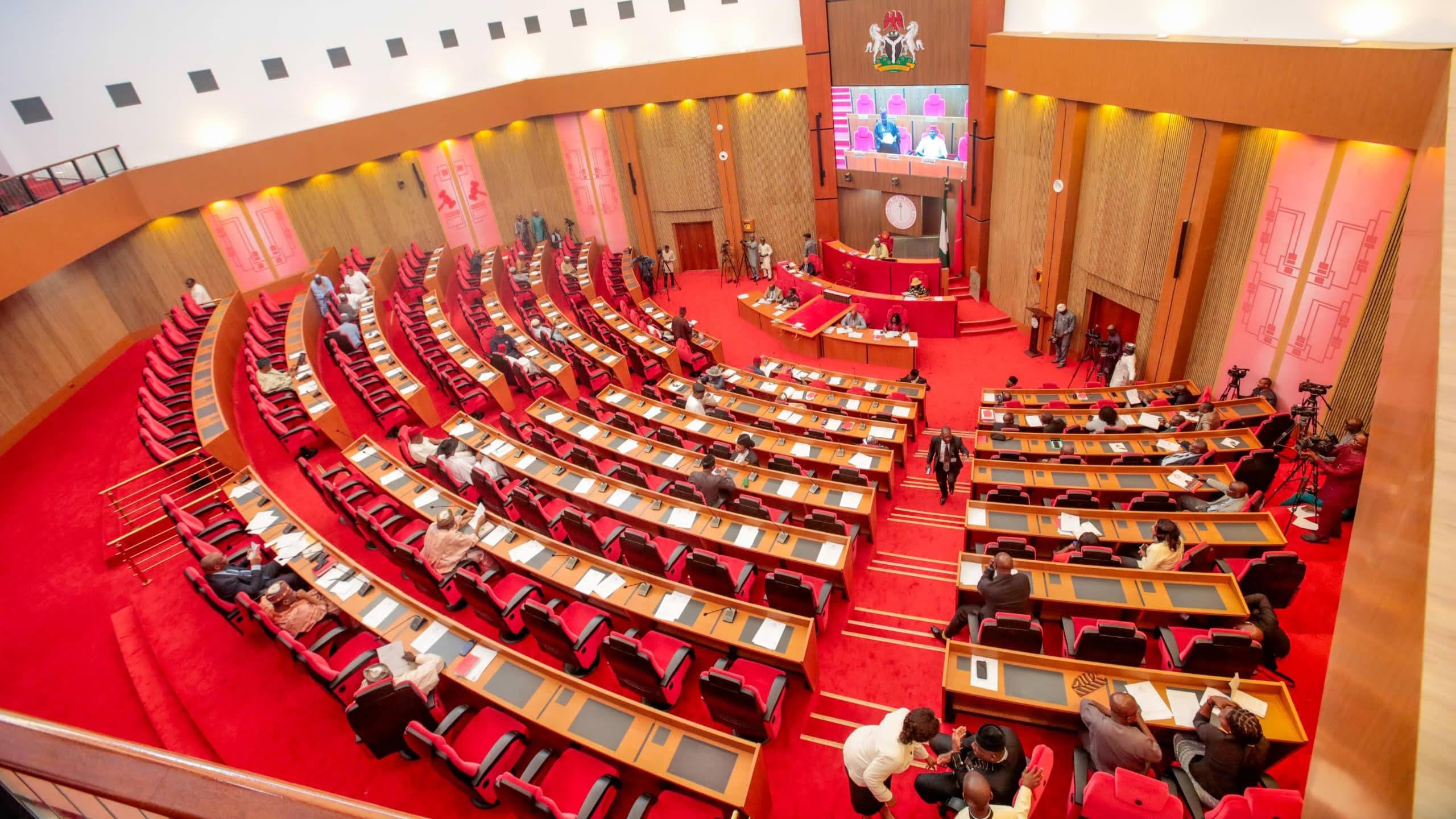
The Senate yesterday began consideration of a critical amendment to the Banks and Other Financial Institutions Act (BOFIA) aimed at bringing Nigeria’s rapidly expanding fintech and technology-enabled financial services under enhanced statutory regulation, as lawmakers warned that emerging digital platforms now operate at a scale that poses systemic and national-security implications.
Leading debate on the Bill for an Act to amend BOFIA 2020 to provide for the designation, registration and enhanced supervision of systemically important institutions, the chairman of the Senate Committee on Banking, Insurance and Other Financial Institutions, Tokunbo Abiru, said the amendment seeks to modernise Nigeria’s financial regulatory architecture in line with global standards and evolving risks in the digital economy.
Abiru, who co-sponsored the bill with all members of the Senate Committee on Banking, Insurance and Other Financial Institutions, noted that technology-enabled institutions, comprising mobile money operators, payment service banks, switching companies, wallet providers and digital lenders, have become central to Nigeria’s financial ecosystem, serving tens of millions of customers and processing enormous daily transactions.
“While their growth has been rapid and commendable, the legal framework that governs them has not kept pace with their increasing scale, influence and interconnectedness,” he said.
According to him, BOFIA in its present form is still structured around traditional deposit money banks and does not account for the possibility that non-bank entities may pose equal or greater risks to financial stability.
Abiru warned that Nigeria is currently exposed to major vulnerabilities, citing data sovereignty concerns, offshore data storage, foreign-linked digital infrastructure and opaque beneficial ownership structures among some large fintechs operating in the country.
He stated, “In a digital economy, financial data is no longer a mere administrative asset; it is a strategic national resource. Yet today, we cannot say with certainty where all the financial and behavioural data processed by some of these institutions is stored, who has access to it, or which foreign jurisdictions may lay claim to it.”
He recalled the Central Bank of Nigeria’s temporary suspension of onboarding for several major fintechs in April 2024 over KYC, AML and suspicious transaction issues as clear evidence that their operations have outgrown the existing supervisory tools.
The bill, he explained, seeks to give the CBN explicit statutory authority to designate fintechs and digital financial service providers as systemically important institutions, establish a national registry to enhance transparency, strengthen prudential and risk-based supervision, protect consumer and national financial data and improve market stability.
Other News
Abiru dismissed suggestions for the creation of a standalone fintech regulatory agency, arguing that such a move would “duplicate functions, create bureaucratic overlap, increase administrative costs and fragment regulatory authority,” in a sector deeply intertwined with monetary policy and payments oversight.
He said the global regulatory trend favours integrating fintech supervision within central banks, while mandating structured multi-agency collaboration with regulators such as Security and Exchange Commission (SEC), Nigeria Communication Commission (NCC), NITDA, FCCPC, Corporate Affairs Commission (CAC) and the Office of the National Security Adviser.
“The consequences of inaction are too significant to ignore,” he warned. “If we fail to modernise our legal framework, Nigeria may find itself dependent on foreign-owned, AI-enabled financial ecosystems in ways that undermine domestic innovation and expose consumer data.”
Contributing to the debate, Natasha Akpoti-Uduaghan drew attention to what she described as a huge discrepancy in earnings received by Nigerian creators compared to their counterparts in the United States for identical promotional content on platforms such as Facebook.
“Today, many of our youths have found careers and jobs on social media,” she said. “One particular trend worthy of mention is the huge discrepancy in payments for transactions carried out on Facebook in Nigeria compared to the United States.”
Citing examples, she revealed that while American creators receive between $10 and $30 for every 1,000 views of a promotional video, Nigerian creators earn as little as 50 cents for the same engagement.
“I’m speaking for the content creators because social media has become a very critical source of income for our youths,” Akpoti-Uduaghan stated, adding that such disparities have broader implications for Nigeria’s digital economy, competitiveness and financial inclusion.
She urged the Federal Government and regulators to engage global technology companies to ensure fairness, transparency and equitable earning structures, insisting that Nigeria must protect the interests of its growing digital workforce.
Her intervention underscored the bill’s wider relevance to the digital economy, highlighting the need for more assertive regulatory engagement with multinational platforms whose operations significantly influence national financial outcomes.
The bill was referred to the Senate Committee on Banking, Insurance and Other Financial Institutions for further legislative action.