Follow Us on Google
The Senate Committee on Industry has called on President Bola Ahmed Tinubu to intensify government support for local vehicle manufacturing, saying Nigeria can save scarce foreign exchange, create jobs and provide affordable mobility by reviving the country’s automotive industry.
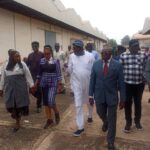
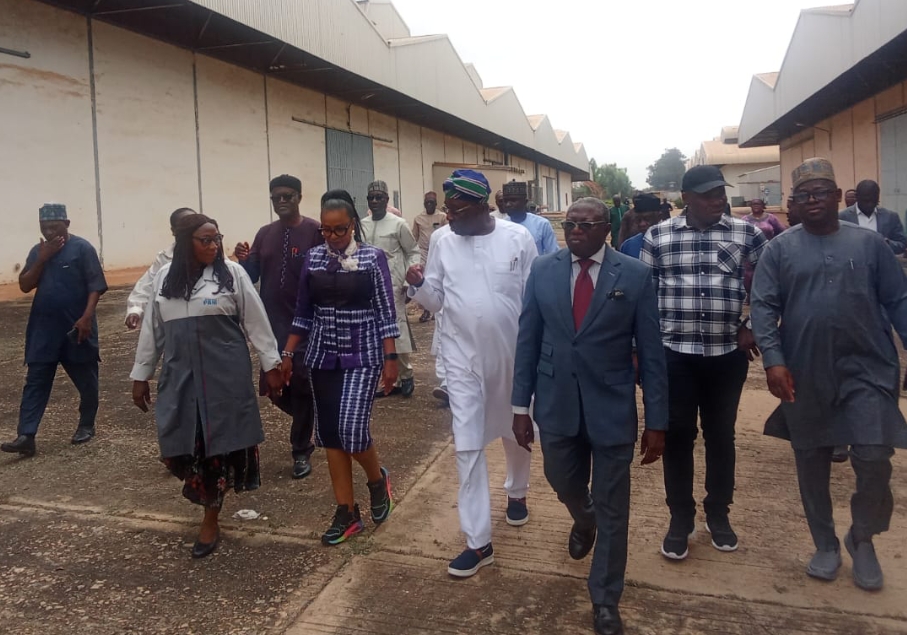
The Chairman of the committee, Senator Francis Adenigba Fadahunsi, made the call during an oversight visit to PAN Nigeria Limited in Kaduna, shortly after touring the company’s sprawling manufacturing facilities.
Fadahunsi said the visit was part of the committee’s assessment of government-owned and private industrial facilities and efforts to determine how the Federal Government’s Renewed Hope Agenda could translate into tangible benefits for Nigerians, particularly those in rural communities.
“We have been going round the facilities of NADDC and all, including their research centre. Today, we are here again to see what the Federal Government, this government of Renewed Hope, can do and can contribute to the well-being of the masses in the form of production of cheaper vehicles, tricycles and various products of mobility,” he said.
The senator said the committee had seen locally developed prototypes capable of competing favourably with imported vehicles and tricycles, arguing that greater government support for local production would reduce Nigeria’s dependence on imports.
“We have seen a prototype that is even stronger than the ones they are bringing from India,” Fadahunsi said. “Today, the Federal Government will be aware that there are better alternatives that Nigerian engineers can produce, so as to ameliorate all the imported vehicles and imported tricycles that are being used by the rural population.”
He also criticised the continued influx of used vehicles, popularly known as Tokunbo, into the Nigerian market, describing the country as a dumping ground for foreign vehicles.
“As a retired Customs officer, I saw that we are wasting money,” he said. “Nigeria has become a dumping ground. So, we have to reject it.”
Fadahunsi said PAN’s extensive facilities in Kaduna demonstrated that Nigeria possesses the infrastructure and technical capacity to produce vehicles on a large scale if adequately supported by government.
He noted that the plant has an installed capacity of about 90,000 vehicles annually and could produce up to 240 vehicles daily.
“They can produce 240 a day if aided by the same Federal Government that is looking on the other side while Tokunbo cars are coming in at a very huge cost,” he said.
According to him, reviving PAN to full capacity could also significantly increase employment and stimulate economic activity.
“If aided, the whole facility could employ more than 3,000 staff, which is huge, to affect the economy positively,” he said.
The senator also praised PAN’s training facilities, noting that thousands of artisans, including roadside mechanics and vulcanisers, had received training.
He said the training of 12,000 artisans could have a multiplier effect across rural communities.
“The 12,000 that were trained during this regime, automatically, the 12,000 will have an impact on nothing less than one million people,” Fadahunsi said.
He therefore urged the Federal Government to strengthen its support for such programmes as part of efforts to improve livelihoods and expand economic opportunities outside major urban centres.
Earlier, the Managing Director of PAN Nigeria Limited, Mrs Taiwo Oluleye, used the occasion to appeal to the Senate committee to support the proposed National Automotive Industry Bill 2026.
Oluleye described the lawmakers’ visit as timely, particularly as the company and other stakeholders prepare for new legislation aimed at protecting local investment and encouraging domestic vehicle production.
“Your visit, sir, distinguished Senators, is particularly at this time timely for us because we’re presently preparing the National Automotive Industry 2026 Bill, which will be presented very soon for legislation,” she said.
“We appeal to you, by this visit, that you review and legislate. The legislation of this policy will protect investments and develop local production, as opposed to importation of vehicles.”
Oluleye said the automotive sector was currently facing high operating costs, exchange-rate pressures, expensive borrowing and policy inconsistencies, all of which had contributed to declining production.
Despite the challenges, she said PAN remained committed to maintaining operations and deepening local content.
According to Oluleye, PAN had previously achieved 40 per cent local content in its production when the operating environment was more favourable, but local content across the industry has now fallen to below four per cent.
“At that time, PAN achieved 40 per cent local content in its production, and that was because there was an enabling environment. But today, in the industry, we have below four per cent,” she said.
Other News
She, however, expressed optimism about the Federal Government’s Nigeria First policy, saying it could promote backward integration and help rebuild local manufacturing.
Oluleye said PAN had already begun working with academic institutions and professional organisations, including Ahmadu Bello University, Kaduna Polytechnic and Engineers Without Borders, to identify locally available raw materials for vehicle-component manufacturing.
She also disclosed that the company was exploring alternative energy sources to reduce its production costs.
The PAN managing director described the automotive sector as a critical driver of industrialisation because of its extensive links with other sectors of the economy.
“This industry is a goldmine,” Oluleye said. “Auto industry is a goldmine. And with what we’ve seen in PAN, with just modest investments, we’ll be able to revive the company again to peak, to peak at the installed annual capacity.”
She said the industry had strong linkages with steel, aluminium, plastics, rubber, finance, ICT, logistics, engineering, research and development.
“It’s not just the assembly of vehicles. It’s in the auto industry, when it is enabled, it’ll create an industrial ecosystem, and there’s a lot of value chain, there’s a lot of value in the chain to be unlocked in the auto industry,” she said.
Oluleye further urged the government to protect existing investments while creating incentives capable of attracting new investors.
She said passage of the proposed automotive legislation would also enable Nigeria to take advantage of opportunities under the African Continental Free Trade Area (AfCFTA), particularly the regional rules of origin requiring a minimum level of local content for qualifying exports.
“Legislating this bill will also grant us access to the gains and advantages of African Continental Free Trade Agreement, particularly the rules of origin, which states that you must achieve a minimum of 40 per cent local content before you can export,” Oluleye said.
She said Nigeria could potentially transform itself from a major importer of vehicles into a regional manufacturing and export hub.
“Just imagine Nigeria exporting to the region alone, and the proclamation that we are the giant of Africa will be affirmed,” she said.
Fadahunsi, meanwhile, appealed to President Tinubu to give greater attention to the automotive sector, arguing that increased local production would reduce pressure on the nation’s foreign-exchange reserves and lower the cost of mobility for Nigerians.
“We are calling on Mr. President to please support this mission, and it will reduce his budget. It will reduce our budget,” he said.
The senator also urged Nigerians to reconsider their preference for imported used vehicles, saying locally manufactured vehicles could provide more durable and cost-effective alternatives if properly supported.
“We are appealing to Nigerians that they should change their system of patronising foreign cars, foreign used cars,” he said.
He added that even new imported vehicles should be subjected to appropriate testing to ensure they are suitable for Nigerian roads and operating conditions.
Fadahunsi pledged the committee’s support for measures aimed at strengthening Nigeria’s automotive manufacturing capacity, saying the National Assembly had a responsibility to ensure that the country’s rural population benefited from industrial development.
“We all are coming from the rural sector. And if we don’t forget them, we are going back to them very soon, to give them hope that Mr. President is thinking of them,” he said.
Also speaking, the Director-General of NADDC, Oluwemimo Joseph Osanipin, said the inspection had demonstrated that Nigeria had the capacity to meet a substantial part of its domestic vehicle demand through local assembly.
“What we have seen here is evidence that we have the capacity,” Osanipin said.
He said PAN’s 90,000-unit annual installed capacity, combined with facilities in other parts of the country, particularly Lagos, could provide sufficient capacity to meet Nigeria’s local demand if fully activated.
The NADDC boss said the Council was already working to address the major impediments confronting the automotive industry, including legislation, patronage and access to credit.
He said the Federal Government’s Nigeria First policy had created an opportunity to revive local manufacturing, adding that NADDC was working with the Credit Corporation to expand vehicle financing beyond cars and motorcycles.
Osanipin said the combination of stronger legislation, government patronage, access to credit and protection of local investments would help reposition the automotive industry and reduce Nigeria’s dependence on imported vehicles.