Follow Us on Google
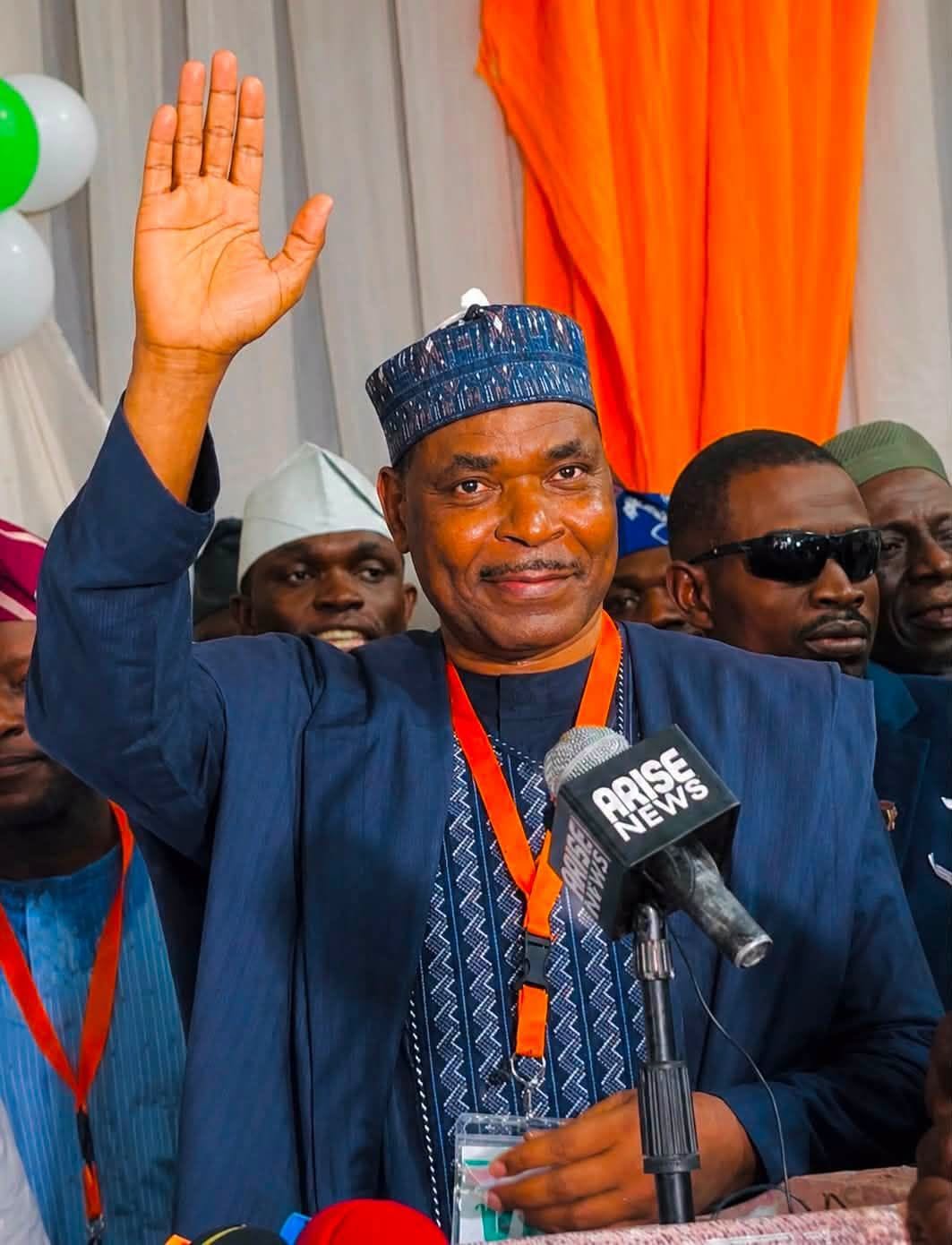
From APC’s internal contest to SDP’s new platform, Mohammed Adamu’s emergence has altered the political equation, but whether he can convert momentum into victory remains the bigger question.
From Abel Leonard, Lafia
For much of the period leading to the 2027 governorship election in Nasarawa State, the emerging political contest appeared to be settling into a familiar pattern: the ruling All Progressives Congress (APC) on one side and the Peoples Democratic Party (PDP) on the other.
The APC has the advantage of incumbency, government structures and a statewide political machinery. The PDP, meanwhile, has a candidate who is already familiar to voters after a fiercely contested 2023 election.
But the emergence of former Inspector-General of Police, Mohammed Abubakar Adamu, as the governorship candidate of the Social Democratic Party (SDP), has introduced a new variable into that equation.
Adamu’s emergence did not follow the conventional route.
The SDP had initially presented Musa Adamu Angba as its governorship candidate, and Angba’s name was subsequently listed by the Independent National Electoral Commission (INEC).
He later withdrew from the race, creating a vacancy that the party filled through a substitution primary conducted on September 5.
The exercise produced Adamu as the SDP’s new flag bearer, formally ending the uncertainty over whether the former police chief would contest the election. The party said the substitution exercise was conducted across the state’s 13 local government areas, with 28,637 delegates participating.
The question now is not simply why the SDP picked Adamu. The bigger question is whether the former police chief can transform his profile, political network and growing visibility into the kind of statewide coalition capable of breaking the established APC-PDP pattern in Nasarawa.
From APC aspirant to SDP standard-bearer
Adamu’s political journey to the SDP ticket is itself one of the defining stories of the 2027 contest.
He initially sought the APC governorship ticket, where he faced Senator Ahmed Aliyu Wadada and other aspirants.
When the APC primary was held in May, Wadada emerged with a decisive victory. The official result announced by the party’s primary committee gave Wadada 195,285 votes, while Adamu was declared second with 39,675 votes.
Political observers stressed that the significance of that contest goes beyond the figures. They argued that it created a political situation in which two men who had contested for the same APC ticket eventually found themselves on opposite sides of the 2027 contest.
Wadada remained within the APC and became the ruling party’s candidate.
Adamu moved to the SDP.
That development, they said, potentially makes the 2027 election more complicated for the APC than it would have been had Adamu simply disappeared from the contest after losing the primary.
Political commentator Amos Akaleku said the former IGP already had visibility within the ruling party’s political space. His subsequent decision to contest under another platform means that whatever support he commanded during the APC primary becomes an important political question.
“It would, however, be premature to assume that the votes recorded by an aspirant in a party primary automatically become votes in a general election.
“They do not.”
He added that a primary is a contest among party members and delegates. A general election involves millions of registered voters, competing interests, local calculations, personalities, religious and ethnic considerations, incumbency, party structures and, ultimately, the ability of candidates to mobilise voters on election day.
That distinction could determine whether Adamu’s current momentum becomes a genuine electoral threat or merely a political sensation, he said.
The APC advantage
Any serious assessment of Adamu’s chances must begin with the strength of the APC. The ruling party enters the election with an enormous structural advantage.
It controls the state government and has an established political network extending through the state’s 13 local government areas and 147 electoral wards.
Its candidate, Wadada, is also not an outsider to Nasarawa politics. He is a sitting senator representing Nasarawa West and has previously demonstrated an ability to mobilise voters outside the traditional expectations of party politics.
The 2023 election provides an important historical reference.
INEC declared Governor Abdullahi Sule of the APC winner with 347,209 votes, while PDP candidate David Ombugadu scored 283,016 votes. The election was subsequently challenged in court, with the governorship election tribunal initially declaring Ombugadu the winner before the appellate process ultimately upheld Sule’s victory.
That history demonstrates two things.
First, the APC has a substantial electoral base in the state.
Second, the PDP is not an opposition party that can simply be dismissed.
The gap between the two major parties in 2023 was not enormous enough to suggest that the APC has an impregnable electoral fortress. Indeed, the political environment that produced that close contest remains relevant to 2027.
And then there is PDP
Musa Abdullahi, a political scientist at a state university, noted that the most important question surrounding Adamu’s emergence is not whether he can defeat the APC alone. It is whether he can rearrange the opposition vote.
He said the PDP has returned to a familiar strategy by retaining Ombugadu, its candidate in the 2023 election. The party has formally reaffirmed him as its 2027 governorship candidate.
“Ombugadu therefore enters the race with something Adamu does not have: a demonstrated statewide electoral base.”
He contested the 2023 election, received 283,016 votes according to the results declared by INEC, and built a political identity around the contest. His name is therefore already familiar across the state.
“But that familiarity can work both ways.
“For some voters, it represents experience and persistence.”
For others, it could create fatigue, particularly among voters looking for a fresh political alternative. That is where Adamu’s candidacy becomes strategically interesting, he added.
He further stated that Adamu can attempt to position himself not merely as an opponent of the APC, but as an alternative to both the APC and PDP. If he succeeds, he could attract voters dissatisfied with the ruling party while also drawing some voters who do not want to return to the PDP.
That would transform the election from a conventional two-party contest into a three-way struggle.
Adamu’s biggest political asset
Adamu’s greatest advantage may be the combination of name recognition, professional background and political timing. He is not entering the race as an obscure politician seeking to introduce himself to voters.
He is a former Inspector-General of Police and a former senior public servant whose career gave him national visibility.
That profile could appeal particularly to voters who prioritise security, discipline, competence and institutional experience.
His message is already beginning to reflect this positioning. At the SDP substitution primary, Adamu promised to address rural roads, healthcare, agriculture and the management of mineral resources.
He also promised an issue-based campaign, saying his programmes would be presented specifically according to the needs of individual local governments and communities.
That could become important.
However, Nasarawa’s political conversation cannot be reduced to party slogans. Questions around roads, healthcare, agricultural productivity, education, employment, rural development and the management of the state’s mineral wealth are issues that directly affect voters.
If Adamu succeeds in making the election a referendum on these issues, rather than simply a contest between political personalities, he could widen his appeal beyond the traditional SDP constituency.
But a famous name is not enough
This is where the SDP gamble becomes risky. The Nigerian political system is heavily dependent on structure.
A candidate can be popular and still lose an election if his party cannot translate that popularity into organisation at the ward and polling-unit levels.
The APC has that structure. The PDP also has an established statewide network.
Danladi Suleiman, a chieftain of one of the political parties in the state who did not want his name published, said the SDP must therefore answer a fundamental question: Does it have the organisational capacity to carry Adamu’s candidacy into every polling unit in Nasarawa?
“The party’s growing visibility is encouraging for its supporters, but visibility should not be confused with electoral organisation.”
He further stated that a successful governorship campaign requires thousands of party agents, coordinators, ward structures, mobilisation teams, polling-unit representatives and a disciplined election-day operation.
This is where Adamu’s political team will be tested.
The former IGP can attract crowds. He can generate headlines. He can attract former political allies.
But can those advantages be converted into votes? He asked.
That is the real test.
The defection question
Another factor that could influence the race is the movement of politicians and supporters between political parties.
Adamu’s move from the APC to the SDP has the potential to create a wider realignment, particularly as some political actors who were dissatisfied with the APC primary followed him.
There have already been discussions about political movements around the former IGP and the growing competition between the SDP and APC. Some reports have characterised the contest as one in which the SDP is attempting to seize political initiative from the ruling party.
But again, caution is necessary.
Political defections make headlines.
Votes determine elections.
A politician moving from one party to another does not necessarily take an entire constituency with him.
The SDP therefore has to demonstrate that its growing political network is more than a collection of prominent individuals. It must become a functioning electoral machine.
Wadada’s challenge
Political observers are of the opinion that Adamu’s emergence creates a particularly interesting political challenge for Wadada.
Other News
Recall that the APC candidate defeated the former IGP decisively during the party’s primary. That should ordinarily give him the psychological advantage.
But the same primary also demonstrated that Adamu possesses some level of support within the APC political family.
Observers further stressed that the APC’s task, therefore, is to prevent the post-primary contest from becoming a referendum on the fairness of its internal process.
Wadada has already called for unity among APC stakeholders following his emergence. That message will become increasingly important.
If the APC successfully reconciles its internal interests and keeps its political structure united, Adamu’s task becomes considerably more difficult.
“If, however, unresolved grievances persist beneath the surface, the SDP may attempt to exploit them. The difference between the two scenarios could be enormous.”
Ombugadu’s dilemma
The PDP and Ombugadu face a different problem.
They cannot afford to underestimate Adamu.
The party’s 2023 performance gives it a strong foundation, but a three-way contest could alter the mathematics considerably.
A PDP chieftain who spoke on condition of anonymity stated that:
“If Adamu draws primarily from APC, he could weaken Wadada and create an opportunity for PDP. But if Adamu attracts substantial numbers of voters who would otherwise support PDP, the effect could be entirely different.”
That is why the PDP’s strategy towards the SDP will be crucial.
Will the PDP attack Adamu directly?
Will it ignore him and focus on the APC?
Or will it attempt to portray the SDP as incapable of defeating the ruling party and therefore encourage opposition voters to consolidate behind the PDP?
The answers to these questions could shape the second phase of the campaign.
In answering these questions, he said Nasarawa’s political geography will also matter.
The state is not politically uniform.
The three senatorial zones have different political histories, voting patterns and local political structures.
“A candidate who performs strongly in one part of the state but fails to establish a meaningful presence elsewhere will struggle to win a governorship election.”
This means Adamu’s promise to campaign local government by local government is strategically significant.
If properly executed, it could allow the SDP to develop targeted messages for communities rather than rely on a statewide slogan.
The party will need to understand what voters in each area consider their most pressing concern.
For rural communities, it may be roads and agriculture.
For urban voters, employment, education, healthcare and infrastructure may dominate.
For communities in mineral-producing areas, the management and benefits of natural resources may carry greater weight.
The candidate who best understands these local differences will have an advantage.
Is Nasarawa still a two-horse race?
This is perhaps the central question.
Technically, it is too early to declare the race a three-way contest.
The APC remains the governing party.
The PDP has a proven statewide electoral base.
The SDP is still attempting to translate the popularity of a relatively high-profile candidate into a comparable political structure.
Musa Adamu, a political pundit at the Federal University, stressed that dismissing the SDP would equally be a mistake.
“Adamu’s emergence changes the strategic calculations of the other parties.”
“He is sufficiently prominent to attract attention. He has a political history inside the APC. He has national visibility.
“He has now obtained the formal SDP ticket. And, perhaps most importantly, he is entering the race at a time when voters are increasingly being presented with alternatives to the two dominant parties.”
The 2027 election may therefore become less about whether Adamu can immediately overtake the APC and PDP and more about whether he can deny either of them a comfortable victory.
That is an important distinction.
“A third candidate does not necessarily need to win immediately to become politically consequential.
“If SDP can secure a substantial share of the vote, it could determine which of the other two parties wins.”
The real Adamu gamble
Ultimately, the SDP’s decision to replace Angba with Adamu is a political gamble.
The party has exchanged a relatively less prominent candidate for a nationally recognised former police chief.
That gives it visibility.
It gives it a clearer narrative.
It gives the party a candidate with a recognisable record in public service.
But it also raises expectations.
Former police officer Monday John said that once a former IGP is presented as the man capable of transforming Nasarawa, voters will demand evidence of competence, organisation and a realistic programme.
Monday said Adamu will have to move beyond the language of “bad governance” and demonstrate precisely what he would do differently.
“He will have to explain how his government would finance rural roads, improve healthcare, transform agriculture and ensure that mineral wealth benefits communities.
“He will also have to convince voters that his campaign is not simply an extension of his disagreement with the APC primary.”
The road to 2027
For now, the Nasarawa governorship race has three major political narratives.
For the APC and Wadada, it is about defending power and maintaining the ruling party’s structure.
For the PDP and Ombugadu, it is about turning the strength demonstrated in 2023 into another serious challenge for Government House.
For the SDP and Adamu, it is about convincing voters that the state does not have to choose between the two established political camps.
The next several months will determine which narrative gains traction.
Adamu has secured the ticket.
That was the first battle.
The harder battle is now beginning.
He must build structures, reconcile interests, attract credible political actors, win over undecided voters and persuade the electorate that his experience in national public service can translate into effective governance at the state level.
The APC must keep its house together.
The PDP must defend its established opposition territory.
And the SDP must prove that its new momentum is more than political excitement.
But one thing is becoming increasingly clear: with Adamu now formally on the SDP ticket, the 2027 Nasarawa governorship contest can no longer be analysed solely through the old APC-versus-PDP lens.
The former police chief has entered the race.
Whether he merely changes the arithmetic or ultimately changes the winner may depend less on the size of his name than on the strength of the political structure he builds between now and election day.