Follow Us on Google
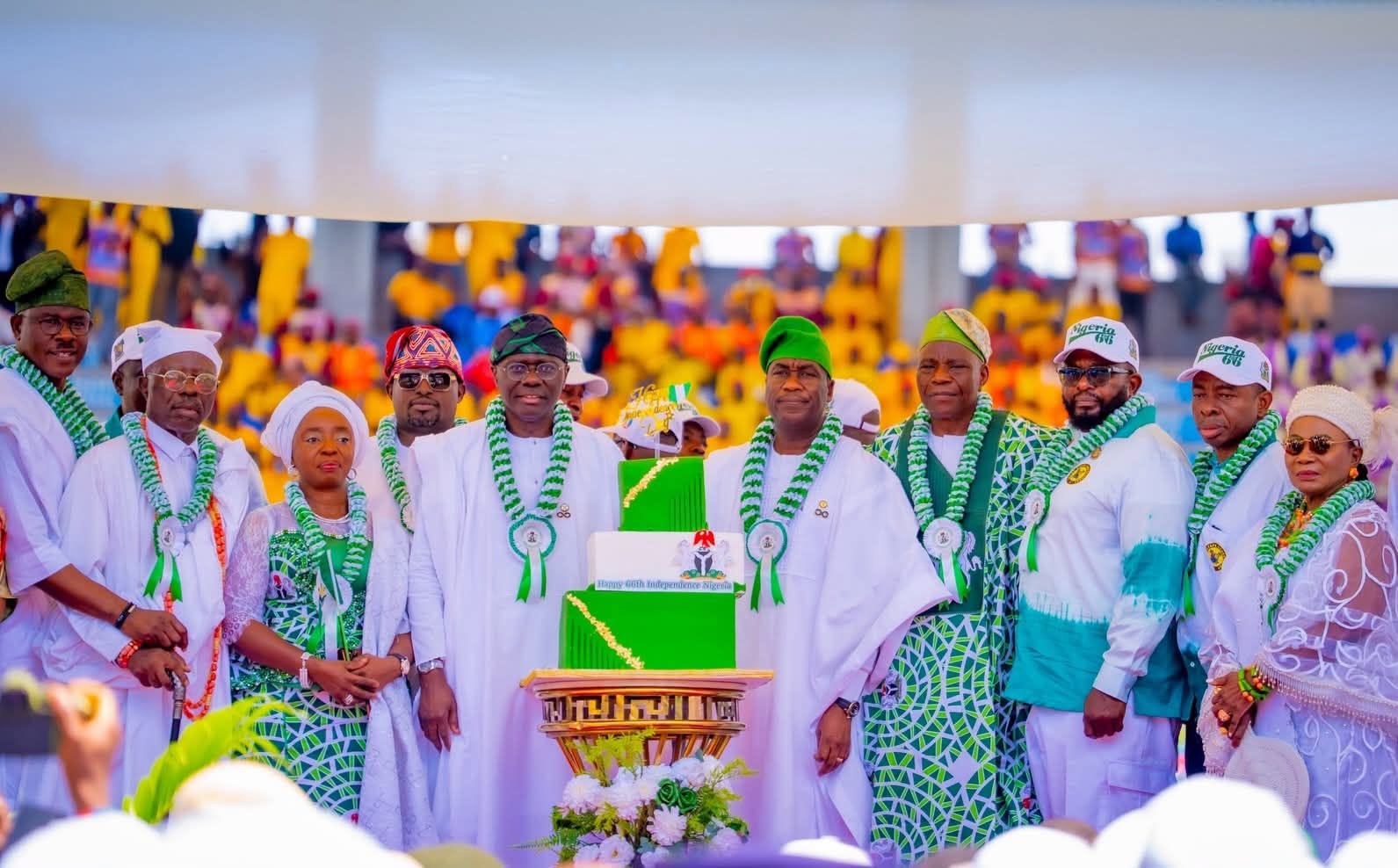
Lagos State Governor Babajide Sanwo-Olu has said Nigeria’s survival through civil war, military rule, economic hardship and political upheavals over the past 66 years was a testament to the resilience and determination of its people.
Sanwo-Olu spoke on Thursday at the Mobolaji Johnson Arena, Onikan, Lagos, during the state’s celebration of Nigeria’s 66th Independence Anniversary.
The colourful ceremony featured an Independence Day parade by the Nigeria Police Force, paramilitary agencies and students, with the governor taking the salute. It also included the cutting of the anniversary cake.
The governor said the venue held special historical significance, recalling that only a few hundred metres away, the Union Jack was lowered at midnight on 1 October 1960 as the Nigerian flag was raised to mark the country’s independence.
“Sixty-six years ago tonight, a few hundred metres from here, the flag came down. At the stroke of midnight, in the eyes of the world on this city, the Union Jack was lowered for the last time, and the green-white-green went up for the first time,” he said.
Reflecting on the thousands of ordinary Lagosians who gathered to witness the historic moment, Sanwo-Olu said Nigeria’s independence was not merely the achievement of political leaders but a victory belonging to the people.
“In Nigeria, it did not begin at the top. Nigeria began with ordinary people who decided on a night like this one, and they stood to begin,” he said.
The governor said the significance of the 66th anniversary must be understood against the backdrop of the country’s turbulent history, including the civil war and decades of military rule.
However, he noted that Nigeria had remained one country and had sustained 27 uninterrupted years of constitutional democracy — the longest stretch of civilian rule in its history.
“Here we are, 66 years, one country, one flag,” Sanwo-Olu declared.
The governor acknowledged the economic difficulties confronting Nigerians, saying recent reforms had placed considerable pressure on households, with rising food, transport and other living costs affecting families across Lagos.
“I’ve asked a great deal of ordinary families. The price of a bag of rice, the price of a bus to work, every household in Lagos has felt it, and I’ve felt it,” he said.
He said the priority should now be to ensure that the gains expected from the reforms ultimately translate into improved living conditions for Nigerians.
Turning to Lagos, Sanwo-Olu described the state as a microcosm of Nigeria, with people from virtually every part of the country living, working and pursuing their aspirations there.
“Lagos does not succeed in spite of Nigeria, and Nigeria does not succeed without Lagos,” he said.
Other News
The governor also highlighted projects and reforms undertaken by his administration in transport, healthcare, education, infrastructure and digital governance, citing the Blue and Red rail lines, road and bridge projects, healthcare facilities and the expansion of tertiary institutions.
But Sanwo-Olu said the achievements could not be credited to government alone, acknowledging the role of Lagos residents in driving the state’s development.
“I did not build these things, Lagosians built them with me. With your taxes, your patience, your complaints, your holding us to account, the governor’s name fades on the plaque, but what remains is the people,” he said.
As his tenure draws to a close, the governor said his priority was to leave behind strong institutions capable of functioning beyond the tenure of any individual office holder.
He identified youth development and democratic participation as critical to Nigeria’s future, noting the contributions of young Lagosians to the creative, technology and entrepreneurial sectors.
Sanwo-Olu also spoke on the 2027 elections, declaring his support for the All Progressives Congress (APC) and calling on Lagos residents to support President Bola Ahmed Tinubu for a second term and his preferred successor, Dr Femi Hamzat, as governor of Lagos State.
He urged Nigerians to participate peacefully in the elections and exercise their franchise responsibly.
The governor said Lagos had maintained a record of peaceful transfers of power since the return to democratic rule in 1999, describing it as one of the state’s most important democratic legacies. “Vote peaceably, vote in your numbers, vote with your eyes open,” he said.
Returning to the symbolism of the Nigerian flag, Sanwo-Olu said its continued presence despite the country’s challenges represented the endurance of the Nigerian nation.
“Sixty-six years after, those flags are still flying through war, through hardship, through long nights of trial, through every prophecy of collapse that clever people have written about this country since 1960. The flag has never come down,” he said.
Sanwo-Olu urged Nigerians, particularly young people, to protect the country’s unity and build on the legacy inherited from previous generations. “It is not our hour to retire, it is our hour to build,” he said.
He also paid tribute to the security and paramilitary personnel who participated in the parade, as well as the schoolchildren who represented the next generation.
“To the school children in this arena who’ll see the 100th anniversary, this is your inheritance. Guard it, protect it, improve on it, and hand it to your own next generation,” the governor said.
The event was attended by government officials, traditional rulers, security agencies, students, members of the diplomatic community and other residents who gathered to commemorate Nigeria’s 66 years of independence.