Follow Us on Google
By Vivian Onyebukwa
Membership has been identified as the heartbeat of any organisation. There is no issue challenging any club such as membership. As a result, for Rotary Club to continue to do the great work it is known for across the world, quality membership is important.
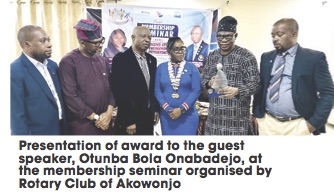
It was for this reason that Rotary Club of Akowonjo, Lagos, organised a seminar with the theme “Harmonising attraction and engaging for dynamic membership growth”, which took place in Ikeja, Lagos, recently.
President of Rotary Club of Akowonjo, Dr. Esther Sunkanmi Amoye, said the essence of the lecture was to equip the club’s leadership and other members with the knowledge they need to effectively attract and engage members so that the goals of Rotary can be achieved in a sustainable manner.
The guest speaker, Otunba Bola Onabadejo, a past District Governor of Rotary Club, broke the membership development seminar into three stages, namely, attraction, engagement and extension.
He started by describing “attraction” as the act, process or methodology of bringing new members into a club, and enumerated strategies for effective attraction.
First, according to him, is to form and inaugurate a strong and diverse club membership committee to achieve the club’s membership goals, identify the demographic missing from the club, analyse the club’s record from prior to bringing in new members and see what the club was doing well and what could be improved upon.
“Also, enhance your club’s image on social media, consider those who have recently retired, former Rotary members, young professionals, Rotrators and Rotary alumni, and then customise your approach based on each group’s needs,” he said.
Other strategies were to develop no-pressure method to engage prospective members, using online methods to attract members, abandon traditional practices that may be unattractive to guests and other prospective members and then have documented activities and projects done by the clubs within the community in a pamphlet to distribute to guests at meetings.
He mentioned other strategies, which included holding prospective member events to help members of the community discover Rotary, organise and invite prospective members to a partnership night and bring someone to talk to them about Rotary.
He said: “Activities by the club to retain members is called engagement. When clubs make considerable efforts to bring in new members through attraction, it is important to ensure that such members don’t seamlessly drift away.”
After attraction of new members, Onabadejo said it was important to retain them through engagement: “One of the tricks is inclusivenes, it is very key. Appreciate that your members are precious, make meeting interesting, take cognisance of time with all organised programmes, involve all members when implementing changes and vital decisions. Again, assimilation of new members and everyone is very essential. Show appreciation and recognise sponsors of new members.”
He further noted that, for the club to retain members, they should encourage diversity in age, gender, classification, ethnicity, occupation and give club members, young and old, duties in all club activities, while they also orgnaise Special Training and Action in Rotary (STAR) programmes to educate and inform members regularly and make Rotarians out of their members.
He emphasised the importance of special training and action in Rotary.
“Invite speakers within and outside Rotary to discuss topical issues; hold club assemblies to discuss club businesses; carry everyone along; set goals and assess club progress towards goals,” he said.
Other ways to retain members, he noted, were to adopt a pairing system, involve families and educate the spouses of their members about Rotary, conduct member satisfaction survey, and give female members a platform to be club speakers. Also, they should encourage members to attend district programmes and give a report to the club.
He said, sometimes, members or intending members do not really have time to attend meetings as a result of their career or other reasons, which could make them lose interest in their memberships. The guest speaker advised the club to relax attendance rules, allow different kinds of membership and consider marrying time and location.
Executing service projects that make impact on community and involving everyone also has a way of enhancing the club’s visibility.
“They should also build pride in membership and constantly recognise those who help in building the club through membership, ensure continuous Rotary education because an informed Rotarian is always a better Rotarian. Celebrate members’ achievements, events, success, promotions, birthdays, including spouses’ anniversaries, utilise the social media for the benefit of your clubs; have a good qualitative club bulletin, and promote attendance at meetings,” he said.
Some members, he noted, drift as a result of much expenses in their clubs. He, therefore, told them to keep costs manageable.
Other strategies to grow and keep membership, according to Onabadejo include keeping clubs’ achieves and records. He identified the importance of past president and advised them to always invite them to their club’s activities and engage them constructively.
He advised that they should also pay attention to the younger members as they are likely to stay if they believe that the club is willing to accommodate their interests, as well as their work, family and personal needs.
Experience is quite important in the growth of any club, which is why he asked them to appoint experienced Rotarians to mentor new members’ mentorship.
“Show members that you care. Club members should treat all members with dignity, listen to their needs and not overlook their concerns. The future strength of your club depends on what you do how-Mega club status, quality members, more conducive venue and cohesion. While effective membership attraction has brought in many into Rotary through the front door, our poor performance in engagement has opened the back door through which we lose an effective percentage of our membership strength. It is, therefore, imperative to co-ordinate effective strategies for attraction and engagement,” Onabadejo concluded.