Follow Us on Google
Edo State, aptly christened the “Heartbeat of the Nation”, is far more than a slogan. Its strategic location and extensive road network make it one of Nigeria’s most important economic corridors, linking the South to the North and the East while facilitating the movement of people, agricultural produce, goods and services across the country.
For decades, the state’s highways have served as vital arteries of commerce and connectivity. But that role is increasingly being undermined by years of neglect, poor maintenance and the deteriorating condition of several federal roads.
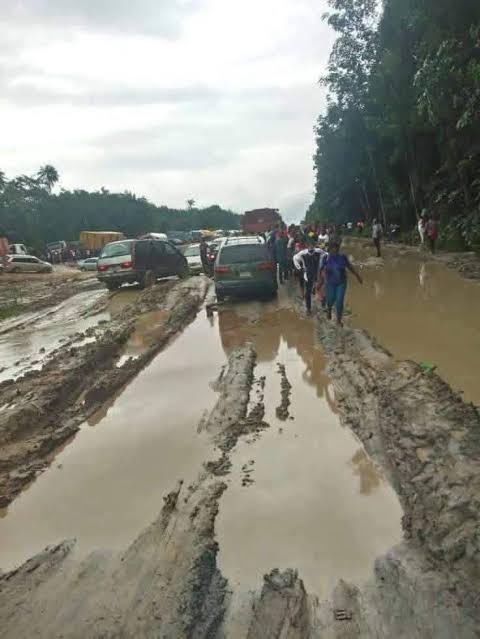
Across the state, roads that once provided relatively seamless connections are now characterised by potholes, failed sections, erosion, damaged shoulders and other dangerous defects.
For motorists and commuters, what should be routine journeys have become stressful, time-consuming and, in some cases, life-threatening experiences.
Residents say the situation has deteriorated to the point where navigating some stretches of the highways has become a daily battle, with motorists forced to slow down, make sudden manoeuvres or abandon safer routes altogether.
The consequences extend beyond inconvenience.
Transport operators are spending more on fuel and vehicle repairs, commuters are enduring longer travel times, businesses are facing delays in the movement of goods, while communities along the affected corridors are becoming increasingly isolated.
For a state whose economic strength is closely tied to its position as a major transport and commercial hub, the continued deterioration of its federal highways represents not only an infrastructure crisis but also a serious economic and public safety concern.
Speaking to Saturday Sun in Benin, Mr Ekeleyede Rick Odion, a resident of the state, recounted his recent experience while travelling to Edo Central.
Odion described the journey as harrowing, saying it was an ordeal he would not want to experience again.
“Actually, some of the federal roads in Benin have been in a dilapidated condition. A lot of commuters and travellers have been finding it very difficult.
“Even myself, I had that terrible experience on Saturday when I was travelling to Edo Central. If not for the help of the escorts, it would have been quite an unhealthy situation for me,” he said.
Mr Ekeleyede noted that Edo’s strategic importance to Nigeria’s economy makes the rehabilitation of its major federal corridors more than a local demand. It is an investment in national connectivity, commerce and safety.
Ekeleyede maintained that until urgent action is taken, motorists and commuters will continue to face the same grim reality: roads that should connect communities and drive economic activity are steadily becoming roads to ruin.
He added that for Edo residents, the demand is straightforward: the federal roads must be restored before the damage becomes even more costly to reverse.
He said the state cannot continue to bear the economic and human cost of highways that are supposed to facilitate movement but increasingly obstruct it.
Another resident, Mr Lucky Oboh-Onokwe, also lamented the condition of the roads, recounting how a journey from Delta State to Benin stretched into several exhausting hours.
According to him, the poor state of the road forced him to manoeuvre through different communities in an effort to avoid the worst sections.
Oboh-Onokwe appealed to the Federal Government to urgently intervene and accelerate the rehabilitation of the affected highways, stressing that residents and other road users desperately need relief.
However, following the outcry from Nigerians travelling along the route, Saturday Sun reports that the Minister of Works, Engr David Umahi, has decided to wade into the situation on the Benin-Asaba Road.
Umahi launched a scathing attack on the Benin-Asaba Expressway Concession Company (BAECC) over the deteriorating condition of the Benin-Asaba Highway, accusing the concessionaire of lacking the technical capacity required to deliver the project to the expected standard.
Umahi made his position known in Benin City during an on-the-spot inspection of the troubled highway, following mounting complaints from motorists over its worsening condition.
The road’s failed sections have reportedly caused severe traffic disruptions, with some motorists stranded for days.
The minister expressed particular outrage over the concessionaire’s decision to remove sections of the existing asphalt without first providing adequate side drainage.
He described the action as a reckless destruction of public infrastructure and blamed it for worsening the condition of the already distressed highway.
The minister warned that such actions would not be tolerated, stressing that the concessionaire had no justification for tampering with the existing road without the necessary approvals and proper engineering measures.
He further stated that, under normal circumstances, the concessionaire could have been arrested for removing asphalt from the existing roadway without authorisation, describing the development as unacceptable and a clear indication of poor project management.
“I commend Governor Monday Okpebholo for his intervention on several federal roads across the state.
Other News
“He is not saying this is a federal or state road. I apologise to commuters plying this road.
“I am disappointed with the concessionaire. I take full responsibility for their misdeeds and destruction of public assets.
“The Ministry of Works does not allow the removal of asphalt. We begged them not to remove it. The concessionaire should have been arrested for destroying public property,” Umahi said.
The minister directed the ministry to arrest any concessionaire found removing asphalt from existing federal roads without authorisation.
Addressing BAECC Chief Executive Officer, Samuel Daramola, the minister accused the company of manipulating the concession process and questioned its technical capacity to handle a major highway project.
“You manipulated the process to get the job. You have no knowledge of road construction. You don’t know what you are doing. You have no technical staff or competence,” Umahi said.
He added that the Federal Government had been compelled to intervene because of the danger posed to motorists and commuters.
“The President has directed us to do whatever is possible to fix this road. The law is there; there is overriding public interest. It is also the fault of government for not finding out the competency of concessionaires.
“You are learning how to do construction on our road. This is dangerous,” he said.
He further revealed that President Bola Tinubu had directed the redesign of roads from Kogi through Edo State to Warri, with concrete pavement to be considered for the reconstruction.
“We need total reconstruction of this road and not this palliative,” he declared.
The visibly angry minister also said the Federal Government would engage competent contractors to restore the failed portions of the highway, while directing that the China Civil Engineering Construction Corporation (CCECC) be approached to fix the worst sections around Asaba.
Responding to the minister, BAECC CEO Samuel Daramola attributed the slow pace of work to heavy rainfall and intense vehicular traffic.
He said the company had expanded sections of the highway to eight lanes and carried out palliative works but was struggling to execute drainage works because of the volume of traffic.
“We are wrestling with the weather as much as we want to keep to the scope of work. We have to choose between doing side drains and combating heavy traffic,” he explained.
According to him, the company was sometimes forced to reopen sections of the road before construction materials had adequately cured because of the need to keep traffic moving.
He, however, assured that BAECC remained committed to completing the project and protecting its reputation.
The representative of the project consultant, Engr Toyin Akinlapa, contradicted the concessionaire’s position, saying the company had ignored professional advice on the proper sequence of construction.
“The concessionaire did not heed our instructions. We told them to first do the drains, but they ignored us, and that affected the road.
“The company had some challenges in its technical team,” Akinlapa said.
Chairman of the House Committee on Works, Hon. Akin Alabi, called on President Tinubu to review the agreement with the concessionaire and consider a broader review of similar road concessions.
He said the Federal Government must ensure that concessionaires had the technical and financial capacity to deliver quality infrastructure, stressing the need for immediate palliative measures to restore movement along the highway.
Senator Allwell Onyesoh described the condition of the Benin-Asaba Highway as “despicable”, while Edo State Governor Monday Okpebholo commended President Tinubu for his prompt response to the plight of motorists and residents.
Governor Monday Okpebholo urged residents to disregard what he described as misleading opposition narratives circulating on social media, assuring them that the Federal Government’s swift intervention reflects its determination to address the challenges confronting the Benin-Asaba Highway.
The strategic highway was concessioned to the Benin-Asaba Expressway Concession Company (BAECC) in 2025 for reconstruction and expansion into a 10-lane expressway, a project expected to significantly improve traffic flow and connectivity along the corridor.
At the time of the concession, the company assured the Federal Government that the massive reconstruction and expansion project would be delivered within the agreed timeframe.