Follow Us on Google
By Emmanuel Iduma
Voices of the Soil, a daring and immersive art and culture exhibition organized by Chidi Ebere, who also exhibited under the name Ekemmiri, was held at the Art Village Gallery in Abuja on February 10, 2021. A variety of sculptures based on identity, memory, and land were included in the exhibition.
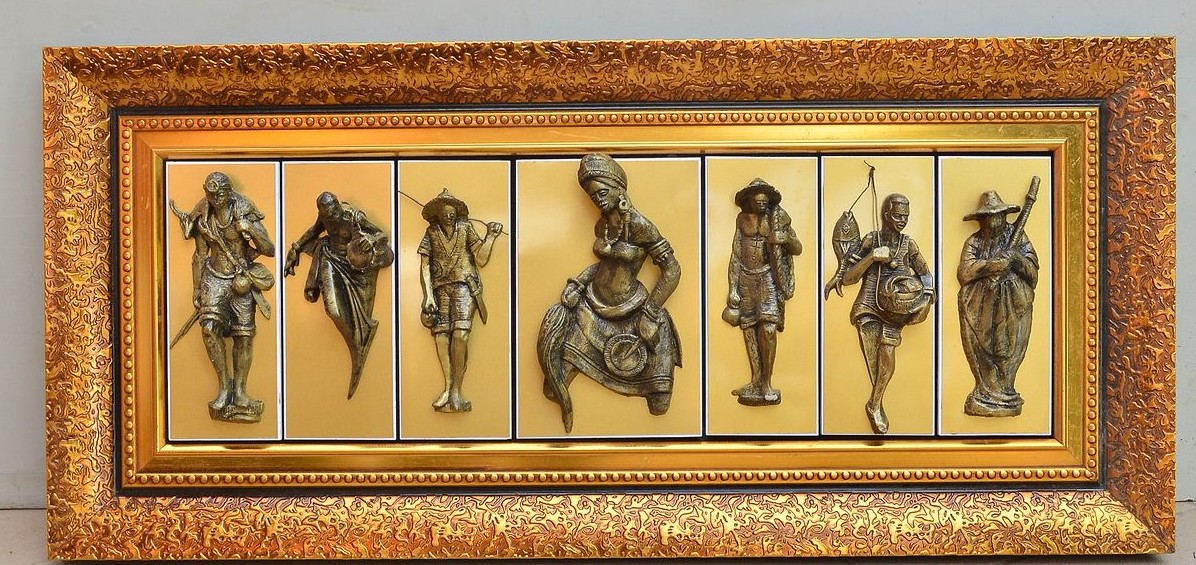
Ekemmiri’s exquisitely carved relief sculpture, Native Nigerians, was one of the exhibition’s main attractions. The hunter, drummer, nomad, traditional female dancer, palm wine tapper, fisherman, and masquerade are the seven traditional figures that appear in the composition. Set on a gold-toned background and carefully modeled in filler, each figure is framed in an elaborate baroque style that conveys respect and deliberate elevation.
Ekemmiri places these figures in dialogue with the present rather than depicting them as sentimental artifacts. Individual dignity and narrative weight are given to each character, acknowledging the diversity and tenacity ingrained in Nigerian culture. Tradition moves and breathes through the central female dancer, who, with her elegant stance and expressive posture, evokes both celebration and continuation.
The clarity of goal in this piece is what makes it so captivating. Instead of using overt dramatization, Ekemmiri uses a subtle yet powerful visual language. The figures are full of life in gesture and detail, despite their motionless shape. Not only are the drummer’s squat, the hunter’s stride, and the fisherman’s cautious grasp of his catch visual compositions, but they are also cultural affirmations.
The overall theme of Voices of the Soil is reflected in Native Nigerians: the recovery of indigenous presence as a living, breathing framework for identity rather than just as historical subject matter. By focusing on common people—workers, entertainers, and spiritual beings—Ekemmiri resists the need to elevate the extraordinary while ignoring the culturally fundamental. It is an artistic and political act that affirms the value of traditional labor and collective memory.
As both curator and exhibiting artist, Chidi Ebere’s dual roles in this exhibition gave it more complexity. His work under the name Ekemmiri encompasses more than just gallery installations; it also includes public artwork and community-based projects that promote discussion about belonging, displacement, and the preservation of traditional knowledge. His work relates to a larger cultural restoration initiative in which art serves as a teaching and therapeutic tool.
Chidi Ebere explained the inspiration behind his artwork during the exhibition:
“As a child, I was constantly exposed to shards of our culture, whether it was through elder storytelling, market displays, or village celebrations. Nevertheless, as time went on, I saw how those pieces were disappearing and how the commonplace roles that constituted our communities—the hunter, the palm wine tapper, the masquerade—were losing their visibility, even within ourselves.”
“In my opinion, art is a means of paying attention to the land, honoring those who shaped it, and creating space for customs that still have a lot to teach us.
Also featured by Chidi Ebere at the Voices of the Soil exhibition is Ogbu Opi (Royal Flutist), a striking relief sculpture that captured a quiet but powerful moment. With his head bowed and the flute pressed gently to his lips, the flutist appears not just to be playing music, but listening , as if receiving melodies from another realm. His posture is calm, almost meditative, suggesting a deep spiritual link between sound and the divine. The work doesn’t demand attention, instead it draws you in slowly, inviting you to share in that moment of sacred communication. It feels less like a performance and more like a prayer, a silent offering to the gods through music.
Filler is a sculptural material used in creating both pieces that enables surface detail and smooth shaping. Although filler works well for capturing shape and motion, it is also naturally sensitive, which means that if it is not handled carefully, the artwork may crack or otherwise be damaged. The work’s material fragility gives it another level of significance since, like the cultural memories they contain, these objects are priceless, vulnerable, and in need of preservation.
Voices of the Soil was a reckoning, not just an exhibition. Ekemmiri’s work reminds us that culture doesn’t only live in museums or textbooks. It lives in gestures, in music, in movement, and in memory. Through these sculptures, he gives value and honour to roles that are often overlooked yet remain central to who we are.
Voices of the Soil was more than an art event. It was a reminder that the soil beneath us holds stories, and that art can help us hear them again.