Follow Us on Google
The ancient Athenians, confronting the tiny island of Melos in 416 BC, delivered a verdict that still governs international relations: “The strong do what they can and the weak suffer what they must.” Right, as the world goes, is only in question between equals in power. Nations weigh words by counting guns. The strong do what they have to do and rationalise it later.
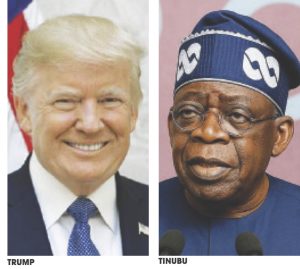
President Donald J. Trump’s address of 28 February 2026, announcing major combat operations against Iran, is the 21st-century translation of that Melian logic. International law exists as a strategy applied by the strong and interpreted for the weak. Any Nigerian who still calls Trump “crazy” or “unpredictable” needs urgent neurological examination. In less than three months, his administration has dismantled the leadership of Venezuela, neutralised a Mexican cartel kingpin, and launched a surgical obliteration of Iran’s nuclear and missile infrastructure with breath-taking speed and consistency. Decades of diplomatic paralysis have been solved in weeks. That is not madness; that is method. A strategic geopolitical realignment and balance of regional power ever executed in modern American history. The war in Iran could be over in a day or two, but the United States chose restraint in place of reckless deployment of its military might. It has refrained from attacking some critical infrastructures that will serve the over 97 million Iranian population. The war, as framed by America and Israel, is not a war against the Iranian people but against what they termed the evil regime- the Ayatollahs. According to President Donald Trump, the regime is run by lunatics and extremists who sponsor terror around the world. They armed ISIS in Syria, funded the Houthis, armed Hezbollah in Lebanon, and Hamas in the Palestinian territory. The Israeli Ambassador to Nigeria alleged that the regime is linked to ISWAP and several terrorist groups in Nigeria. The regime has developed cheap drones, medium and long-range ballistic missile capabilities, to pose threats to regional neighbours and the United States Allies. In this conflict, Iran has attacked over 12 countries and struck civilian facilities, like airports, hotels, embassies, and US military command bases. The regime has demonstrated what many fear most about them. Iran already has rockets capable of reaching Israel and missiles capable of threatening large parts of the Middle East. Why are they spending billions developing long-range missiles? Obviously, those missiles are not meant for Tel Aviv or Paris but for America – the ‘Big Satan.’ Hence, the US quest to stop its nuclear and long-range missile capabilities is not out of place.
Yet Nigeria’s official posture remains an embarrassing ideological fence-sitting. When the United States eliminated Iran’s Supreme Leader, our government issued pious pronouncements that sounded more like mourning a lost brother than sober statecraft. We pity-party with Iran and Venezuela as though feathering a bed of sovereignty excuses us from domestic and international responsibility. This is not neutrality; it is self-harm. Iran once abused diplomatic cover to smuggle ten container-loads of RPGs and explosives into Nigeria in 2010, in clear breach of UN sanctions. Most of the arms and drones used by terrorists in Nigeria may be hardware from Iran. That same regime now lies in ruins, its currency worthless, its people dancing in the streets after decades of suffocation. Venezuela, another oil-rich “anti-imperialist” comrade, has equally collapsed. President Maduro and the wife are currently standing trial in the New York District of the United States for narcotics Trafficking. Nigeria, which shares its economic DNA—crippled Naira, sabotage-ravaged oil output, and inability to meet OPEC quotas—should be studying these corpses, not mourning or saluting them.
Our foreign policy cannot be religiously driven while our citizens perish. Even Iran is neither a mono ethnic nor a monolithic religious country. Even though the State is governed by theocratic rules, similar to what obtains in Kano State Nigeria, Iran has other minority tribes and religious mix.
That said; Pakistan and Afghanistan, both Muslim nations, exchange artillery of which the Afghanistan Supreme Leader like Khamenei, was smoked. Russia and Ukraine, largely Orthodox Christians, have been bleeding each other white. The Iran–US conflict is neither a jihad nor a crusade; it is a raw contest for supremacy and geopolitical realignment. Nigerians, Muslim and Christian alike, share the same land, the same poverty, the same terrorist bullets. Our real enemies are at home and in plain sight. To pretend otherwise is to not just mortgage our conscience but our children’s future on imported slogans.
Worse still, quasi-terror sympathisers and newly appointed “honorary ambassadors” like FFK issue incendiary statements daily, purporting to speak for the government. This is a clear usurpation—bordering on treasonable sabotage—of sovereign diplomatic space. While serious nations calibrate responses through professional channels, we allow social-media megaphones to poison the well. The result is predictable: Washington reads mixed signals, our credibility evaporates, and our citizens abroad pay the price.
The imperatives for recalibration are therefore existential. First, Nigeria must free itself from the parasitic embrace of a diminished France and an increasingly distracted United Kingdom. Their rhetorical warmth has never insulated us from economic cold. Like lighting cigarettes to ward off harmattan, the gesture produces smoke but no heat. Second, our foreign policy must be calibrated strictly to our military and economic realities. We are neither a superpower nor a regional gendarme. If we cannot project power commensurate with our rhetoric, we should adopt the dignified silence of Norway or Denmark—quiet, prosperous and respected. At best, we should pursue a total, pragmatic alliance with the United States, the sole remaining power capable of shaping outcomes in our lifetime.
Third, we must stop playing “big-broke brother” to ECOWAS and African Union members. Dignity demands we develop strictly commercial relationships with them or risk mutual descent into Armageddon. Hand-outs we cannot afford have only bred resentment and exposed our fragility. A recalibrated diplomacy anchored in enlightened self-interest, not ideological posturing, will enable us to negotiate from strength, protect our diaspora, attract genuine investment, and—above all—deliver tangible benefits to Nigerian citizens.
The prophetic outcome is already written in Tehran and Caracas. Countries that refuse to auto-correct their diplomatic trajectories when power shifts find themselves on the wrong side of history’s ledger. Their currencies collapse, their youth emigrate, their sovereignty becomes a slogan recited in ruins. Nigeria stands at that same fork. We can continue performative anti-Westernism while our people suffer, or we can wake up, recalibrate, and do the right thing with dignity.
The hour is late, but not yet lost. Let us match our words to our weight, align with reality rather than rhetoric, and place Nigeria and Nigerians first—always. History does not repeat itself, but nations that refuse to learn from it certainly do repeat the same mistakes.