Follow Us on Google
•Experts attribute attitude to fear, silence, misinformation
By Doris Obinna
Medical experts have disclosed that over 80 per cent of Nigerian men with prostate cancer present themselves late for treatment, making the disease almost incurable. They attributed this attitude to fear, silence and misinformation.
Medical Director, The Prostate Clinic (TPC), Prof. Kingsley Ekwueme, said in Lagos that the mission is to reduce what he described as the “unacceptably high burden” of late-stage prostate cancer diagnoses in Nigeria. He said the decision to invest in healthcare infrastructure in the country followed years of practice in the United Kingdom, where he said early detection and advanced treatment have significantly improved survival rates.
According to him, prostate cancer remains one of the leading causes of cancer-related deaths among Nigerian men, largely because many patients present at advanced stages when treatment options are limited. He contrasted this with the United Kingdom, where he said a significantly higher proportion of cases are diagnosed early and are therefore treatable.
“There is a stark difference in outcomes,” he said, adding that early detection and timely intervention remain critical to survival. He emphasised that prostate cancer, if identified early, is curable, and that patients can go on to live normal life expectancies.
Ekwueme, a Robotic Surgeon, said the clinic has treated patients from Nigeria as well as from several other countries. He reiterated that patients travel to Lagos for treatment and return home shortly after procedures, highlighting what he described as the efficiency of care provided.
He also announced the development of a robotic surgery centre in Imo State, which he said would be equipped with a Da Vinci surgical system, widely regarded globally as a leading platform for minimally invasive procedures. He stated that the facility is being modeled after international standards and would be completed soon, with the installation of robotic equipment.
He further disclosed plans for what he described as an integrated “medical city” that will combine robotic surgery and radiotherapy services within a single facility. According to him, the design will eliminate the current separation between surgical and oncology care, allowing patients to receive comprehensive cancer treatment in one location.
Ekwueme said the project is being developed with input from international collaborators, including medical physics experts from the United Kingdom, and is intended to serve as a regional hub for cancer treatment in Africa. He added that the initiative is part of a broader strategy to decentralise specialist healthcare and make advanced treatment more accessible across Nigeria.
Stressing the importance of local capacity building, he stated that Nigerian medical personnel are being trained to operate advanced surgical systems and deliver high-level care without reliance on foreign specialists. He said this approach is intended to ensure sustainability and affordability of services.
Misconception
Addressing common misconceptions about prostate cancer, Ekwueme outlined age, ethnicity, and family history as established risk factors. He noted that risk increases with age, particularly from the sixth decade of life, and said black men face a higher likelihood of developing aggressive forms of the disease.
Risk factor, treatment
Ekwueme also highlighted family history as a significant factor, recommending earlier screening for individuals with affected relatives.
He cautioned against unverified claims regarding diet or lifestyle practices as preventive measures, stating that there is no scientifically confirmed dietary method to prevent prostate cancer. He urged Nigerians to rely on medical screening and evidence-based treatment rather than social media-driven advice.
On treatment practices, he criticised outdated approaches such as routine removal of testicles in early-stage cases, describing them as no longer standard in modern oncology. He said current treatment protocols favour medication-based hormonal management where necessary, preserving quality of life for patients.
Ekwueme also emphasised surgical safety and expertise, arguing that patient outcomes depend heavily on the experience of the operating surgeon. He compared surgical proficiency to aviation, stressing the importance of training, repetition, and adherence to safety standards.
Reflecting on the challenges of establishing advanced medical infrastructure in Nigeria, he acknowledged financial and logistical difficulties, noting that he personally invested significant resources into the project without initial external funding. However, he said growing institutional partnerships and government engagement have strengthened progress.
He reaffirmed his long-term goal of expanding access to high-quality prostate cancer care across Nigeria, stating that future plans include extending services to other regions beyond Lagos and Imo State. According to him, the ultimate objective is to ensure that patients across the country can access advanced cancer treatment without travelling abroad.
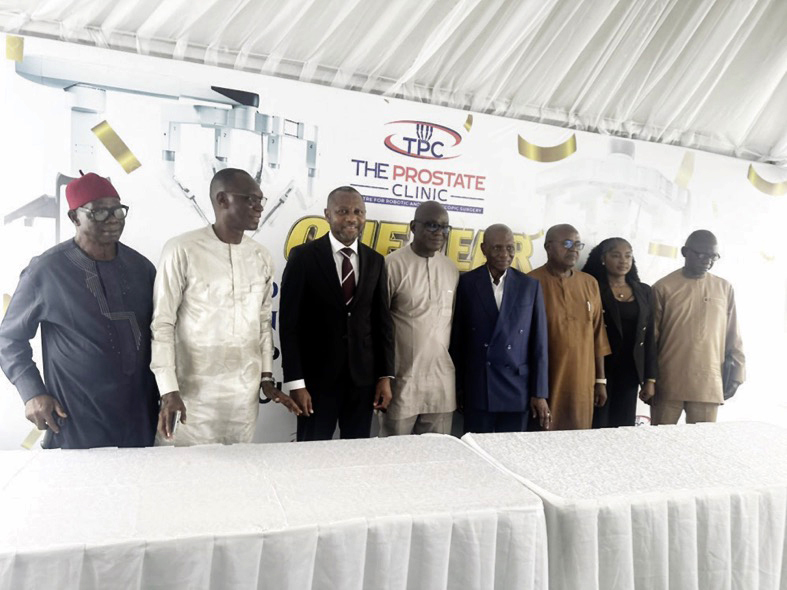
The event, attended by medical professionals, patients and stakeholders, also celebrated the clinic’s 100th successful patient, a figure that includes Mr. Francis Ogboro, who revealed he was among those treated.
Ogboro, also the Chairman of TPC, described the milestone as significant for the clinic, which began operations a year ago. He praised the vision of the medical expert whose expertise he said has attracted patients from across the world and contributed to the clinic’s growing reputation in advanced prostate care.
Ogboro reaffirmed the clinic’s commitment to excellence and continued collaboration describing the first year as the beginning of a broader vision for advanced healthcare delivery in Nigeria.
Survivors’ experiences
Other News
Former spokesperson, Nigerian Armed Forces, Major General John Enenche (retd.), whose story captured both the danger, and hope surrounding prostate cancer.
Others are Ichie Sylvester Osigwe, Mr. Adesina Alabi, Mr. Ben Alozie, Mr. Innocent Ihebuzor, and Mr. Emmanuel Okolie who came all the way from Canada.
“My testimony is that of divine intervention,” Enenche said.
“I heard clearly: ‘Go and check yourself, check your prostate, check your kidneys. That instruction saved my life.”
Enenche admitted he had noticed subtle changes in his body years earlier but ignored them until that prompting pushed him to act. When he eventually went for a test, his PSA level came back at 14.2.
Enenche continued: “They saw something that could be cancerous,” he said. Fear took over. “I told the doctor, ‘Remove everything, both testicles and nerves. Let me just live so I can continue serving Nigeria,” he recounted.
“But Prof. Ekwueme, insisted on a more measured, evidence-based approach. He told me, ‘General, you will need those structures. Let us do what is best medically.’ That gave me confidence,” Enenche said.
According to Enenche, four hours of procedure changed everything. Enenche underwent robotic surgery, which he described as seamless. “Ekwueme told me the operation would take about four hours. When I woke up, it was done. I didn’t even realise what had happened,” he said.
Now fully recovered, he speaks with gratitude. “I walked into that hospital. I walked out. The money I spent became nothing compared to the life I gained.”
Enenche’s testimony was one of many at the event, which marked one year of TPC’s operations and brought together beneficiaries of its treatment.
For Enenche and others, the anniversary was more than a celebration; it was a call to action. “Too many men are dying because they are afraid or unaware. If you are over 40, don’t wait. Don’t assume. Go and check yourself. That simple decision saved my life.”
Ihebuzor described months of distress before his procedure. “I was urinating up to 10 times a night. I couldn’t sleep. After the surgery, everything returned to normal. I urinate like a young boy again.”
Okolie, who travelled from Canada, said his diagnosis came at a devastating moment.
He said he abandoned treatment delays in Canada to fly to Lagos. “I would rather die in the hands of a human being.”
He expressed joy, as his surgery was successful with a fast recovery.
Osigwe explained how the Surgeon reassured him at the blimey of his wife’s death and operated on him after.
“My PSA (prostate-specific antigen) was 69, and my wife had just died of cancer. I asked, ‘Will I survive?’ The professor told me, ‘You will not die.’ Today, I am alive.”
Alabi shared how his PSA level shot up to 7.9 last year. Frustrated by delays and poor service at another facility, he was referred to TPC.
He underwent robotic surgery on December 27 and recovered smoothly.
“This new place is excellent,” he said, praising the professionalism and care he received.
Alozie, a journalist survivor, reflecting years after his surgery, added: “Prostate cancer is not a death sentence. I am practically cancer-free.”
These beneficiaries are part of the 100 patients who have been treated at the hospital in the last year of its operation in Nigeria.