Follow Us on Google
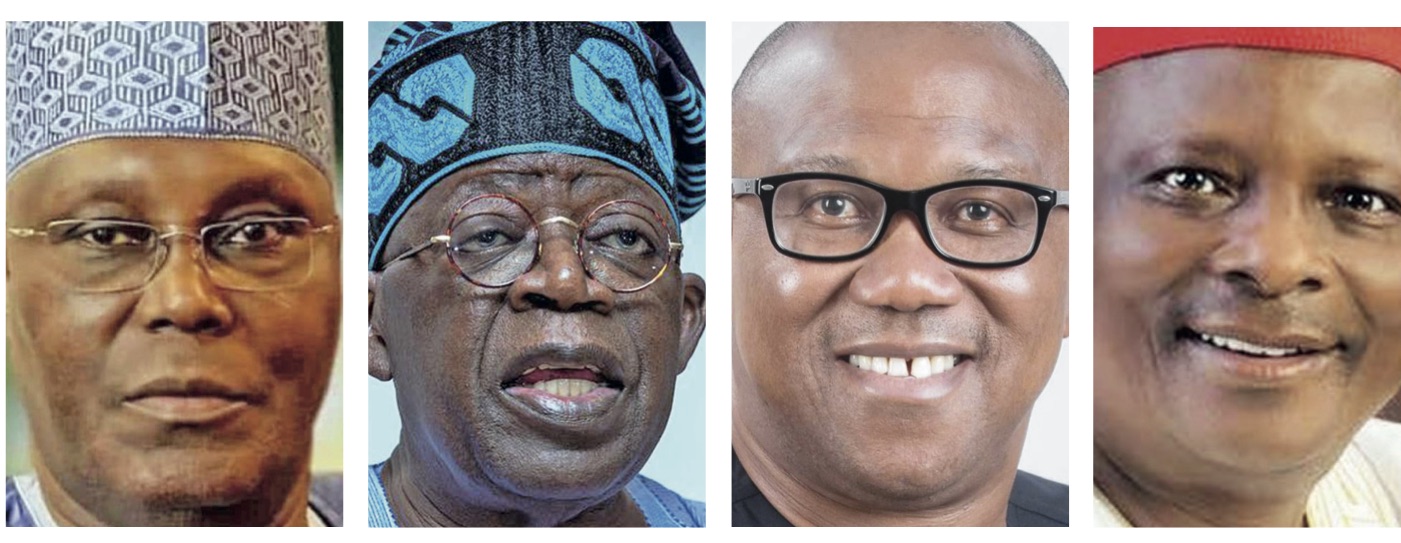
• Nigerians decide Atiku, Tinubu, Obi, Kwankwaso’s fate today • Sowore, Kola Abiola, Al-Mustapha, 11 others also battle for Buhari’s
From Fred Itua, Abuja
After months of intense campaigns, horse-trading and mudslinging by different presidential contenders, Nigerians will be trooping out in large numbers today to elect their next president.
Eighteen political parties will slug it out at the polls today. Many Nigerians, however, believe the race for the presidency is actually being run by four leading candidates. These include Bola Ahmed Tinubu of the ruling All progressives Congress (APC); Atiku Abubaka of the Peoples Democratic Party (PDP); Peter Obi of the Labour Party (LP) and Rabiu Musa Kwankwaso of the New Nigeria People’s Party (NNPP).
Other political parties and their candidates include Professor Christopher Imumulen of Accord (A); Hamza Al-Mustapha of the Action Alliance (AA); Sani Yabagi Yusuf of the Action Democratic Party (ADP); Nnadi Charles Osita, Action Peoples Party (APP); Omoyele Sowore, African Action Congress (AAC); Dumebi Kachikwu, African Democratic Party (ADP); Professor Peter Umeadi, All Progressives Grand Alliance (APGA); Yusuf Mamman Dan Talle. Allied Peoples Movement (APM); Adenuga Sunday Oluwafemi, Boot Party (BP); Osakwe Felix Johnson, National Rescue Movement (NRM); Mr Kola Abiola, Peoples Redemption Party (PRP); Prince Adewole Adebayo, Social Democratic Party (SDP); Prince Malik Ado-Ibrahim, Young Progressives Party (YPP) and Dan Nwanyanwu of the Zenith Labour Party (ZLP).
Unlike many of the other 14 candidates, Tinubu, Atiku, Obi and Kwankwaso were more visible throughout the campaigns, visiting virtually every part of the country and campaigning at large rallies in every state.
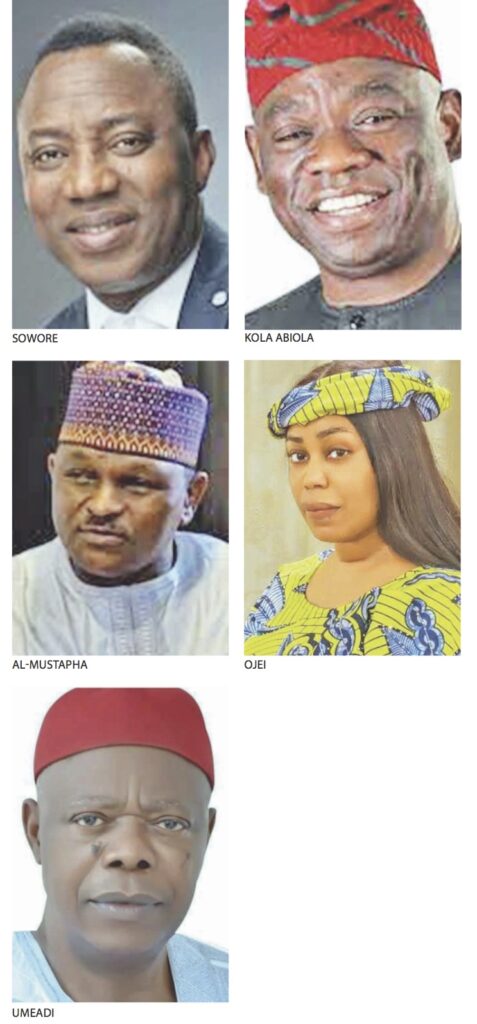
However, voters across the divide have since aligned with their respective candidates. There are a number of reasons advanced by stakeholders which earned the candidates the support of the electorate.
Bola Ahmed Tinubu – APC
A former governor of Lagos, Tinubu was also a Senator during the short-lived Third Republic. Among the political class, there seems to be some consensus among the political elite in the current dispensation that power should be ceded to the South, after eight years of the administration of President Muhammadu Buhari, a Northerner. Though the current Vice President Yemi Osinbajo hails from the South West, Tinubu’s ambition still receives the needed support from advocates of power shift to the South. Voters who go to the polls believing a power shift to the South will create a national balance might support Tinubu or any of the other candidates from the South.
Tinubu is also believed to enjoy a broad-based support from leaders of the ruling APC. This was clearly displayed during last year’s primaries of the party at the Eagle’s Square, Abuja. The support from governors elected on the platform of the APC is also considered a huge asset for Tinubu. He also has allies in every part of the country.
But, like other candidates, there are factors that threatened his ambition during the just concluded campaigns. Some have raised issues about his health. But those arguments were also countered that he successfully crisscrossed the length and breadth of Nigeria campaigning almost non-stop, with no incidents warranting medical attention.
Tinubu’s decision to pick a fellow Muslim as running mate pitted his party, the APC against some sections of the nation’s Christian community. But his long relationship with the church and Christian leaders as well as the fact that his wife is a serving pastor while his children are Christians have been adduced to counter allegations that he might hate Christians leveled against him.
Atiku Abubakar – PDP
Atiku ABubakar, a former two-term Vice President of Nigeria, has cemented friendships across the Niger. As an active player in the botched June 1993 presidential elections, Atiku has been part of Nigeria’s political evolution in the last three decades. Also described as a serial presidential aspirant since 2007, Atiku is also believed to have wide allies in every part of the country.
With President Buhari out of the ballot for the first time in 20 years, Atiku might be filling the void as the most popular candidate from Northern Nigeria. His Islamic and Fulani backgrounds might be an added advantage for him from up North.
On the flipside, some have raised issues about his age. With many Nigerians pushing for younger leaders, Atiku and his supporters have countered that even in advanced countries, like the United States, elderly persons have secured the nod of the electorate in those places to serve as president. Donald Trump and Joe Biden, immediate past and current presidents of the United States, have been cited as good examples of presidents that are in their 70s.
Some have also noted that Atiku’s feud with the group of five governors from his party, PDP, might affect his chances in the election. But Atiku and his party have since moved on without the governors, holding large rallies even in the states of such governors.
Peter Obi
Obi was governor of Anambra State for eight years. In the 2019 presidential election, Obi was running mate to Atiku Abubakar on the platform of the PDP. This time, his emergence as Labour Party’s presidential candidate raised the profile of the party, with many young people expressing support for his candidacy. Many believe he represents a generational shift and resonates well with the youths.
Besides that, the call for a power shift to the South also favours Obi, having come from a geopolitical zone that has not had a shot at the seat of power since the end of the First Republic.
Obi also has some sections of the Christian community in Nigeria behind him.
On the flip side, some have tagged his lack of structure and spread across every nook and cranny of the country as his biggest albatross. The party does not have a sitting governor, beside a handful of serving members of the National Assembly. But his supporters have argued that his structures are the people.
Many stakeholders have also expressed concerns about his ability to fulfill the numerous promises he has made if elected president. But Obi and his supporters have insisted that every promise he made to the Nigerian people would be fulfilled.
Rabiu Kwankwaso
Kwankwaso is a former governor of Kano State, a former Deputy Speaker of the House of Representatives, a former senator and a former Minister. Among the four candidates, he is the only one that has served in almost all capacities.
Kwankwaso is popular among the Muslim-dominated North West, especially in Kano State. He’s relying on his famed popularity in the geopolitical zone to spring up a surprise.
The former governor is, however, seen by some people, notably in the South, as having not much clout in the South or among the Christian community in the North. Some are also insisting that he might not have the constitutional spread required to clinch power.
But his supporters insist that the current realities do not support such arguments, as he has been campaigning in many parts of the South with large numbers of people coming out to attend his rallies.
Strength of the candidates
There are also arguments on key states that each of the candidates are expected to clinch. Tinubu for instance, is expected to harvest the highest number of votes in the South-West. He’s also expected to secure some votes in North West because of the governors of the various states who are members of APC.
With Kashim Shettima’s presence in the North East, Tinubu is also expected to secure the mandatory 25 per cent in some of the states. He’s expected to also garner votes in the North Central. His major challenge might be in the South East and South South.
For Atiku, besides the 19 Northern states where he’s expected to show a serious outing, he’s also expected to give some fight in some South West states like Lagos, Osun and Oyo, where the PDP has serious structures. In the South-South, pundits believe Atiku would make a decent showing. His running mate, Ifeanyi Okowa, is from the South South.
Peter Obi, it is believed, would have a considerably good outing in the South-East and South-South. But he’s also expected to perform decently in places like Lagos, Benue, Plateau, Kaduna, Kano and some other Northern states because of the significant number of working class people who are among his biggest supporters.
Kwankwaso is believed to have his greatest strength in the North. But with many of his supporters also living outside the North, he cannot be taken for granted in the election.
It is Decision Day today for Nigerians, as they will be electing the one that would take over from President Muhammadu Buhari on May 29 this year. And one of the candidates listed above will be president.
Who will that candidate be? The nation waits with bated breath.