Follow Us on Google
By Omoniyi Salaudeen
The judgment of the Presidential Election Petition Court (PEPC), which on Wednesday affirmed the victory of President Bola Ahmed Tinubu in the February 25 presidential and National Assembly elections may just be the beginning of another legal firework that is shifting to the Supreme Court.

Expectedly, mixed reactions have continued to trail the judgment of the tribunal. The candidates of the two leading opposition political parties, Atiku Abubakar of the Peoples Democratic Party (PDP) and his counterpart in the Labour Party, Peter Obi, had approached the Court seeking to upturn the results of the election declared by the Independent National Electoral Commission (INEC).
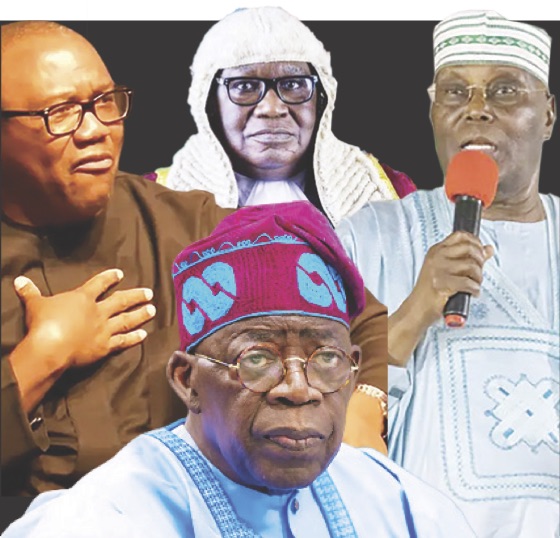
The unanimous ruling of the five-man panel led by Justice Haruna Tsammani did not only dismiss the consolidated petitions of the PDP, the APM, and the LP, but also affirmed the victory of Tinubu as the validly elected president. Justice Tsammani, who read the decision of the Tribunal in a 12-hour marathon address, said: “This petition accordingly lacks merit. I affirm the return of Bola Ahmed Tinubu as the duly elected President of the Federal Republic of Nigeria. The parties are to bear their costs.” The court cited the inability of Atiku and Obi to prove the substance of their respective cases. It equally dismissed the third petition filed by the Allied Peoples Movement (APM) for lacking in merit.
While the ruling All Progressives Congress (APC) has described the judgment of the tribunal as an “undiluted victory for democracy”, Atiku and Obi have rejected the ruling and indicated their intentions to go on appeal at the Supreme Court. Until otherwise decided by the apex court, the judgment has laid to rest the prolonged discourse about the legitimacy of the Tinubu administration.
In a statement by its spokesperson, Felix Morka, Wednesday, the APC said: “We commend the PEPT for doing manifest justice in this matter and for upholding the popular will of Nigerians as expressed through their ballots.
“We congratulate our dear President Tinubu, Vice President Kashim Shettima, party members, supporters, and the Nigerian electorate on this magnificent victory.”
The National Publicity Secretary of the Labour Party, Obiora Ifoh, in a swift reaction, said the judgment did not reflect the law and the desire of the people, adding that the party would not relent because “justice was not served”.
He added: “The Labour Party watched with dismay and trepidation the dismissal of petitions by the five-person panel of the Presidential Election Petition Court led by Justice Haruna Tsammani today, and we reject the outcome of the judgment in its entirety because justice was not served, and it did not reflect the law and the desire of the people.
“Nigerians were witnesses to the electoral robbery that took place on February 25, 2023, which was globally condemned, but the Tribunal, in its wisdom, refused to accept the obvious. What is at stake is democracy, and we will not relent until the people’s will prevail.” He said the party would present a more detailed position when it gets the certified true copy of the judgment. Speaking further with Sunday Sun in a telephone conversation about his perfective of the judgment, he reaffirmed the same position, saying “I stand on my earlier statement.”
The National Legal Adviser of the LP, Edun, while also expressing his mind, described the ruling as a strange judgment, stressing that the tribunal was unfair to reject 10 of their 13 witnesses.
He explained ‘’that a subpoena is an invitation to the person indicating that the court has given him an order to come and give evidence. So, if the court has not ordered the person, how can he give any statement?
“This is why I said the judgment is so strange. And it is on the basis that they knocked out the evidence of 10 of our 13 witnesses, which inevitably weakened our case. It is a strange judgment.”
Obi’s lead counsel, Livy Uzoukwu (SAN), also voiced out his reservation on the court’s decision, saying “our clients are dissatisfied with the judgment just delivered. I have the firm instruction of our client to challenge the judgment on appeal.”
In view of the perceived difficult challenge of litigants proving their case in court, Uzoukwu warned that “electoral jurisprudence” would disappear.
“We have to be very careful in this country; otherwise, electoral jurisprudence will disappear. When those who contest elections find it difficult to establish their case, they may resort to other means which might not be quite good,” he posited.
Similarly, Atiku’s Lead Counsel, Chris Uche (SAN), said he had received instructions from his client to file an appeal at the Supreme Court.
“The judgment has been delivered, but we have not received justice. Luckily, the law has given us leverage to go on appeal to the Supreme Court. We have instructions from our clients to go to the Supreme Court. The struggle continues,” he declared.
One of the grounds of the case filed by Peter Obi’s counsel challenging the victory of President Tinubu is the refusal of the INEC to transmit the election results electronically to the IReV portal real-time as stipulated in the Electoral Act. Clause 38 of the Act stipulates electronic transmission of results as contained in Section 60(5) empowering the INEC to exercise its discretion to make guideline, regulations of its activities for the conduct of elections. It states that the presiding officer at the polling unit, after counting votes and declaring the number, is to transmit the result in accordance with the directives of the Commission.
However, during the conduct of the February 25 presidential and National Assembly elections, the umpire elected to transmit results manually from the polling unit to the ward collation centre, then from ward to local government, from local governments to state, and finally to the federal.
For that reason, there had been so many social media insinuations, innuendoes, and incendiary remarks that were capable of robbing the judiciary of its integrity.
But the Presiding Justices in their unanimous judgment in Abuja held that INEC could not be compelled to transmit election results electronically. “Nothing in the Electoral Act 2022 specifically states that BVAS should be used to transmit election results,” Tsammani stated, adding that neither the electoral Act nor INEC manure specifically provided for electronic transmission.
For some public affairs analysts, this judgment portends a great danger to the survival of the country’s democracy.
Ebun Adegoruwa (SAN) speaking with Sunday Sun expressed the view that Justices should have held INEC accountable for the guidelines made for the elections, adding that when you do any programme that has no prediction, there will be a tendency for people to resort to manipulation.
He said: “Even though the judgment of the Court of Appeal is correct, holding that INEC is not bound to transmit election results electronically, it’s like throwing back the nation into the crisis of electoral violence, manipulation, and fraud. That decision has eroded all the gains we made from the Electoral Act that was amended in 2022. It took us so long to be able to get to that position to remove human intervention in the electoral process because that was what led to fraud in our past experience.
“So, reversing all those gains for INEC to continue to manually transmit results is quite unfortunate. I believe by the grace of God the Supreme Court will correct that. Once the INEC made that guideline, it should have been held accountable for the refusal to transmit electronically or at least give the reason for doing otherwise. It falls short of our expectations.”
Dr Tunji Abayomi, a constitutional lawyer, gave his own perspective on the matter thus: “First, the position of the judge is the constitution, and the Electoral Act 2022 guide that election. If you look at both documents there is nothing that makes it compulsory for INEC to transmit electronically. While it is true that INEC can make regulations for the conduct of elections within the powers allowed by the constitution, it can also change the guidelines, So, the position of the Justices is that there is nothing in the law that makes it binding and compulsory for INEC to transmit results electronically as long as the election is conducted according to the prescription of the law.
Dismissing the argument against INEC’s refusal to transmit results, he said: “What you cannot refuse is what you are bound to do in law. In this case, there is nothing in the law that compels the electronic transmission of results. When you insist on that, to my mind, you are just waking up emotion. Once the result is authenticated by the signature of the polling agents of political parties, you cannot turn around to say that the election is invalidated because there was no transmission.
“What the justices are saying is that the petitioners didn’t present any evidence of irregularity not even in one single polling unit. So, they dissipated and wasted so much energy on electronic transmission.”
Also, on the issue of the special status of Abuja as a condition for declaration of the winner of the election, he clarified it, saying, “people don’t understand that voters belong to states and not to the Federal Government, which is why Abuja is treated like a state.”
He added: “But because it is the Capital Territory and it is an unequal state, there is a need to use “and” to achieve a single purpose of creating an equal state.
“This matter had been decided since 1983. I was a lawyer in the case of Waziri Ibrahim against Shagari in 1983; the same provision was stated very clearly. In that case, Abuja was considered as a territory for the purposes of computation. And that is what it should be.
“So, there is nothing special about Abuja, it is just a nomenclature. You cannot have a city where voters have more votes than other citizens. If you make Abuja a special state, that will mean that Abuja voters have higher and special votes than voters in the same territory under a system that allows equality of citizens. The position of the judges is exceedingly very sound on that. They took a lot of time to go into all the issues.
“To say that the judgment on electronic transmission of result constitutes a threat to our democracy is irrationality. Look at America with over 200 years of a stable democracy, the supporters of Donald Trump invaded the Congress. People will react but democracy will continue. I have always maintained that all the noise from Obi’s camp about the electronic transmission of results and the controversy over the Federal Capital Territory is because they have no sustainable case at the tribunal.”
Chief Chekwas Okorie, corroborating the same argument, said: “I am not surprised at the outcome of the judgment of the Presidential Election Petition Tribunal, PEPT. I took the time to read through the petitions of Alhaji Atiku Abubakar of the PDP and Peter Obi of the Labour party before now. I was satisfied that the petitioners failed woefully to specify the polling units or collation centers where they were denied lawful votes, which could have earned either of them victory at the polls.
“Rather than prove a case of substantial non-compliance with the electoral law, they seemed to have relied on scoring technical points to win their petitions. Their strategy failed. It is clear even to the unwary that the framers of the 1999 constitution could not have intended to confer on the Federal Capital Territory, FCT, superior status to the rest of the states of the Federation. What is clear to the discerning public that painstakingly followed the delivery of the unanimous judgments by the five judges of the Tribunal which lasted for more than 12 hours and which was broadcast live by all major television and radio networks in Nigeria is that the declaration of President Tinubu as the lawful winner of the February 25, 2023 Presidential election was well founded. While the petitioners may wish to exercise their right of appeal, l do not expect a different outcome.”
As the battle moves to the Supreme Court, Nigerians are anxiously waiting for the final verdict of the judiciary.