Follow Us on Google
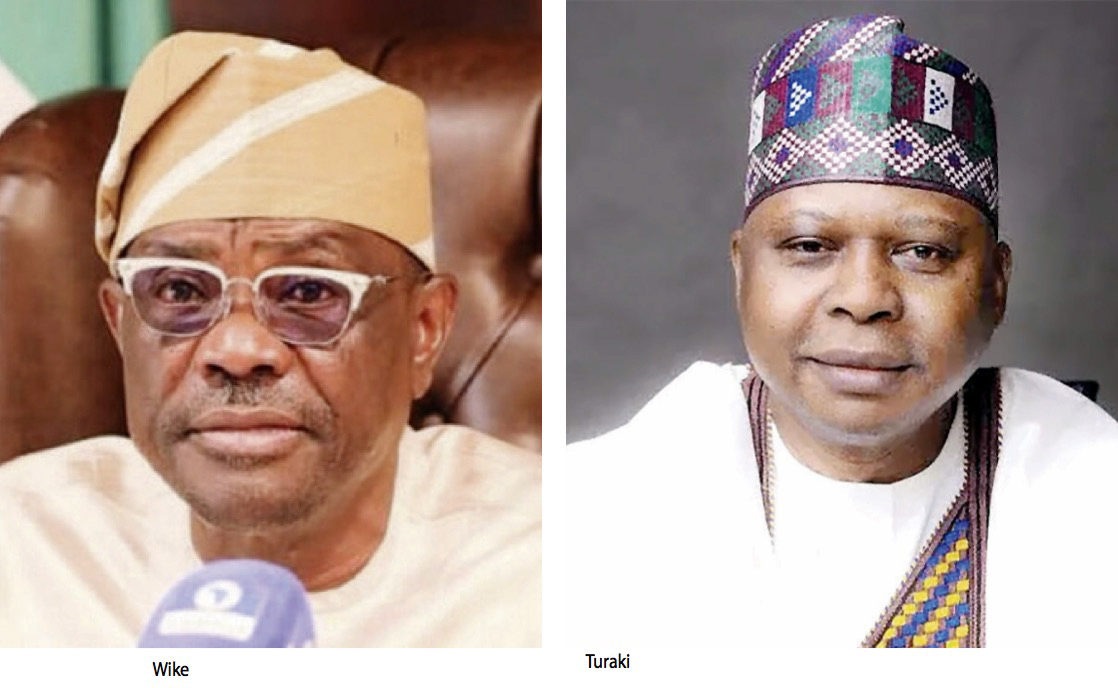
•Inside a party at war with self
By Ndubuisi Orji, Abuja
What does the 2027 general election hold for the People’s Democratic Party (PDP)? In the runup to the 2027 elections, the opposition party is caught in a web of litigation. The litigations are a fallout of the intractable leadership crisis, which has led to the polarisation of the major organs of the party.
The polarisation of the PDP began with the National Convention organised by the immediate past National Working Committee (NWC), led by Umar Damagum and backed by Governors Seyi Makinde and Bala Mohammed of Oyo and Bauchi states, respectively, which elected a new NWC led by former Minister of Special Duties and Inter Governmental Affairs, Tanimu Turaki. Prior to the Ibadan convention, two Federal High Courts, in separate judgements, had barred the opposition party from proceeding with the exercise until it had complied with extant rules.
Immediately after the Ibadan convention, loyalists of the Minister of the Federal Capital Territory (FCT), Nyesom Wike, who dismissed the exercise as a nullity, set up a 13-man caretaker committee, headed by Abdulraham Mohammed, to pilot the affairs of the opposition party, pending the conduct of a fresh convention.
Ironically, months earlier, PDP members and supporters had looked forward to the opposition party’s convention with great optimism, hoping it would serve as a springboard for the party in the 2027 elections by which the opposition sought to regain control of the reins of power in the country.
The immediate past national publicity secretary, Debo Ologunagba, had underscored the importance of the convention thus: “the outcome of the convention at Ibadan is going to give birth to a very solid party having regard to its character in the past. We are truly connected to the people to ensure that whatever comes out of the convention, we will be sure that we put our party on very solid ground to take over government come 2027.”
Unfortunately, that exercise deepened the schism within the party, which once dominated Nigerian politics for 16 unbroken years. Since November 2025, gladiators in the PDP have taken to the courts to validate their respective positions. In a twist, the Court of Appeal, Abuja Division, on March 9, nullified the Ibadan convention. After the judgement, there were efforts by the two camps to reconcile. When the reconciliation failed, the Wike camp held its own convention on March 29 and 30 in Abuja to elect new NWC members, while the Turaki camp took its case to the Supreme Court. On April 30, the Supreme Court, in a split judgement, upheld the judgement of the Court of Appeal, nullifying the Ibadan convention.
Against expectations that the judgement of the Supreme Court would give clarity on the leadership of the major opposition party, the verdict deepened the PDP crisis, with the two sides claiming victory. The Senator Adolphus Wabara-led Board of Trustees (BoT), after the apex court verdict, organised a National Executive Committee meeting where an Interim National Working Committee (INWC) chaired by Turaki was inaugurated.
At the moment, the Mohammed-led NWC is recognised by the Independent National Electoral Commission (INEC) as the authentic leadership of the PDP. On the flip side, the Turaki camp, through the Wabara-led BoT, is back in court seeking to compel the electoral umpire to recognise the former minister as leader of the opposition party. Recently, a Federal High Court in Abuja dismissed the suit filed by the Wabara group to that effect.
The spokesman of the Turaki-led INWC, Ini Ememobong, reacting to the judgement, said it would be challenged at the Court of Appeal. According to him, the judgement reads more like an appeal against the judgement of the Supreme Court and the Court of Appeal. “It is clearly inconsistent with the extant decisions of the Supreme Court and the Court of Appeal that form the foundation of our case. Rather than determine the question of enforcing those subsisting judgments, the decision, in our considered view, ventured into issues already settled by superior courts. It is for this reason that we have exercised our constitutional right of appeal.”
Other News
Nonetheless, the National Publicity Secretary of the Mohammed-led NWC, Jungudo Mohammed, said it is within the right of the Turaki camp to take their case further to the Court of Appeal. However, he expressed confidence that the issue would be resolved in favour of the NWC, noting that the case they were canvassing had long been settled by both the Court of Appeal and the apex court.
According to him, “This is not the first time they are appealing what is not appealable. The issues are very clear; these matters have been decided long before now. It is within their right to appeal. But it is not anything that anyone will lose sleep over. Yes, it is within their constitutional right to do so. But facts are sacred. We are not scared. We are not perturbed about their resolve to go on appeal. Since they have decided to continue to pursue litigation, we too are determined to continue to protect the interest of the party and to promote the independence of the PDP.”
Ahead of the 2027 polls, rival blocs conducted parallel primaries to nominate candidates for the PDP. While the Mohammed-led NWC settled on former Cross River senator Sandy Onor as the party’s presidential candidate, the Turaki bloc said it had nominated former President Goodluck Jonathan as the opposition party’s presidential standard-bearer.
Consequently, for the first time in its 28-year history, the PDP is fielding two sets of candidates for a general election, with each set claiming to be the authentic standard-bearers for the party. Nonetheless, the electoral umpire has published the list of candidates nominated by the Mohammed-led NWC as PDP standard-bearers in the 2027 elections, alongside the candidates of other political parties.
Mohammed says the publication of Onor as PDP’s 2027 presidential candidate “has effectively laid to rest the sustained misinformation and propaganda by those who desperately sought to convince Nigerians that the PDP would not field a presidential candidate. For months, these unfounded claims were deployed as a campaign tool to mislead Nigerians, discourage our supporters and create doubts about the future of our party.
“Today, the facts have prevailed, the law has taken its course, and the PDP has once again been vindicated.”
Regardless, Ememobong, who announced recently that the Turaki camp had successfully submitted the names of its candidates, including President Jonathan’s, manually to INEC, is confident that the Turaki bloc would have the last laugh, no matter the obstacles.
He, therefore, urged PDP “members, supporters and the teeming Nigerians who eagerly await the candidature of President Jonathan and our other candidates not to despair. We are exhausting every constitutional, legal and democratic avenue to ensure that our party is not hijacked or annexed to the ruling party.”
There is no doubt that the PDP will be on the ballot for the 2027 election, as promised by the two feuding camps at the height of the crisis. But the question is this: beyond being on the ballot, what impact can the opposition party possibly make in next year’s polls, with leaders and members at each other’s throats?
As the gladiators return to the Court of Appeal, party members and supporters will be waiting anxiously for the verdict. Nonetheless, pundits say the judgement, whichever way it goes, is unlikely to mark the end of the tussle for control of the PDP in the runup to the 2027 general election. Analysts say the court battle will likely continue until the Supreme Court makes a categorical statement on the leadership of the opposition party.