Follow Us on Google
By Chinelo Obogo
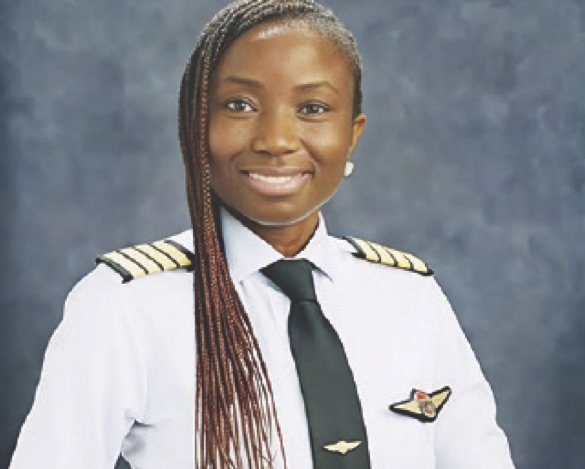
Capt. Imole Adebule is the Director of Flight Operations at Aero Contractors. Daily Sun caught up with her during the 2026 International Women’s Day celebration hosted by the National Association of Aircraft Pilots and Engineers (NAAPE) in Lagos recently, where she spoke about her journey, the myths she is tired of hearing and the advice she gives younger women who want a career as a pilot.
At what stage of your life did you realise you had interest in flying?
I grew up in Zaria and that was basically part of how I got into flying. Being very close to the College of Aviation was part of the motivation that got me in, and that was where the journey started for me. Looking back at where I started and where I am today, I have to say thank you to God first. There has been quite a lot of growth in my career. I have gone from being just a line pilot to being part of management, and now what is very different for me is managing the people that I work with. So that is one distinct difference between when I started and where I am today.
What does it feel like to be a successful pilot in a male dominated industry?
Let me say I feel very privileged to have been given the opportunity and to have grown in this field as much as I have. But I must say that we have seen a lot of growth and greater inclusion of women over time. Women have grown in numbers, and as we can see, we have a very capable MD of FAAN doing very well where she is. There are also many of us from CEOs in different airlines to directors to managing directors. Yes, we have grown.
What is one myth about women in the cockpit that you are tired of hearing, and what matters instead?
“We didn’t know women could fly” is something I still hear till now. Sometimes people come on board and say, “Oh, this is my first time seeing a woman flying”. But yes, I am glad that we are breaking all of those barriers and stereotypes, and everybody is beginning to warm up to the fact that women are capable.
Have you ever been on an all-female crew flight before?
Oh, absolutely, yes. If I remember correctly, around 2009 or 2010, Aero Contractors pioneered the first all-female flight, where from the captain to the cabin crew, everyone was female. I was fortunate to have been at Aero at that time and witnessed the whole thing. I have also had my own experience where, as captain, I had a female co-pilot, and I have also flown as a co-pilot with a female captain, with all the cabin crew being female as well. Interestingly, we even had a day where the engineer who released the aircraft was also a female. So it has been amazing.
How many airlines have you flown with and what is your aircraft type?
Aero Contractors and I fly the Boeing 737.
When a young woman says she wants your seat someday, what is the candid advice you give her, the training paths, the trade-offs, life outside the flight deck?
it takes a lot of focus, a lot of determination and a lot of commitment. I cannot say enough about these things. To deliver that safely to the standard expected in aviation requires a great deal of discipline and commitment. This is not an easy task, but many have done it and many will still shatter that glass ceiling.
Tell us about a challenging experience you have had while flying. How do you handle turbulence and difficult conditions?
I would not call it a bad experience, I would rather call it a learning experience. We go through a minimum of two training sessions a year, specifically to prepare us for situations like that, whether it is weather-related or anything else that falls slightly outside the norm. So the first thing to know is that we are well trained to handle these situations.
I remember one occasion, I was flying as co-pilot and we were coming into Lagos from Benin, and it was raining heavily. We left Benin with conditions still good, but by the time we were approaching Lagos, the rain had moved in and it looked really bad. We were able to navigate our way around it, though. Up there, we were saying to each other what a day it was to fly. We landed, and right after we touched down, everyone on board erupted into applause. Meanwhile, up on the flight deck, we were telling each other that after this we were going home and not doing this again but the moment we landed, parked and all the passengers disembarked, we were already asking where the next destination was and getting ready to go again. I think that would be one of the most memorable ones.
How do you balance work and family?
The main thing is, first, to know your limits and respect those limits. There were times when I pushed myself to the point of burnout, and I saw the implications of that first-hand, because productivity drops and declines significantly. So what I try to do is create a balance between work and personal life. I take my breaks, I rest and I reset before returning to work.
For a female who wants to come into aviation and become a pilot, can you walk us through the steps, the subjects should take in secondary school and how to navigate the path?
Whatever subjects you take in secondary school does not matter in the strictest sense. Some subjects could be advantageous during the learning process, but they are not necessarily a prerequisite for getting into flying school. The aviation industry is growing, and we now have at least three flying schools in Nigeria, NCAT in Zaria, one in Ilorin, and another in Enugu. Walk in, speak to their admissions or licensing office, go through their application process and you will be taught everything you need to know about flying. After that, you obtain your Commercial Pilot License with your multi-engine rating and instrument rating. Once you have those, you can begin airline flying, but before that you will need to complete type-specific training on whichever aircraft you will be flying. That is essentially a summary of the stages involved.
There are two issues that NAAPE has consistently raised. The first is that pilots graduate from Nigerian flying schools and there are no jobs for them, partly because airlines bring in aircraft on wet lease with their own crew. The second is that many airlines employ expatriates, taking jobs that could go to local pilots and engineers. How do you think these issues can be resolved?
On the first question, I would say yes, partly, but I would also say not entirely. I think we need to look a little deeper. Why are we getting foreign-registered aircraft in the first place? That, I think, is the more fundamental question rather than simply saying airlines are not employing local pilots. As the industry grows, I hope we reach a point where we have more domestically registered aircraft, more Nigerian-registered aircraft. Once we achieve that, the market opens up and we can bring far more people onto the flight deck and into the cabin.
On the second question, if you had asked me that 10 years ago, I would have said absolutely, it was a serious problem. But now, looking around, for most, if not all Nigerian-registered aircraft, I do not think you see foreign pilots in the cockpit anymore. It is almost entirely local. So yes, the problem is not as serious as it once was. I must say that all the stakeholders, operators and the association alike, have been very intentional and deliberate about this and are working to ensure the local market is protected.