Follow Us on Google
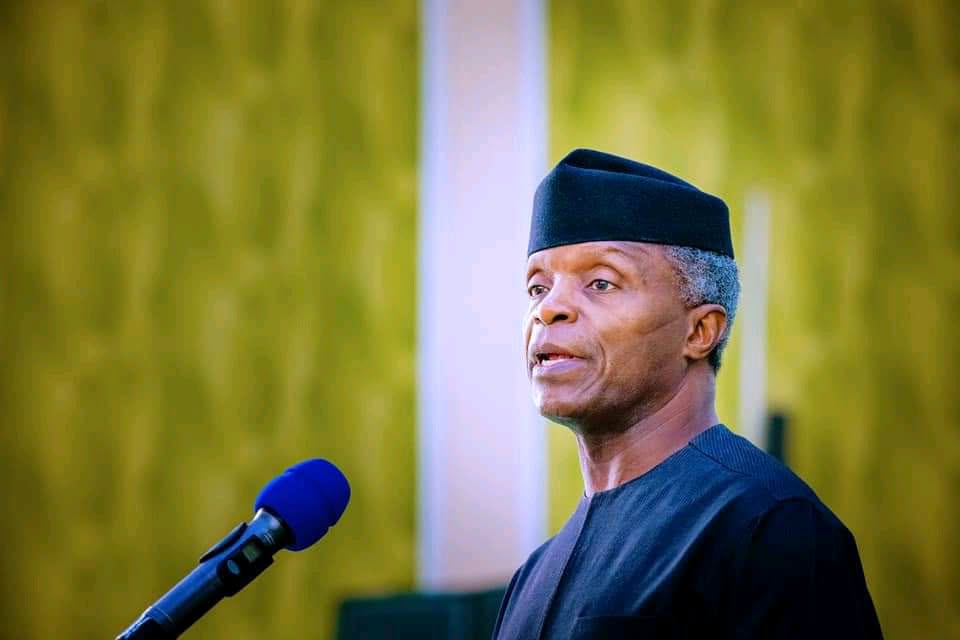
Former Vice President Yemi Osinbajo has called for a people-centred justice system in Nigeria, saying access to justice should go beyond obtaining court judgments to ensuring that such decisions are effectively enforced.
The former Vice President made the call while reflecting on the public life and legal legacy of Archbishop Emeritus of Lagos, Anthony Cardinal Olubunmi Okogie, during the annual lecture of the Anthony Cardinal Okogie’s Foundation in Lagos.
Speaking on the theme, “The Rule of Law and the Challenges of Executive Compliance,” Osinbajo said Nigeria’s justice system must be assessed not only by the number of cases decided by the courts, but by whether ordinary citizens ultimately obtain meaningful remedies.
He said the life and public interventions of Cardinal Okogie demonstrated a consistent commitment to constitutionalism, democracy, good governance and the protection of the rights of ordinary Nigerians.
According to him, shortly after Nigeria returned to civilian rule in 1979, Okogie challenged the Lagos State Government’s takeover of mission schools, resulting in a landmark legal battle over the constitutional rights of religious organisations and private individuals to establish and operate schools.
He said the Court of Appeal eventually ruled in Okogie’s favour, holding that the right to own and operate private schools was protected under the fundamental right to freedom of expression.
Osinbajo explained that the court’s reasoning was that freedom of expression included the ownership of mediums through which ideas could be received and imparted, with schools constituting such mediums.
He described the case as one of the early legal landmarks of Nigeria’s new democratic era following years of military rule.
He said Okogie’s interventions under successive military and civilian administrations were characterised by opposition to oppression, injustice and abuse of power, regardless of the government in power.
“Government exists for people. Political authority is not an end in itself. It is a trust, and those who exercise it must be accountable for the welfare, dignity and rights of the people over whom they govern.”
Turning to the central issue of access to justice, the former Vice President said the discussion about executive compliance should not be restricted to whether governments obey court orders, rather the broader question should be whether Nigeria’s justice system actually delivers meaningful justice to ordinary citizens.
His words: “For the citizen who has secured a judgment against government, justice is not complete when the court pronounces its judgment or its decision. It is complete when government obeys it and the promised remedy becomes a reality.”
He noted that most cases before Nigerian courts involved disputes between individuals and organisations rather than government, adding that the enforcement of judgments remained a major challenge.
To illustrate the human consequences of the problem, he cited cases involving ordinary Nigerians, including a widow allegedly dispossessed of her home and vehicle by her in-laws following her husband’s death, a teacher whose land was allegedly taken over by land grabbers, and the widow of a bricklayer who was killed by a truck belonging to a major company.
He said justice for such people should not remain an abstract legal concept but should result in the restoration of their homes, property, livelihoods and rights.
“For the widow, justice would simply mean getting her home back, getting her car back and being able to protect her daughters,” he said.
He warned that prolonged litigation and difficulties in enforcing judgments had consequences far beyond the courtroom, describing denial or delay of justice as a developmental crisis, governance failure and a moral problem.
“When the poor cannot access justice, poverty becomes permanent,” he said, noting that women, particularly those in rural communities, often bear a disproportionate burden.
Earlier, the Catholic Archbishop of Lagos, Most Rev. Alfred Adewale Martins, called on Nigerian leaders to respect the rule of law, uphold constitutional principles and use public office to serve the people rather than for personal enrichment.
Other News
According to the Archbishop, the rule of law is fundamental to the building of a just, peaceful and democratic society, stressing that everyone, including those entrusted with leadership, must be subject to the law.
He said no political position, wealth, influence or social status should place anyone above the law.
“For us as Catholics, respect for the rule of law is not merely a civic responsibility; it is also a moral responsibility,” Martins said, adding that the Christian faith teaches truth, justice, human dignity and the common good.
He noted that Scripture presents leadership as a responsibility entrusted to individuals for the service of others, while the teachings of Jesus Christ emphasise that genuine greatness is found in service.
The Archbishop identified one of the greatest threats to the rule of law as a situation where leaders demand obedience from citizens but refuse to submit themselves to the same laws.
He maintained that leadership compliance with the law requires those who govern to obey the laws they expect citizens to respect.
According to him, public office is a trust and not a personal possession, urging leaders to respect the Constitution, court decisions, fundamental human rights and the legitimate institutions of democracy.
Martins expressed concern over corruption, impunity, political interference, selective application of the law, disregard for due process and abuse of public office, describing them as serious challenges confronting Nigeria.
He urged Catholics and other Nigerians not to remain indifferent to such realities, stressing that the social teachings of the Catholic Church require believers to promote justice, solidarity, human dignity and the common good.
The Archbishop, however, stressed that the responsibility to uphold the rule of law should not be left to political leaders alone.
He said every citizen has a responsibility to live with integrity, noting that Nigerians cannot condemn corruption in government while simultaneously giving or receiving bribes.
“We cannot demand justice while supporting injustice because the offender belongs to our political party, family, ethnic group or religious community,” he said.
Martins called for consistency between the values Christians profess in church and their conduct in society, saying Nigeria needs leaders of character, conscience and courage who will seek the truth and accept accountability as a duty.
He also urged citizens not to remain silent in the face of injustice, but to become witnesses to the rule of law by living truthfully, rejecting corruption, respecting human dignity, defending justice and promoting the common good.
The Archbishop called for the building of a Nigeria where nobody is above the law, vulnerable citizens have access to justice, and leaders serve rather than exploit the people.
He also appealed to Nigerians to ensure that their faith translates into a commitment to truth and justice in society.
In his concluding prayer, Archbishop Martins asked God to give Nigerian leaders the wisdom to govern justly, the courage to obey the law and the humility to serve the people entrusted to their care.
He also prayed for the Catholic Church and Nigeria, asking that the nation become an instrument of justice, peace and the common good, while urging Nigerians to work towards a country founded on justice, integrity and respect for human dignity.