Follow Us on Google
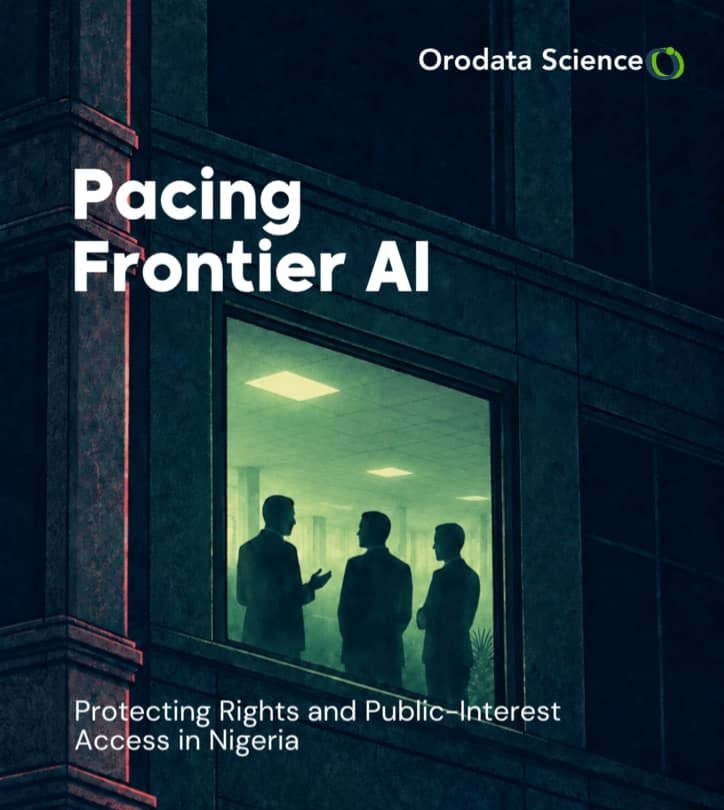
Orodata Science, a Nigerian data science and research organisation, has urged civil society organisations (CSOs) to participate actively in shaping frontier Artificial Intelligence (AI) governance.
Orodata made the call in a policy brief titled “Pacing Frontier AI: Protecting Rights and Public-Interest Access in Nigeria”, released in Lagos on Wednesday.
The organisation said the global debate on slowing the development and deployment of increasingly capable AI systems presented risks and opportunities for Nigeria and other Global South countries.
It said the debate followed recent calls by Dario Amodei, the Chief Executive Officer of Anthropic, for deliberate pacing of frontier AI development.
According to the brief, Amodei proposed stronger independent evaluation, binding technical safety standards and international coordination before AI systems reached potentially dangerous capability thresholds.
It said the proposals received public support from OpenAI Chief Executive Officer Sam Altman and Elon Musk, founder of xAI and Chief Executive Officer of Tesla.
Orodata, however, cautioned that voluntary commitments by technology companies should not be treated as legally binding agreements or substitutes for enforceable regulatory frameworks.
It said Nigeria needed to guard against systemic risks associated with unchecked frontier AI, while preventing digital marginalisation and excessive concentration of technological power.
The organisation urged Nigerian CSOs to use existing domestic and continental frameworks, including the Nigeria Data Protection Act 2023, National Artificial Intelligence Strategy and African Union Continental AI Strategy.
It said the frameworks should be used to demand verifiable commitments from AI developers, funded African red-teaming, data sovereignty protections and equitable access to AI technologies.
Orodata explained that “pacing” did not mean an abrupt halt to software development or withdrawal of existing digital services.
Rather, it involved introducing regulatory checkpoints, red-teaming phases and capability thresholds before more advanced AI systems were trained or deployed.
The organisation identified independent evaluation, harmonised industry safety standards and multilateral coordination as key elements of responsible frontier AI governance.
It said independent evaluators should have sufficient access to AI development processes to assess models throughout their training and deployment lifecycle.
Orodata also warned that Nigeria’s dependence on foundational AI models developed and governed largely outside Africa could create strategic vulnerabilities.
It said changes to foreign AI platforms, including pricing, licensing conditions, access restrictions or withdrawal of application programming interfaces, could disrupt Nigerian start-ups and public-interest initiatives.
These, it said, included healthcare programmes, educational platforms and governance initiatives.
The organisation urged policymakers to consider existing and everyday AI-related harms alongside potential catastrophic risks.
It identified linguistic and cultural marginalisation, political disinformation, deepfake manipulation, financial fraud and exploitation of African data workers as concerns requiring greater attention.
Orodata said frontier AI systems should be evaluated for performance in Nigerian languages, socio-political contexts, ethnic diversity and local fraud patterns.
It also called for greater investment in Nigerian universities, research institutions and CSOs to conduct AI safety testing and red-teaming tailored to African realities.
The organisation urged international donors, development finance institutions and technology companies to provide dedicated technical and financial support for such initiatives.
It further recommended that Nigerian CSOs be included in international AI safety networks and consultations to ensure Global South perspectives were represented.
On regulation, Orodata called for tiered liability and proportional compliance requirements distinguishing between frontier AI developers and downstream users.
It said developers should bear responsibility for structural design flaws, baseline safety and inadequate testing.
According to the organisation, organisations deploying AI should have responsibilities proportionate to the nature and potential impact of their applications.
Orodata said automated systems used in consequential decisions should retain meaningful human oversight.
It listed social welfare allocation and legal or community interventions among areas requiring such oversight.
For non-profit organisations, Orodata recommended five immediate internal controls.
These include auditing AI applications in use, restricting the transmission of sensitive beneficiary information into consumer AI systems and requiring human verification of AI-generated outputs.
Others are demanding clear supplier terms on data retention and security, and joining civil society working groups to share knowledge, incident reports and procurement resources.
Orodata said Nigeria should not wait for international consensus or new domestic legislation before taking steps to protect institutions and citizens from AI-related risks.
It said responsible AI governance should protect democratic rights and social justice while ensuring African countries were not excluded from technological development benefits.
The organisation said Nigerian civil society had an opportunity to influence the emerging global AI governance framework.
It urged CSOs to demand stronger data protection, local technical capacity and affordable public-interest access to AI.
Orodata stressed that voluntary restraint by foreign technology executives alone could not guarantee Nigerian digital sovereignty or protect civic space from algorithmic harm.