Follow Us on Google
From Aloysius Attah, Onitsha
Prince of the Church and Catholic Bishop of Ekwulobia Diocese, Peter Ebere Cardinal Okpaleke, has pointed out that the bane of the Nigerian society today is the fact that moral leadership is in short supply.
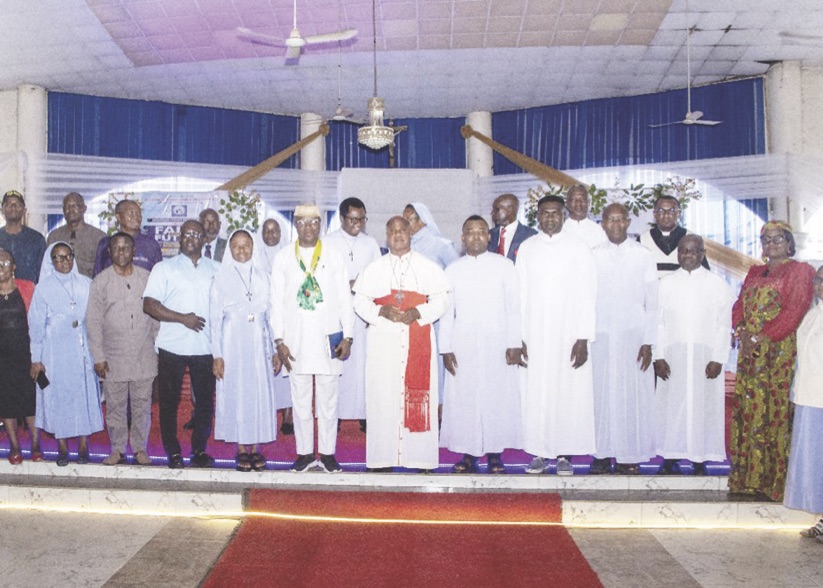
Delivering the maiden edition of the Madonna University lecture series at the Okija campus of the university in Anambra State, Okpaleke, who spoke on the topic “Faith and the future: Reclaiming moral leadership in a fractured Nigeria,” said many people’s actions today in Nigeria are guided by narrow, self-serving motives, which sometimes boils down to the assertion of self.
He regretted that what is obtainable in our society today can be described as the rule of the powerful where people want to assert themselves, take advantage of situations without consideration of the consequences for others or for the community at large.
Shedding more light on this, he said the rule of law which should be pursued and promoted to thrive in the society is a higher value that transcends the individual while the rule of the powerful revolves around individuals. He said those entrusted with protecting the interest of the community by enforcing laws meant to protect the common good, privatize the power.
He stated: “They use it to enforce their wills and for their private advantage and those of their cronies. No higher value, not even the common good, guides actions and relationships. This frame of understanding has trickled down to the different strata of society.
“There is a common denominator between the custom officer who turns a blind eye to firearms and fake drugs, for example, being moved through the checkpoint he is manning, and the fruit seller who uses harmful chemicals to ripen fruits despite the health hazard this poses.
“Both have no commitment to the common good. Their actions are dictated by selfish considerations and not by any higher value. This logic of action has become so rampant and insidious that it has become normalized. Actions to the contrary provoke a backlash. The result is that the social environment discourages moral leadership.”
Okpaleke stated that the Church not only helped the society navigate a turbulent period of history characterized by wars, plagues and other disasters, but also stabilized it. He expressed the hope that however fractured the Nigerian society has become, Christianity can still contribute to salvaging it.
He said some social media presenters blame religion for the problems of Nigeria.
“The blame is not on account of religious bigotry leading to violent conflicts or the mobilization of religious or denominational identities during elections to derail issue-based politics and throw up clueless political leaders.
“This negative view of religion is behind those who adjudge the religiosity of Nigerians as a diversion of attention. These affirm that if the number of Nigerians who attend religious activities is multiplied by the number of hours spent in such activities, it is astronomical. They argue that those hours are non-productive, wasteful and divert the people’s attention from the issues behind their misery and substitute religious rituals for the purposeful actions that can turn things round”
“In response, one can observe that although the number of (wo)man-hours spent in religious activities is high, a significant number, if not majority of Nigerians, do not engage in such activities. Yet, these people who have not come under the regime of the false consciousness of religion have not changed the face of Nigeria.”
Okpaleke also pointed out that colonialism and the nationalists who fought for independence of Nigeria influenced the attitude of Nigerians in many negative ways including the introduction of indiscipline and corruption which have subsisted till today.
“Despite political independence, the (post)colonial state continues to be an enduring legacy of the colonial era. In a sense, the nationalists who fought for political independence helped in entrenching rather than dismantling the colonial legacy.
“Worse still, is that the struggle for independence, “entailed a necessary but destructive strategy: sabotage of the administrative efforts of the colonizers. A great deal of the anti-colonial activities by the African bourgeoisie consisted of encouragement to their followers to be late for work, to go on strikes for a variety of reasons, etc.
“The African who evaded his tax was a hero; the African labourer who beat his white employer was given extensive coverage in newspapers. In general, the African bourgeois class, in and out of politics, encouraged the common man to shirk his duties to the government or else to define them as burdens in the same breath he was encouraged to demand his rights. Such strategy, one must repeat, was a necessary sabotage against alien personnel whom the African bourgeois class wanted to replace. The colonialists pushed back by creating division among the nationalists along ethnic lines”
“Obligation to the government is seen as a burden to be evaded while the resources of the state or government, is seen as belonging to no one and up for grabs by the powerful. Thus, any who could misappropriate these resources is celebrated by his or her primordial public as a hero or heroine who has acquired their share of the national cake. What this means is that there is no commitment to the common good.”
He said the nationalists strove first to get the political kingdom but failed to address some of the contradictions built into the colonial state that made it serve colonial interests.
“The warrant chieftaincy created in Igboland and how those recruited for this office were those to whose credit was the readiness to carry out the bidding of the colonialists with ruthless efficiency. This presented governance in terms of the rule of the powerful, with or without legitimacy, rather than the rule of law. The result was corruption and abuse of power.
“Similarly, the colonial state was not answerable or accountable to the Nigerian people but to officers in Britain. This lack of accountability has continued under both the military and civilian dispensations. Electoral fraud is the highest manifestation of this disdain for the choice of the people.
He called for renewed moral leadership first as an individual and spiraling into any group one may belong nothing that the moral leadership required to redeem Nigeria pertains to steering one’s life according to the higher values of justice, love, truth and peace.
“This guarantees the integration of the fractured Nigerian polity and discharge the transformational power of the Christian faith. What the Christian faith did in Medieval Europe, it can still do in the Nigerian context. We only need to pitch in, allow ourselves to be transformed by the loving power of God, so that we can carry the fire of that love into the whole world beginning with our immediate context,” he concluded.
Chairman of the occasion, Prof. Jonah Onuoha, said the maiden legacy lecture was designed to be a platform to foster national reflection, intellectual engagement and visionary discourse.
“The title of your lecture, ‘Faith and the future: Reclaiming moral leadership in a fractured Nigeria’, was both timely and important as we navigate the complexities of the nation.”
Onuoha stated that the achievements of the early Catholic missionaries and the successful establishment of the first schools, hospitals and other facilities in Nigeria laid good foundation for the country.
“The church established schools from primary to secondary and tertiary institutions. The church-run-schools emphasised on moral values, discipline and character development but things fell apart in the 1970s when the Nigerian government took over many of the schools and hospitals”.
While thanking His Eminence for delivering the lecture, he restated that the church has enormous role to play in cleansing the society of drugs, kidnapping, fast -money and moral decadence.
“In short, the church must reclaim its moral leadership in Nigeria” Prof Onuoha stated.
Earlier, chairperson of the lecture organizing committee, Prof. Nkechi Ezenwamadu, said the maiden lecture series was to plant the seed of a tradition that would blossom into an enduring intellectual and moral landmark for the university, the church and the nation.
Ezenwamadu, Dean, Faculty of Education and Arts, said the series was conceived as an annual event of high academic, cultural and moral value.
“It is designed to be a meeting point of scholarship and conscience-a forum where leading voices in the academy, the church and society come together to interrogate critical issues of our time and chart pathways toward a better future. This series reflects the essence of Madonna University’s founding philosophy: to cultivate a community of learning where knowledge, character and service converge to serve humanity,” she said.
Administrator of Okija campus, Rev. Fr. Cyriacus Emedolu, in his vote of thanks, expressed pleasure having the privilege to host the His Eminence, team from Elele campus and guests from the government circles.
He urged the students, teachers and non-academic staff not to relent in their effort to ensure high moral standards and discipline were maintained in the society.
Fr. Emedolu said the students of Madonna University are groomed to be balanced in academic formation, morale, culture and religion since 1999 when the university was established in line with the vision of the founder, Very Rev. (Prof) Emmanuel Edeh.