Follow Us on Google
By Christy Anyanwu
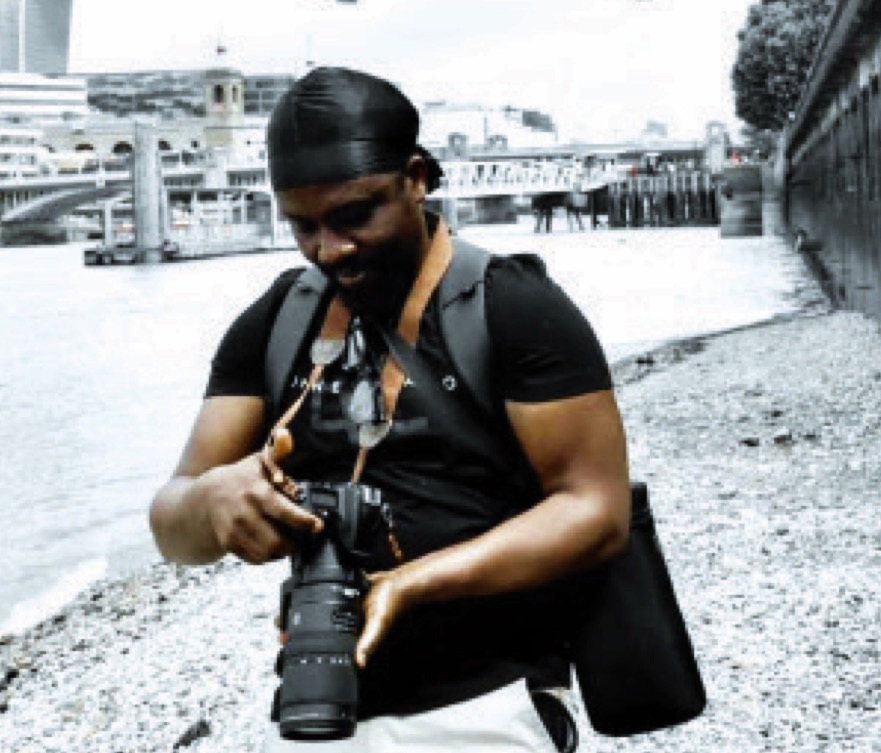
Aduragbemi Okeyemi is a creative artist with a passion for storytelling through photography and design. He started his artistic journey as a fashion designer, a path he followed for several years before discovering a deep passion for photography in 2017.
What started as a self-taught exploration soon evolved into a more refined practice, as he attended photography seminars and creative industry meetups to deepen his understanding and sharpen his visual direction. A Master’s degree holder in Graphic Design from the University for the Creative Arts in Farnham, United Kingdom and Bachelor’s Degree holder in English and Literary Studies from the University of Ado-Ekiti. Nigeria. Aduragbemi is the Creative Director of BonnevieLagos. Currently based in Kent, England, he’s a member of the Royal Photographic Society London and the Dartford and District Photographic Society, Kent.
In this interview, he speaks about himself and his craft.
What informed your decision to go into Arts and photography?
My decision to pursue arts and photography comes from a deep desire to create. I’ve always been drawn to turning the ideas and images in my mind into something tangible. I originally began my creative journey in fashion design, but I often felt the need for a more expressive medium. That search is what ultimately led me to photography, where I found a stronger way to bring my vision to life and express myself better.
What was your growing up like and in what way did you think it influenced your artistic journey?
I grew up in Ebute-Metta/Yaba, Lagos State, where I spent my formative years in an average family alongside my four brothers, our parents, uncles, aunties and some other extended family members. Like many Nigerian kids, my early life was shaped by a strong sense of community and structure; it was within this environment that my interest in the arts started to show. A significant influence was one of my uncles, an artist studying fine art at the Yaba College of Technology. I always watch him paint and I guess that was what sparked something in me, even before my teenage years. I remember clearly how I see the world through a more creative lens. I also remember how I used to be among the top fine art students in my junior secondary classes.
However, you know how Nigerian parents in the 90s in Nigerian would rather their children be the “bata mi a dun konkon ka” kind of profession (a more conventional career path at the time) when they grow up than be an artist or anything of sort. That temporarily suppressed my artistic inclinations and led me away from fully embracing that side of me at the time. I found myself eventually returning to the arts in my senior secondary class and this sort of reaffirmed my artistic dream. Inherently, I was an artist and that was when the journey truly started, I think. The search for a medium to express the artistic part of me will take me 15 years to finally find clarity.
What were your initial challenges when you started and how were you able to overcome them?
Funding was one of the biggest challenge at the start of my journey as a photographer. I’d invested time in seminars, workshops and photography classes but still couldn’t afford a camera for a very long time. When I eventually got my first one; a Nikon compact camera, not even a DSLR, I still struggled to afford a good laptop. What carried me through was the passion and consistency. I kept going despite the limitations, and overtime I realised this challenge wasn’t unique to me, as many photographers – both established and just starting out that I came across in my journey – had faced similar obstacles along their journey as well.
Another challenge was security. Taking cameras outside to take pictures in Lagos, Nigeria is usually not for the gentle soul. It required a lot of boldness and guts because you’ll definitely get harassed by lots of miscreants always ready to extort or damage your camera equipment. Lastly, another challenge for me was the decision of style. It was a bit difficult to define what style I wanted to do as a photographer because a lot of photographers were springing up in Nigeria at the time, and everyone seemed to be doing every genre of photography from documentary to events, to beauty, fashion and lifestyle. So I ended up starting out to do most of this genre before I finally found passion for beauty, portraits and eventually fine art photography since I moved here in the UK.
As a Nigerian artist in the UK creative space, how have you been able to blend your African heritage with your UK creative experience?
Blending my African heritage with my experience for me is still an evolving process. Yes, my Nigeria background shapes the way I see the world through culture, colour, storytelling and identity even as the UK has exposed me to different perspectives, styles and creative influences. To be honest with you, I have not done so much work as to blending both worlds other than when I was studying as a Graphic Design Masters student where I consistently integrated elements from my Nigerian photographic practice in my class projects. But of course I intend to do more, staying rooted in where I come from while I also embrace the diversity around me through the themes I explore, my use of natural lights mostly, compositions and the stories I choose to tell, reflecting the balance between authenticity and growth. My work will be like a bridge; something that connects my Nigerian heritage with my UK experience, creating work that feels both personal and relates globally.
Can you share the success stories you’ve recorded so far?
When I moved to the United Kingdom, I made a conscious effort not to focus on commercial photography at the start like I did back in Nigeria. For me, visibility and creative growth were more important to break into the England Art and global space, so I dedicated a lot of times to personal projects, volunteering and collaborations. Those experiences have played a key role in shaping my journey and contributing to the success I’ve achieved so far, even though I know there’s still much more ahead.
One of my proudest achievements has been having my work published in journals and magazines, as well as exhibiting in various exhibitions here in England. Notably, my article ‘What eye sees,’ was published in the Royal Photographic Society’s DI online issue in September 2025. This project was intended to explore the true essence of black and white photography as a form of fine art. Some of the works featured in that article have also been exhibited in several galleries and exhibitions. This include the second edition of the Vogue exhibition by the Boomer Gallery in London, The Best of 2025 exhibition by the Dartford and District Photographic Society held at the Peter Blake Library in Dartford, Kent, January this year. I am also currently exhibiting some selected works from the series with the Dartford and District Photographic society at the Bluewater Shopping Centre, Kent, (one of the largest malls in the UK) in support of the Ellenor Hospice Charity. I also got my work featured in the March Issue of the Artells Magazine. In addition, I’ve been fortunate to win local competitions such as the President’s Cup, an annual competition that has been running for over 40 years now by the Dartford and District Photographic society. Another success for me in my journey is being a featured artist on Artsy, a platform that connects over 200,000 artists with collectors worldwide.
Are there artists or photographers that influenced you positively in your career?
Over the years, a number of photographers have profoundly influenced my journey, both as an artist and a photographer. At the forefront is Tolani Alli, whose resilience and passion for capturing moments continues to inspire me. I also admire Henry Oji (Big H); his thoughtful creative process from conception to final outcome is something I deeply respect. Kelechi Amadi-Obi also stands out for me for his remarkable consistency and ability to stay evergreen and relevant despite his many years in the art and photography space. I am equally inspired by Chief Mrs Nike Okundaye of Nike Art Gallery and Tokini Peterside-Schwebig of Art X Lagos, whose contribution to the art world are truly impactful. Just like these two, I look forward to establishing my own gallery and curate exhibitions with impacts in the UK and Africa.
What have been your happiest moments doing this job?
Every time I pick up my camera, whether I’m shooting indoors or outdoors, I feel a rush of excitement knowing I’m about to create something new. Seeing my work published and exhibited brings a sense of fulfilment; it’s like watching an idea that once existed in my mind come to life, no longer seen by just me, but shared and experienced by others as well
What role do feedbacks and critiques play in your artistic growth, and how do you incorporate it into your practice?
Feedbacks and critiques are very important for me. Since moving to the UK, I’ve had different opportunity to submit my work to competitions and take part in photography conversations where certified photography judges carefully critique and scrutinize my images. Even when their observations end up not being what I initially expect, they never feel negative.
Rather, they reveal perspectives I did not consider, helping me see things I completely missed in my own work that in turn push me to improve with every new project. Presently, I’m part of a critique group of photographers within the Royal Photographic Society in London, where we exchange printed batches of our works and review each other’s images in rotation, which has been very valuable for me. There’s something different about seeing your work through someone else’s eyes, especially in print.
So yes, I take feedback very seriously. Not as a form of validation but as a way to learn, to grow and to uncover what I couldn’t see on my own. In a way, feedback helps me discover what wasn’t visible to me in the first place.
Are you working on any new project at the moment?
Oh yes. One of these is an ongoing volunteer collaboration with the Ellenor Hospice and the Bluewater Shopping Centre where I am working as a photographer alongside artists who are painting the bears for the annual Dartford Bear Hunt 2026. Selected photos from this collaboration will be exhibited during the event which will be taking place in few months now; This project allows me to document the intersection of community, art and storytelling in a meaningful way. My second project is one to be titled Lumen Shadow (a fusion of “She” and “Shadow”). This is a fine art photography series to be presented entirely in black and white with a strong emphasis on the interplay of light, shadow and beauty. It’s a follow up from my previous project What Eye See, further reinforcing my perspective that black and white photography is the true fine art photography a pure form of fine art expression. Lastly, towards the end of the year, I will be working towards my distinctions with Royal Photographic Society with the goal of becoming an Associate of the Royal Photographic Society UK. This process requires the submission of a cohesive body of work built around a clear and compelling theme, marking an important milestone in my photographic journey.
These projects are the reflection of my creative direction and professional growth.
What advice would you give anyone who would like to go into arts and photography?
My candid advice to anyone who is looking to pursue a path in art and photography is that you will need a lot of patience, perseverance and most importantly passion. It’s not a space you want to go into with the primary goal of making money (at least not in the first instance).
That’s not to say financial success is not important but passion for the craft must come first, especially if your aim is to create work that carries a lasting value. Photography in particular can be an expensive pursuit but that shouldn’t discourage you, just start with what you have. Take your time to grow, ask questions, do your research, watch YouTube photography/art tutorials and learn continuously. Trust the process, stay consistent and allow your journey to unfold and you’d be fine.