Follow Us on Google
…Post-harvest losses, high fares, spoilage, lack of storage facilities threaten gains
By Oluseye Ojo

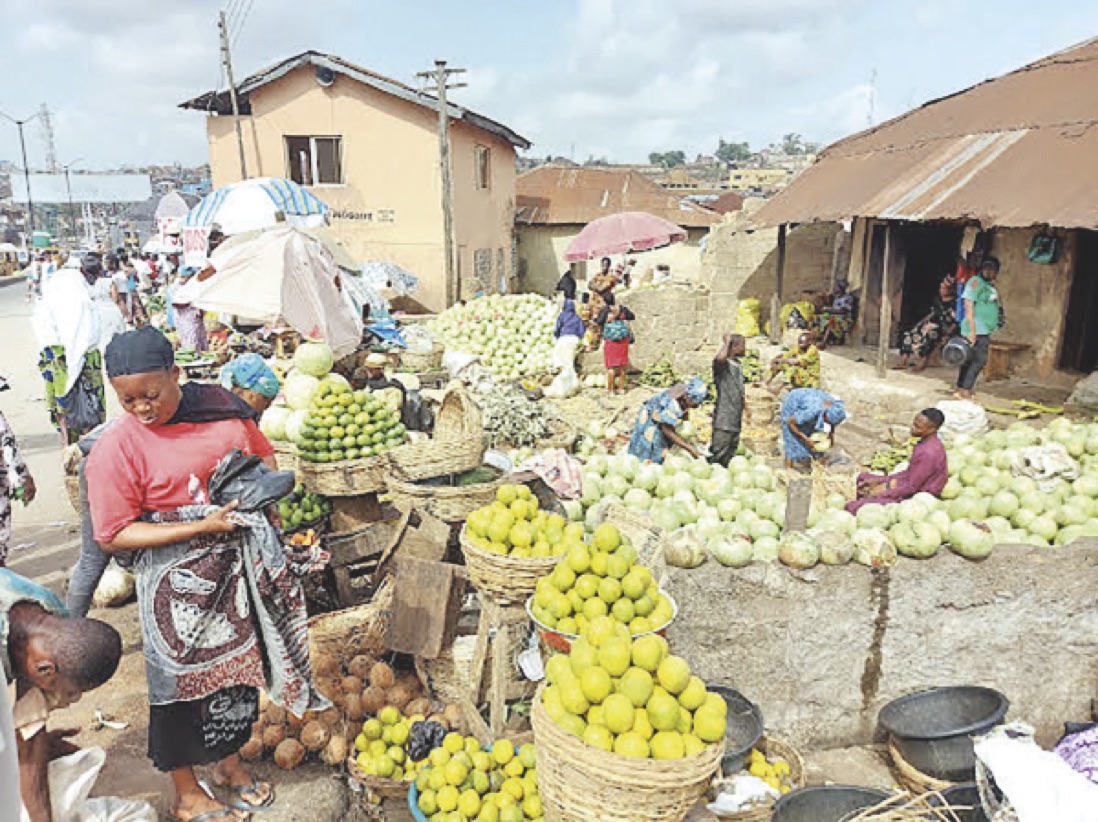
•Orange and Watermelon section
Fruits and vegetables play a vital role in maintaining a healthy diet and reducing the risk of non-communicable diseases (NCDs).
However, inadequate fruit and vegetable consumption has become a global concern, leading to millions of preventable deaths.
Nigeria, in particular, faces significant challenges in fruit availability and affordability. A recent market survey by this reporter in different parts of Ibadan showed that fruits have become commodities that many people could not afford.

•Pinapple section of Oje Market
Yet a major market for fruits in Ibadan is under threat.
The Oje Market in Ibadan, the Oyo State capital, is the largest fruit market in Ibadan. The market was founded in1884 during the reign of Iba Oluyole in Ibadanland. The name, Oje, was reportedly derived from a town also bearing Oje, between Ijeru in Ogbomoso in Oyo State, and Ilorin in Kwara State. But a war that broke out in the area centuries ago, scattered the people, and the people migrated to Ibadan.

•Alhaji Olaosebikan, Babaloja of Oje Fruit Market
Oje Market was founded almost at the same time the community was established. There are different segments in the market, including sections for Aso Offi and beads, food items, herbs, as well as fruits.
According to World Health Organisation (WHO), an estimated 3.9 million deaths worldwide were attributable to inadequate fruit and vegetable consumption in 2017. Nigeria is said to have appreciable percentage in the number.

•Banana and Plantain section
The report stated further that including fruits and vegetables as part of the daily diet may reduce the risk of some NCDs including cardiovascular diseases and certain types of cancer.
Fruits and vegetables, experts say, are rich sources of vitamins and minerals, dietary fibre and a host of beneficial non-nutrient substances, including plant sterols, flavonoids and other antioxidants. It is believed that consuming a variety of fruits and vegetables helps to ensure an adequate intake of many of these essential nutrients.
As part of a healthy diet low in fat, sugars and sodium, WHO suggests consuming more than 400 grams of fruits and vegetables per day to improve overall health and reduce the risk of certain NCDs.

•Another section of the market
But what are the struggles being faced by fruit sellers in Nigeria, with a special focus on the Oje Fruit Market in Ibadan? What are the key issues and potential solutions, towards raising awareness and encouraging actions to ensure the sustainable production and consumption of healthy fruits in the the country?
Alhaji Kamarudeen Ahmed Olaosebikan, Babaloja of the Fruits Food Producers and Traders Association of Nigeria (Egbe Eleso), Oje Branch, in Ibadan told Saturday Sun that many are the challenges being faced by fruit sellers in the market.
He also highlighted ways to solve the challenges and areas of intervention that the government may favourably consider to ensure that fresh fruits are available all year round.
Olaosebikan, who is the Chairman of the national taskforce of the Fruits Food Producers and Traders Association of Nigeria, stated that enough fruits are no longer available in the South West, which has made majority of fruit sellers to always travel or order bags of different types of fruits from Gboko in Benue State.
According to him, the South West only has advantages in fruit production in the areas of plantains and bananas in Ondo amd Osun states, especially on the Owena axis, as well as mangoes in Ogbomoso zone of Oyo State.
Olaosebikan explained that apart from the fact that fruits have become too expensive, even at the wholesale level, the cost of transportation is also too high.
He stated that a bag of oranges, which was being transported for N3,500 from Gboko in Benue State to Ibadan in Oyo State, is now N6.000. He stated that a bag of oranges, which fruit sellers were buying for N10,000 in Gboko initially rose to N28,000, but has now come down to N25,000, which he said remains expensive.
He also lamented that the rate at which fruits get spoilt at different levels is alarming and has led to serious debts to fruit merchants.
“At times, in the course of transporting the fruits from Gboko to Ibadan, many bags could have been spoilt. There was a time that all the bags of oranges that I transported in a truck from Gboko to Ibadan got spoilt. I lost about N4million to the incident.
“Then, as we were offloading, we discovered that the oranges inside all the bags from the truck had spoilt. I was not the only one that suffered the fate. It also happened to some other people. Some cases even got to the police station before they were resolved.”
Olaosebikan also decried the appalling state of roads from Gboko to Ibadan. He added that a truck that loaded fruits should get to Ibadan within 24 hours in a normal situation. He said these days, some trucks have been spending four to five days on the road. In the process, a lot of fruits would get spoilt.
“If we are to make profit, we would have to spread the cost of transportation and spoilt fruits on the good fruits. This is why fruits are expensive today.
“But let me tell you something; we have not been making profit in this business the way we used to. Fruits consumers have adjusted their preferences because their purchasing powers have reduced. The fruit that we sell for N500 today, we are supposed to be selling it more than that price. If we do, who will buy it from us?”
Olaosebikan stated further that the fruit market in Oje Market starts from the junction, where there is a filling station and it stretches on both sides of the stops at the stream before the house of the Kadelus on Oje-Beere Road. He added that the stretch is less than a kilometre.
According to him, if storage facilities can be provided for the Oje Fruit Market, the rate at which fruits have been spoiling in the market would not only reduce, it would also lead to a situation whereby fruits would no longer be expensive and fresh fruits would be available every time of the year.
“We are also using this medium to appeal to the state government to facilitate the siting of juice factories at the appropriate places because fruits are perishable items. The juice factory, he stated, would also help to reduce the losses that many fruit sellers have been incurring over the years.
“The fruits that we sell in this market include water melon, pineapple, plantain, banana, cashew, orange, cherry, and coconut.
“When we go to Gboko to buy fruits, a truck cm carry 200 bags and a long truck can also carry 300 bags. At times, a half of all the bags or more and it can be less, would have got spoilt before getting to Ibadan. Then, in Ibadan, if we don’t sell them on time, they will also get spoilt.
“If you (referring to the reporter) had come some years ago, we would have shown you a dumpsite of spoilt fruits at the back of this market. But the state government has stopped us from dumping our spoilt fruits at the place again.
“The government has been dispatching waste disposal vehicles to this market. For only this fruit market, we were charged N150,000 per month. But from Ile Epo to Ita Akinloye, the traders there were being charged N100,000.
“I must state that since Governor Seyi Makinde came on board, we have not been paying. But recently, the Oyo State Solid Waste Management Agency informed us that this fruit market alone will be paying N1.2million per month. They explained that if a truck comes once to pack spoilt fruits, the charges would be N300,000. But discussions are still ongoing. We have not agreed.
“If we are to be paying N1.2million on waste disposal in this market per month, all the fruit sellers will contribute this money. The effect of this will also bounce on the prices of fruits.”
He also mentioned the high cost of diesel as one of the major factors responsible for expensive prices of fruits in the market.
Asked if the fruit sellers in the market and other smaller fruit markets in Ibadan have been using chemical preservatives to reduce the rate at which their fruits get spoilt, Olaosebikan said: “We don’t use chemicals to preserve our fruits. When you go to the hospital, the doctors ll always advise that you should eat a lot of good fruits. So, we are conscious of the importance of fruits and why they must not be preserved with chemicals because of the adverse effects it will have on human health, including cancer.
“In Oje Market here, we have set up a task force that has been ensuring compliance on our stance against the use of chemicals to preserve fruits. We have also been enlightening our members of the best practices.
“We have our task force in different parts of Oyo State. We also have working relationship with fruit sellers in other states in the South West. What I happening at Oje Market is also happening in other places.
“If you take Mile 12 in Lagos for example, the fruit sellers in the market are facing the same ordeals. They too don’t have storage facilities to preserve their fruits from perishing in a hygienic way.
“Still on the task force, we have a working relationship with the police. We do go out together for enforcement. We do this in all parts of Oyo State, including Ibadan, Ilora and Ogbomoso..
“We shall also call on the Ministry of Health to collaborate with us in sensitising fruit sellers on the dangers of preserving the fruits with chemicals. At our level, we may not use chemicals for preservation. What about the retailers? They would buy from us and take the fruits home. If they used chemicals to preserve the fruits, there is no way we would know. This is why it is important for the Ministry of Health to come in.
“Our position against the use of chemicals for preservation is so because anybody can fall victim of fruits that have been contaminated by chemicals. Our task force.”
Olaosebikan, however, listed some reasons, which led to shortage in production of fruits in the South West. He mentioned insecurity that stemmed from destruction of plants in the farms by cows and the alarming rate in which farmlands are being turned to housing estates.
Oje is a market that may scare night crawlers. Anyone that drives through the market in the dead of the night may see some middle-aged or old women carrying baskets and sitting down on the road median. But they are not witches. They are only waiting for trucks bringing fruits from Gboko. They are only waiting to have their own share of the fruits and go home.
Based on the way in which the market operates, the leadership of the market has called for improved security measures in the place. They added that the streetlights provided along Agodi Gate-Oje-Beere Road has been helpful. But the light is often switched off around 4am or 5am when it is still very dark.
The leadership of the market also appealed to the government, well-meaning Nigerians, and corporate organisations to provide solar power streetlights for the market.
“In the same vein, we need modern toilets with running water, and bathroom. Once it is built, we would find an effective way of managing the facility very well. We need about 10 of them because this is a big market. This will surely improve hygiene in the market,” Olaosebikan said.
He stated that a prominent politician in the state wanted to build the toilet for the market before the 2023 general elections.. But the cash crunch that preceded the exercise thwarted the plan.
“Chief Joseph Tegbe actually gave us solar system that we are using inside our shops. He donated the solar system to us after he lost the senatorial election last year.”
One of the issues threatening the fruit market is the display of fruits on edges of the tarred road. The space being used for sales of fruits in the market is more or less makeshift. There is also no car park. Buyers of fruits with cars usually park by the roadside, leaving narrow space for other motorists, while pedestrians must walk with care to avoid being hit by vehicles.
Olaosebikan said the situation at the market is so because it is an ancient market founded by people themselves, and not by the government. One of the interesting things in the fruit market is that it divided into two by the Agodi Gate-Oje-Beere Road. One side belongs to Ibadan North, while the other side belongs to Ibadan North East Local Governments. A Senior Lecturer, Department of Agric Extension and Rural Development, University of Ibadan, Dr. Olabode Badru, told Saturday Sun what should be done to check the high rate of post-harvest losses in the country, which have also accounted for escalating prices of fruits in the market. He called for a re-evaluation of the staffing and funding of research institutes to support the agricultural sector.
“Our research institutes should actually be made to be more vibrant. All the research institutes are owned by the Federal Government. When you look at them, they are staffed. But are they properly staffed?
“A situation whereby we have more of administrative staff than the scientists that ought to carry out the research is actually a problem. It is because the process of recruitment and the policy, and the way they implement those policies. We need to rework all of these things.
“I did my own post-doc in Sweden. The administrative staff in the research institute were very few compared to the scientists that would actually do the research work. We have to look at this. When we have too many hands that are not contributing meaningfully to the mandate of the agency, the research institute that we have set-up, it is a serious problem.
“Another thing is that we must make sure that the quantum of fund meant for research is actually provided. If they are properly funded, they will come up with research findings that will help us address the issue of post-harvest losses that is between 45 to 70 per cent. After you have harvested, what you are going to lose, before it gets to the market, could be up to 70 per cent in some cases.
“Most of the time, we focus on agriculture as if it is an isolated sector on its own. It is not isolated. Agriculture works within the larger macro-economy. So, if other supporting sectors are ailing, it will affect the agricultural sector as well.
“Agricultural sector requires power, good road, good communication network and things like that. Rural roads are within the preview of local government. If local governments are not functional, it will continue to be a problem. Federal Government cannot come and be grading rural roads on state roads. Even, if they are doing it, they are already doing the work that is actually in the purview of local government. We have to make sure that the local governments work and they do what is expected of them. Power is required to do processing of agricultural inputs and outputs.”
The opinion polls conducted for some of the fruit sellers in Oje Market showed that to ensure the availability of fresh fruits year-round and address the challenges being faced by fruit sellers in Nigeria, it is imperative that stakeholders and the government work together. They suggested that by investing in storage facilities, supporting the establishment of juice factories, addressing the high cost of transportation and diesel prices, and providing the necessary infrastructure in fruit markets, the country can improve fruit accessibility and affordability for consumers. The opinion polls also harped on concerted efforts needed to promote sustainable farming practices and protect farmland from conversion for other purposes.
The fruit sellers noted that only through collaborative action can Nigeria strive towards a future where its citizens have access to affordable, high-quality fruits, promoting healthier lifestyles, and reducing the burden of NCDs in the country.