Follow Us on Google
-
Calls for special anti-corruption court
-
Warns against awarding titles to questionable characters
By Henry Uche
Former Executive Chairman of the National Human Rights Commission, Professor Chidi Odinkalu; Mrs Funmi Falana (SAN), wife of Mr Femi Falana (SAN); Chairman of the Lagos State Public Complaints and Anti-Corruption Commission, Hon. Justice Mojisola Olatoregun (retd); and other public interest advocates have decried the rising cases of corruption, particularly in Nigeria’s public sector.
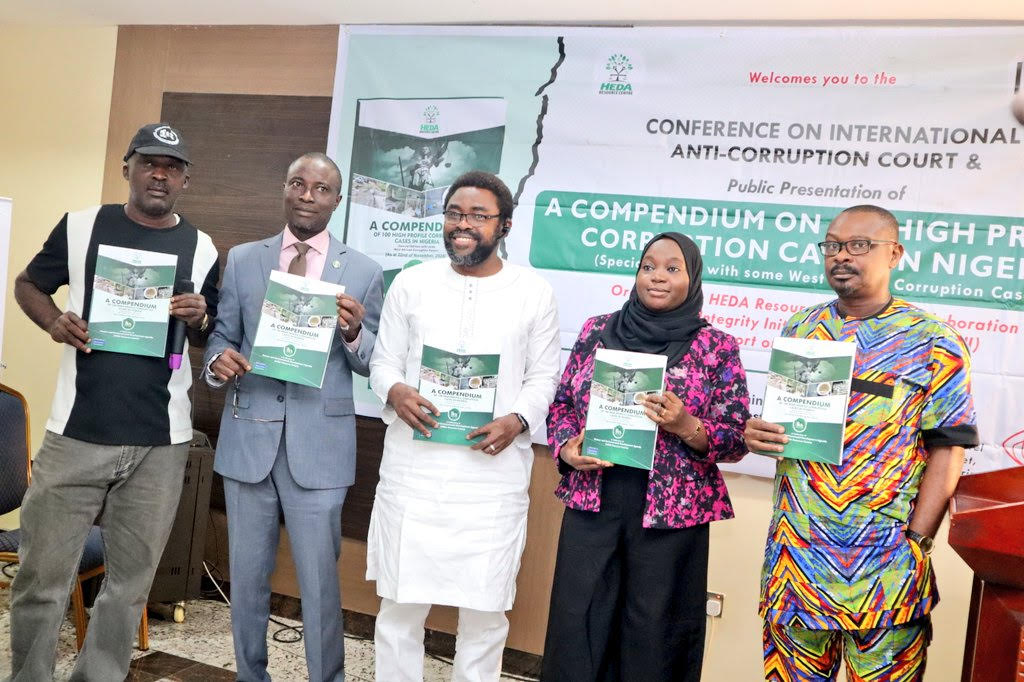
Speaking at a conference on the International Anti-Corruption Court and the public presentation of the Compendium of 100 High-Profile Corruption Cases, held in Lagos to mark International Anti-Corruption Day, Professor Odinkalu condemned the practice of celebrating corrupt individuals by awarding them chieftaincy titles and other honours from traditional institutions and corporate bodies.
The event, organised by the Human and Environmental Development Agenda (HEDA Resource Centre) in collaboration with Integrity Initiative International (III) and supported by the MacArthur Foundation, brought together representatives from the Economic and Financial Crimes Commission (EFCC), Independent Corrupt Practices and Other Related Offences Commission (ICPC), Code of Conduct Bureau, Nigeria Security and Civil Defence Corps (NSCDC), labour organisations, the Nigeria Police Force, and various embassies. Participants reiterated their commitment to combating corruption in all its forms.
With the theme “Engaging Young Stakeholders in Attaining Global Cooperation in the Fight Against Corruption and Repatriation of Illicit Assets,” stakeholders advocated for the establishment of a special anti-corruption court staffed by individuals of unquestionable integrity. They believed such a court would significantly reduce corrupt practices in the country.
Other News
Professor Odinkalu, a good governance advocate, criticised some Independent National Electoral Commission (INEC) and judicial officials for announcing election results favouring candidates who did not win. He stated: “Anyone who steals elections can steal anything. We must strengthen our institutions, mete out appropriate punishments to corrupt individuals, implement effective mechanisms, and end these irregularities if we must progress.”
HEDA Chairman, Mr Olanrewaju Suraju, pledged to intensify efforts in the fight against corruption, which he said has caused immense hardship for Nigerians. Suraju urged the media to amplify efforts to eradicate corruption from Nigeria’s socioeconomic and political systems. He remarked:
“Today serves as a reminder of the work being done by organisations like HEDA in the fight against corruption. If Nigeria contributes significantly to illicit financial flows leaving Africa annually and is among the countries with public officials owning multimillion-dollar assets abroad, it is deeply unfortunate. Looters are not relenting—they are devising new methods. We need institutions and individuals to commit fully to this fight.”
Hon. Justice Olatoregun (retd) called for strict enforcement of anti-corruption laws by empowering anti-corruption agencies. Speaking on “The Strategic Importance and Imperative of Anti-Corruption at the Sub-National Level: The Role of Youth,” she emphasised the need to protect whistleblowers and include anti-corruption education in school curricula. “We need stricter execution of our laws to promote accountability, transparency, and probity in all sectors,” she said.
The HEDA Compendium of 100 High-Profile Corruption Cases in Nigeria highlights cases involving public officeholders—both past and present—that are either ongoing, suspended, or ignored by the courts. The public is encouraged to access the compendium, as the information it contains could guide sound decision-making, planning, and policymaking for socioeconomic and political development.