Follow Us on Google
From Fred Itua, Abuja, and Timothy Olanrewaju, Maiduguri
Insecurity in Borno, Yobe and Adamawa states has dragged on for close to two decades, eroding social life, economic activities and governance across Nigeria’s North East. Nearly 11 years after the military first claimed to have “technically defeated” Boko Haram, the insurgency and its offshoot, the Islamic State West Africa Province (ISWAP), continue to shape not only where people can live and farm but also where, and how, they can vote.

As it stands, large parts of Borno remain volatile and inaccessible. Local government areas such as Guzamala, Marte, Abadam and Kala Balge are still contested terrain, held in a fragile balance by the continuing presence of Boko Haram or ISWAP fighters. Reports through 2025 and into 2026 show that, rather than fading, the insurgency has in some respects hardened. Analysts tracking attacks on military installations recorded more than a dozen assaults on bases across Borno and Yobe since the start of 2025, including a raid on a base in Monguno in April 2026 that killed a battalion commander and an earlier attack on a base in Benisheikh that killed a brigadier general.
Rights groups have also flagged a worrying resurgence of the Jama’atu Ahlis Sunna Lidda’awati wal Jihad, or JAS, faction of Boko Haram, which has returned to targeting civilians directly even as ISWAP concentrates on the military. Mass abductions have continued too; in early March 2026, suspected militants struck the town of Ngoshe in Southern Borno and abducted more than 300 civilians, prompting a combined air and ground response from the military.
The human cost has been immense. Elections could not be held in most of these areas in either 2019 or 2023. While displaced people have been resettled in local government headquarters recaptured by the military, access to these centres remains a serious challenge, since the roads leading to them are frequently laden with landmines or improvised explosive devices.
Survival before governance
For residents of liberated communities, the calculus of the conflict is stark and unchanged from previous cycles. The immediate demands of survival continue to outweigh the promise of good governance.
“What matters to people in those communities is not good roads, health centres, schools or electricity. They are more concerned about their survival and safety, because attacks are still going on,” said Aliyu Buba, a resident of Maiduguri.
Despite the challenge, federal and state governments have extended essential social support to resettled communities, including housing units, water supply, hospitals and schools, alongside food and non food relief distributed regularly to internally displaced persons and other civilians affected by the conflict.
Security and political analysts in the North East observe a growing alignment between residents of liberated communities and their state governments, driven largely by direct engagement. They point in particular to Borno Governor Babagana Zulum, whose regular visits to displaced persons, including those in volatile areas, have become a defining feature of his administration.
“It’s a natural thing for such affected people to vote for the party of their governor, because he relates with them often,” said Usman Ali, a Damaturu based teacher and observer.
He noted that although humanitarian support from the National Emergency Management Agency for communities affected by the conflict has dwindled, state governments have nonetheless taken up much of the burden of assisting their people. Observers believe the decline in federal aid is unlikely to seriously dent support for President Bola Tinubu in the North East, where the All Progressives Congress, or APC, controls all but one state.
“More of the voting population will go for the candidates of their governors. The APC governing states will accept President Tinubu, aid or no aid,” Ali added.
Beyond this political alignment, insecurity continues to distort the electoral process across the region. Since 2015 it has been nearly impossible to hold political campaigns, rallies or elections in parts of the North East because of the prevailing security situation. In 2023, for example, voters in Abadam, on the shores of Lake Chad in Borno, were relocated to Damasak to cast their ballots because of threats of terrorist attack. The Independent National Electoral Commission (INEC has yet to pronounce on whether polls will hold in these volatile areas in 2027, though INEC has already announced new dates for the presidential and governorship elections and has separately warned broadcasters to keep the airwaves a sanctuary for factual campaign coverage rather than a platform for disorder.
One thing is clear, the areas remain vulnerable despite years of military effort to push back the terrorists. This denies candidates direct access to voters in such areas and gives the ruling party an advantage, since it can use state machinery to reach populations that opposition parties cannot.
The battle for the region’s soul
Politically, the North East is overwhelmingly APC territory. Of the six states, Borno, Yobe, Adamawa, Gombe and Taraba now fly the APC flag, following Taraba Governor Agbu Kefas’s formal defection from the PDP in November 2025. Bauchi is the outlier, though even there the picture has become considerably more complicated than a simple PDP hold.
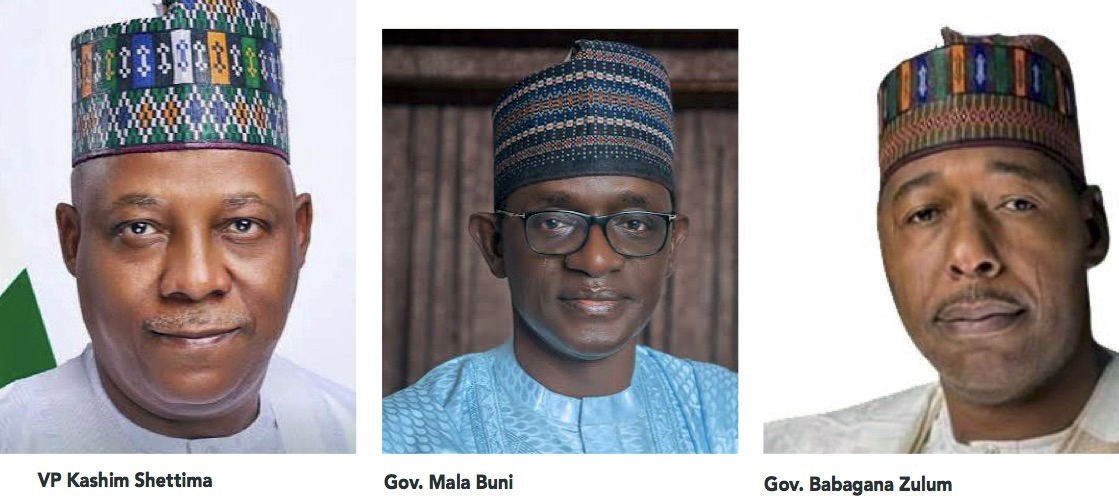
The region is also home to two political heavyweights who will help decide the presidential contest; Vice President Kashim Shettima of the APC and former Vice President Atiku Abubakar, now standing under the African Democratic Congress (ADC). Both will battle for the political soul of a region that, for all its APC dominance at state level, remains genuinely heterogeneous in its underlying loyalties.
Borno, the model under strain
Borno remains the region’s political heartland and the epicentre of the insurgency. For months, the succession question hung over the state, as Governor Zulum moved with unusual speed to anoint his immediate past Commissioner for Works and Housing, Mustapha Gubio, as his preferred successor. That early endorsement, following the dissolution of the state executive council in March 2026, briefly stirred speculation of a rift between Zulum and Shettima, whose alliance has been cited as a rare example of executive harmony within the APC.
Sources close to the Vice President dismissed talk of factional rivalry, and by May 2026, the party had settled the matter. Gubio emerged unopposed as the APC’s consensus governorship candidate, and was formally presented to President Bola Ahmed Tinubu, and later affirmed at a ceremony in Maiduguri attended by both Zulum and Shettima. Gubio has pledged to build on the Zulum government’s record, prioritising education, human empowerment, agriculture and continued reconstruction of insurgency affected communities.
The dust, in other words, has settled rather more quickly than many expected, though undercurrents of dissatisfaction among aspirants who lost out, and questions about how much room Shettima’s own national ambitions leave him in Borno, are likely to resurface as campaigning intensifies.
The PDP appears to have little organisational capacity to mount a serious challenge, while the ADC, weakened by wider disputes over its national leadership, has struggled to establish a strong local presence.
For voters in the state’s contested local government areas, however, the core issue will remain unchanged: whether the military and vigilante forces can secure enough territory for a credible vote to take place at all.
Yobe, politically settled, security unsettled
Yobe looks the simplest of the six states politically. The APC is not expected to face a stiff challenge from opposition parties, since most of the state’s vibrant politicians have already pitched their tents with the ruling party, giving it the kind of grassroots depth it needs for a comfortable win in 2027. Security, rather than party competition, is the state’s defining issue.
Yobe has, alongside Borno, borne the brunt of the renewed wave of attacks on military installations since 2025, and rights monitors have recorded it among the states with the highest number of security incidents nationally, alongside Borno and the North Western state of Katsina. For Yobe’s political class, the practical challenge for 2027 is less about winning votes than about ensuring that voting can happen safely in the state’s more exposed local government areas.
Adamawa, the biggest upset of the primary season
Adamawa has produced the most dramatic twist of the entire North East primary season. Former Vice President Atiku Abubakar’s home state was expected to be a straightforward test of APC strength after Governor Ahmadu Fintiri’s defection to the ruling party, a move that had appeared to bridge long standing divides between APC and PDP blocs, particularly in Yola South. Instead, the APC governorship primary produced a result that stunned observers.
The result has exposed real friction inside the state’s ruling party. Fintiri’s own preferred candidate for governor, Felix Tangwami, ended up being pushed into a senatorial contest instead, while allies of the governor have accused Ribadu’s camp of manipulating the process to sideline Fintiri’s influence within the party’s North East hierarchy, comparing it to the disputed PDP primaries of 2015. On the opposition side, the PDP has fielded Maurice Vunobolki, who argues that Atiku’s presidential run under the ADC banner will not be enough to swing the governorship, pointing to the historical fact that Atiku and Ribadu have both lost elections in Adamawa before.
Gombe, consensus, collapse and a fresh contest
Gombe under Governor Muhammadu Inuwa Yahaya has been one of the APC’s most orderly states, at least until recently.
In May 2026 the party attempted to settle its succession quietly by naming Dr Jamilu Isyaku Gwamna, a former managing director of the Kano Electricity Distribution Company, as its consensus governorship candidate, alongside a full slate of consensus candidates for the senatorial, House of Representatives and state assembly seats.
The arrangement dropped former Minister of Communications and Digital Economy Isa Pantami from contention, a decision Pantami rejected outright, vowing to contest the outcome even at personal cost and submitting his own nomination form to the party’s national headquarters regardless.
The backlash proved strong enough that within weeks Governor Yahaya abandoned the consensus approach altogether, directing the party to proceed instead with direct primaries after weeks of protest from Pantami, former governor and sitting senator Danjuma Goje, and aspirants in the Balanga and Billiri federal constituency who all rejected what they characterised as an elite imposition.
Yahaya has since warned that intelligence reports point to plots by some actors to exploit the primaries to trigger unrest, and has pledged a zero tolerance approach to political thuggery as the state, one of the more peaceful in the North East since its creation in 1996, heads towards a more competitive and unpredictable contest than initially expected. The APC’s dominance at the grassroots remains real, underlined by a clean sweep of local government elections, but the reopening of the governorship race has injected genuine uncertainty into what had looked like a foregone conclusion.
Taraba, a rematch reshaped by performance, not endorsement
Taraba offers the clearest illustration of how the region’s politics have shifted since 2023. Governor Agbu Kefas won that year’s election under the PDP banner, buoyed by the endorsement of elder statesman Theophilus Danjuma and by mobilisation from the Christian Association of Nigeria.
Facing pressure from within his own coalition and from APC figures keen to widen the ruling party’s northern base, Kefas formally defected to the APC in November 2025, becoming one of several PDP governors, alongside counterparts in Bayelsa, Delta, Akwa Ibom and Enugu, to cross the aisle and hand the state to APC. He went on to win the APC’s Taraba governorship primary comfortably in May 2026, defeating former Minister of State for Transport Muazu Jaji by a wide margin.
The 2027 contest is shaping into a rematch with former Senator Emmanuel Bwacha of the PDP, but analysts in the state argue the dynamics have changed fundamentally. Where the 2023 race turned heavily on elite endorsements, the emerging contest is being driven more by voter assessments of Kefas’s actual record in office. Critics have taken to calling him “Mr Promises”, arguing that commitments on infrastructure, youth employment and local economic development have not translated into visible outcomes, a perception gap that Bwacha’s campaign is seeking to exploit even as it tries to convert elite backing into genuine grassroots turnout. For Kefas, the pitch for 2027 rests on his new alignment with the federal government and the argument that this synergy can accelerate delivery in the state’s final stretch.
Bauchi, the region’s genuine wildcard
Bauchi remains the one state in the North East that the APC does not currently control, but describing it simply as a PDP stronghold understates how fluid the picture has become. Governor Bala Mohammed, chairman of the PDP Governors’ Forum, spent months at the centre of speculation that he would defect to the APC, speculation he publicly denied even as reports suggested negotiations over a possible Senate seat and equivalent allowances to those enjoyed by other defected governors.
Those talks were also linked by some reports to legal troubles facing his finance commissioner, who faces terrorism and money laundering charges.
In the end, rather than joining the APC, Mohammed defected to the smaller Allied Peoples’ Movement (APM) in May 2026, a move that has left the PDP’s Bauchi structure without its most prominent figure but which the Nyesom Wike aligned wing of the party insists will not be fatal, arguing that PDP loyalty in the state runs deeper than any single politician.
The PDP has since put forward its own governorship candidate, Adamu Usman Ahmed, who argues that Mohammed’s apparent attempt to instal a successor is doomed regardless of which platform he ends up on, and who is banking on youth demographics to carry the party.
The APC, for its part, has learned hard lessons from defeats in 2019 and 2023 that it attributes to internal disagreement following contested primaries; the party has since set up a conflict resolution committee, tightened its primary rules and held town hall meetings across local government areas in an effort to present a united front.
Former governor Mohammed Abubakar defeated six rivals, including Foreign Affairs Minister Yusuf Maitama Tuggar and philanthropist Bala Wunti, to win the APC ticket in May 2026. With three parties, the APC, a divided PDP, and an ADC facing its own leadership instability nationally, all fielding credible contenders, Bauchi looks set to be the most genuinely competitive governorship race anywhere in the North East in 2027.
What will decide the North East in 2027
Three forces will interact to shape the outcome across the region. The first is security itself. Whether the military, working alongside state backed vigilante and hunter networks credited with helping stabilise parts of Adamawa and Taraba, can create enough safe territory for meaningful campaigning and voting to occur in the worst affected local government areas of Borno and Yobe.
The second is incumbency and patronage, since governors who have engaged directly and visibly with displaced and resettled communities, as Zulum has done in Borno, appear to enjoy a durable advantage that state machinery alone cannot fully explain.
The third is the accelerating pace of defection and realignment, which has already redrawn the regional map once this cycle, turning Taraba APC and pulling Adamawa’s Fintiri across the aisle, only for Adamawa’s own primary to produce an outcome none of the main power brokers had planned for.
Taken together, these dynamics suggest that while the APC enters 2027 with a formidable structural advantage across five of the six North East states, the region’s underlying instability, both political and security related, means that the outcome is far from settled. Adamawa’s upset primary, Gombe’s collapsed consensus, Taraba’s performance based rematch and Bauchi’s genuinely open field all point to a region where insecurity may still determine who can campaign and where, but where, once the ballots are cast, the result is no longer a foregone conclusion.