Follow Us on Google

The Director General, National Information Technology Development Agency (NITDA), Kashifu Inuwa, has urged African nations to take ownership of their digital future, warning that the continent cannot continue to rely on external systems for its technological progress.
Speaking recently at the 2nd Annual Sustainability Week Africa in Cape Town, South Africa, Inuwa said that Africa’s economic growth and competitiveness in the 21st century depend on its ability to build and sustain its own digital infrastructure. He emphasised that aggressive investment in local digital public infrastructure (DPI) is essential to unlocking innovation, creating jobs, and driving intra-African trade.
“In the 21st century, compute power is a primary factor of production. We cannot continue exporting our raw data for others to process and then buy back the finished products. Africa must build its own digital muscle to shape its own destiny,” Inuwa stated.
The Sustainability Week Africa forum convened policymakers, business leaders, and innovators to discuss Africa’s role in achieving energy transition, climate resilience, and sustainable development. During a panel session on Digital Infrastructure for Jobs and Trade in Africa, Inuwa highlighted that building digital infrastructure should no longer be seen as an option but as the foundation for the continent’s economic self-determination.
He explained that digital public infrastructure operates at two levels the physical and technical components such as connectivity, cloud, and compute capacity, and the functional layers, including digital identity, payment systems, and data exchange platforms that enable inclusive and secure access to digital services.
“Digital transformation is not a sector; it is an enabler of every sector,” he said. “Without our own compute capacity, artificial intelligence and emerging technologies will only deepen dependency rather than drive empowerment.”
Inuwa drew attention to the European model of collaboration in building high-performance computing and AI infrastructure, urging African governments to adopt similar policies that attract private sector investment and regional partnerships.
Other News
He cited Nigeria’s digital progress as a continental example, noting that more than 130 million Nigerians have been registered under the national digital identity system. He added that work is ongoing to establish a National Data Exchange Platform and a Digital Public Infrastructure Centre of Excellence to promote interoperability and innovation across all levels of government.
“The Minister of Communications, Innovation, and Digital Economy, Dr. Bosun Tijani, is championing Nigeria’s efforts to build a DPI Centre of Excellence, where we can develop and export our own digital systems rather than depend on imported ones,” he said.
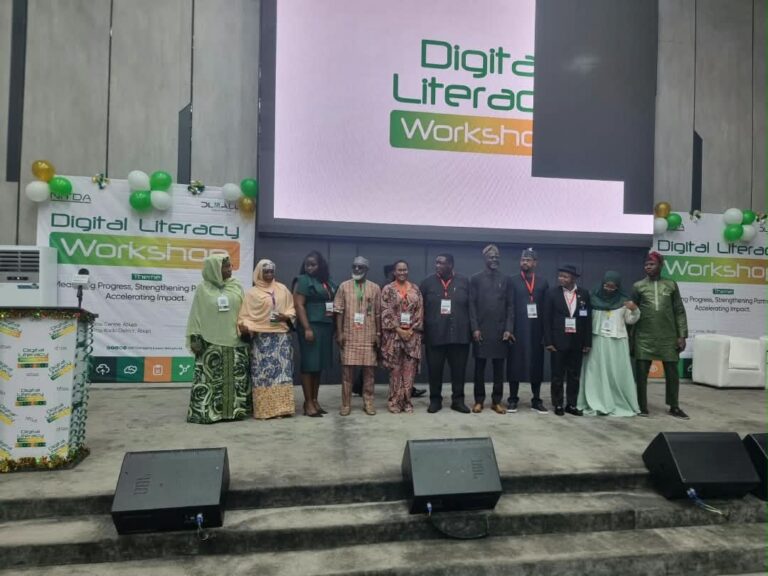
He also reaffirmed Nigeria’s commitment to achieving 95% digital literacy by 2030 and 70% by 2027 under the National Digital Literacy Framework. He said that the government is partnering with Cisco, the National Youth Service Corps (NYSC), and other institutions to train young people, women, and small business owners in the use of digital tools and AI applications to expand economic opportunities.
“Technology is not an end in itself; it is the bridge between where Africa is and where it must go. Our goal is to achieve digital self-determination, a continent capable of designing its own future,” he added.
He called for stronger coordination among African governments, the private sector, and development partners to harmonise digital standards and scale innovation across the continent.
“Africa’s advantage lies in our ability to leap, to collaborate, and to build inclusively. If we construct the digital rails together, our youth will drive Africa straight into the heart of the global digital economy,” he said.