Follow Us on Google
Daniel Kanu
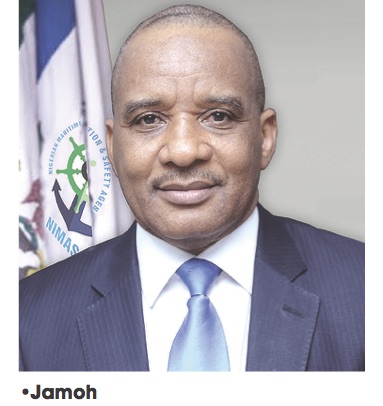
Director-General, Nigerian Maritime Administration and Safety Agency (NIMASA), Dr. Bashir Jamoh has disclosed that the on-going reforms in the nation’s state and flag state administration has earned the country its recent exit from the International Maritime Bureau (IMB) Piracy list.
Also, he noted that the effort of his transformative leadership was changing the narrative of safety of navigation on the Nigerian water, just as he announced an increase of 43.6 percent in condition survey for flag registration by the agency in year 2021 as against the performance in 2020.
Jamoh, made the disclosure during a media interactive session in Lagos, noting that despite the challenges associated with the COVID-19 pandemic, the agency ensured improved Port and Flag State Administration following the safety requirements of the Merchant Shipping Act 2007.
He commended NIMASA for entering the era of scheduling vessels for port state control, using digital means, saying that certifications of the agency’s surveyors must enhance port and flag state function, and bring about more compliance with international convention for Nigeria.
Jamoh announced an increase of 43.6 per cent in condition survey for flag registration by the agency in year 2021 as against the performance in 2020, explaining further that the agency also recorded an improved Port State Control (PSC) implementation this year with 24.2 per cent higher than the PSC inspections of 2020.
A breakdown of the figures shows that in 2020, the agency carried out a condition survey of vessels under Flag Registration for 276 vessels, while in 2021, the figure increased to 489, representing a 43.6 per cent improvement.
“Port State Control implementation by NIMASA in 2021 was assessed onboard 673 vessels, which was a marked improvement on the 510 Vessels Boarded for Port State inspection in 2020 representing a 24.2 per cent increment” he noted.
Jamoh disclosed that the agency reactivated the online portal for stakeholders to verify Nigerian Certificate(s) of Competency CoC from any part of the world.
Said Jamoh“The online certificate verification platform was reactivated last year to reduce falsification of Nigerian Seafarers Certificate and enhance the employment of Nigerian Seafarers.
“We experienced rejection of Nigerian Seafarers both locally and internationally and the Agency decided to introduce an online certificate verification platform which allows shipowners to easily authenticate CoC’s from the comfort of their electronic devices.”
While raising concern over the percentage of failures recorded for Nigerian seafarers who sat for the Certificate of Competency examination last year, Jamoh announced that the agency has commenced investigation into the immediate and remote causes of the trend to address it holistically.
NIMASA helmsman disclosed that in the year 2021, NIMASA signed a Memorandum of Understanding with the Maritime Transport Coordination Center (MTCC) for capacity development to address the need for reduction of greenhouse gas emission in the maritime industry with emphasis on achieving 0.5 per cent sulphur oxide in bunker fuel.
“Our laboratory is already completed and we hope to enter a public-private partnership arrangement this year to manage the laboratory for optimal utilisation,” he said.
He also disclosed that the agency has appointed Recognised Organisations (ROs) to approve Ship Security Plan (SSP) and to issue International Ship Security Certificates to Nigerian flagged ships on its behalf.
Jamoh said the commitment of his leadership is total towards ensuring that the sector delivers on reforms that will put in place the desired returns.
According to Jamoh “The agency also carried out 20 marine accident investigations in 2021, as against 18 in the year 2020, while also enforcing safety regulations on barges and tugboats under the code name; Operation Sting Ray.
The NIMASA helmsman revealed further that the agency took delivery of more Deep Blue Project Assets, which was flagged off by President Muhammadu Buhari, adding that some of these assets have been deployed to the Nigerian Navy for its operational use.
He said the agency is also collaborating with major international stakeholders in the maritime sector to entrench coordinated response to piracy and other criminalities on the Nigerian waters.
Jamoh further noted the agency’s commitment to improved strategic collaboration with the Nigerian Navy, Airforce, Police, Army and the office of the National Security Adviser.
This move, he said, has helped to reduce piracy attacks off the coast of the Gulf of Guinea, as there was no single attack on Nigerian waters in the third quarter of 2021, as reported by the International Maritime Bureau (IMB).
A recent statement by the Acting Head, corporate Communication of NIMASA, Osagie Edward disclosed that NIMASA has endorsed maritime training providers to help guide Nigerian flagged ships and Nigerian port facilities in the training of their maritime security personnel.
These training providers, according to the statement, conduct training for Company Security Officers (CSOs), Ship Security Officers (SSOs) and Port Facility Security Officers (PFSOs) according to the requirements of the ISPS Code and IMO model.
The agency also introduced new measures to check security threats in the Nigerian maritime industry, as ship captains operating in Nigeria are now required to submit the Security-Related Pre-Arrival Information (SRPA) forms to the agency not later than 48 hours before the ship’s arrival at any Nigerian port. All ships are also expected to maintain 24 hours vigilance and surveillance to detect strange movements, including small boats and skiffs that may not be captured by the radar.
There is no doubt that Nigeria’s maritime sector is an overlooked gold mine that is capable of becoming a key engine of economic development, if enhancive strategies are implemented for optimum efficiency.