Follow Us on Google
Nigeria is once again confronting a season of turbulence that is both familiar and frightening. The resurgence of terrorism across the North-west, North-east, and North-central regions has shattered any illusions that the nation had begun to tame the waves of violence. Instead, the country is witnessing the return of an enemy that has grown smarter, richer, and more rooted in the neglected spaces where the Nigerian state has long receded. What used to be described merely as “insecurity” has hardened into a sprawling ecosystem of violence, an industry with its own supply chains, recruitment systems, foreign links, and internal economies.
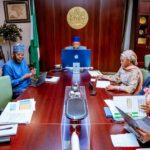
Yet amid this renewed chaos, there is a palpable shift coming from Abuja. For the first time in years, the Federal Government is moving with an urgency that suggests something deeper than routine political response. Air raids have increased, special forces have been redeployed to hot zones, and the military’s operational tempo appears to have quickened. At the highest levels of national security, a significant shake-up has taken place: the security apparatchik has been rejigged with the exit of a defence minister and the appointment of another, who was a few months ago removed as defence chief and the list of alleged terrorism financiers long buried in bureaucratic suspense, finally surfaced. The moves feel abrupt, almost unusually decisive, for a government that had often been criticised for slow or symbolic gestures.
This sudden vigour did not emerge from nowhere. It is the product of pressure, both domestic and international, building over years like a boiling pot whose lid finally rattled loose. At home, Nigerians have grown weary of living with the reality that large swaths of territory have effectively slipped out of state control. Communities negotiate their own safety with warlords. Farmers abandon fertile land because it has become a graveyard. Highways turn into hunting grounds. And every mass abduction deepens the painful question of whether the Nigerian state still possesses the capacity, or will, to guarantee the simplest promise of governance: safety.
But there is also an external dimension to the pressure, one that has reintroduced Nigeria into the consciousness of global powers, none more influential than the United States. Over the past months, the international conversation around Nigeria’s security crisis intensified dramatically due to a wave of reports, testimonies, and advocacy campaigns centred on the allegation that Christian communities in the Middle Belt and some northern regions are facing what some groups describe as a “slow-motion genocide.” Survivors have spoken before global audiences, satellite images of razed Christian villages have circulated among lawmakers, and humanitarian organisations have released stark assessments of the brutality unfolding in parts of Plateau, Benue, Kaduna, Taraba, and Nasarawa.
Although the Nigerian government rejects the label of genocide, and insists the violence is driven by banditry, land disputes, and terrorism rather than religious cleansing, the distinction has not pacified the growing outrage abroad. In Washington, these allegations found a receptive audience among powerful religious constituencies, human rights bodies, and members of Congress deeply influenced by their own domestic Christian advocacy networks. Their voices grew urgent, then angry, then political. Hearings were convened. Petitions landed on the desks of senior officials. Lawmakers demanded to know why the U.S., having once designated Nigeria a Country of Particular Concern, had removed it from the list, even as violence against Christian communities intensified.
Soon the pressure became impossible for the U.S. State Department to ignore.
Thus began a noticeable shift in Washington’s posture toward Nigeria and the return of the country to the infamous tag of particular concern. The United States has not announced any formal intervention, but the signs of renewed involvement are unmistakable. Diplomatic statements have grown more pointed. Intelligence-sharing corridors that once appeared dormant have flickered back to life. High-level meetings have increased in frequency, and American officials are speaking with a sharpness that contrasts with the more measured tone of previous years. A sense of impatience has crept into U.S. diplomacy, the kind that signals both humanitarian concern and strategic anxiety.
For Washington, the stakes are not merely moral. Nigeria remains the anchor of West Africa, demographically, economically, and geopolitically. An unstable Nigeria destabilises the region, fuels mass displacement, strengthens insurgent movements, and widens the corridor for extremist groups expanding southward from the Sahel. It also poses strategic dilemmas, particularly at a time when China and Russia are expanding their footprint across Africa. A Nigeria drifting into deeper chaos, or worse, into the arms of rival global powers, is a scenario Washington cannot afford to overlook.
Thus, what began as outrage over alleged Christian persecution has expanded into a broader geopolitical awakening. America now sees Nigeria as a fragile fulcrum in a region already battling the spread of ISIS affiliates, military coups, and rising foreign competition.
The U.S. is not here purely out of charity or shared faith; it is here because Nigeria’s stability affects global power calculations.
Caught in this swirl of domestic urgency and international scrutiny, the Nigerian government appears to have realised that it can no longer afford the luxury of ambiguity. A state that cannot protect its rural communities risks losing control over its peripheries. A state that cannot secure its highways risks losing its economy. A state that cannot rescue its abducted citizens risks losing its legitimacy. And a state that appears indifferent to allegations of targeted atrocities risks alienating powerful allies and weakening its international standing.
Still, Nigeria must tread carefully. Foreign engagement, especially from a global power, is never neutral. The United States brings partnership, but it also brings expectations. It offers assistance, but also pursues influence. Its interest in Nigeria’s stability is genuine, but it is also strategic. If Nigeria is to benefit from this renewed attention, it must define the terms clearly: cooperation without dependency, intelligence-sharing without intrusion, support without surrendering sovereignty.
More importantly, Nigeria must confront the uncomfortable truth that no amount of foreign assistance can rescue a nation unwilling to rescue itself. The roots of Nigeria’s security crisis run deeper than poverty or ideology. They are tied to years of state absence, broken policing systems, neglected rural economies, and the unchecked spread of illicit weapons. Terrorism thrives in places where government presence is a rumour and justice is a stranger. If Abuja intends to sustain its newfound momentum, it must rebuild authority in spaces where it has vanished, restore trust in institutions that have crumbled, and create opportunities where despair has become normal.
This moment demands consistency, not theatrics. Nigeria has grown accustomed to dramatic offensives that flare brightly and fade quickly. Operations are launched with fanfare, only to lose steam once public anger settles. Villages are secured for a week, only to be abandoned the next. Terror financiers are named, yet rarely prosecuted. Bursts of action cannot substitute for long-term strategy.
What the country longs for now is proof, not in speeches, not in communiqués, but in changed realities on the ground. Citizens want to see secure schools, restored farmlands, reopened local markets, safe roads, and communities that can sleep without fear of midnight gunfire. They want to see abducted Nigerians returned to their families. They want governments, federal and state, to act as though Nigerian lives have weight, as though rural deaths are not statistical inconveniences, and as though the state still believes in its own capacity to govern.
Nigeria is standing in a moment thick with warning and possibility. Terrorism has resurged to remind the country what is at stake. The government has awakened to show that it can still assert authority. And the United States has re-entered the fray, driven partly by moral pressure, partly by strategic necessity, and partly by the loud accusations of a Christian genocide that rattled Washington’s conscience.
What Nigeria does with this convergence will determine more than security outcomes. It will define whether the country begins to reverse years of drift or sinks deeper into fragmentation. It will reveal whether the government’s current energy is the beginning of a new era or simply another passing moment of urgency. And it will show whether Nigeria can reclaim control of its present, or whether it will continue to be defined by crises it once believed it had survived.
The crossroads is here. The next step will determine the road the supposed Giant of Africa travels.