Follow Us on Google

From Juliana Taiwo-Obalonye, Abuja
Minister of Communications, Innovation and Digital Economy, Bosun Tijani, has declared that President Bola Tinubu’s reforms in the digital space were solely for the average Nigerian, as he rolled out sweeping policy, regulatory and investment milestones, powering the three Million Technical Talent (3MTT) programme and Nigeria’s wider digital economy.
Speaking at the 3MTT’s national impact summit in Abuja, themed, “Building Nigeria’s Digital Workforce,” Tijani said President Tinubu’s directive to his team had been clear: “fire up the base” so that citizens can feel the tangible impact of the government.
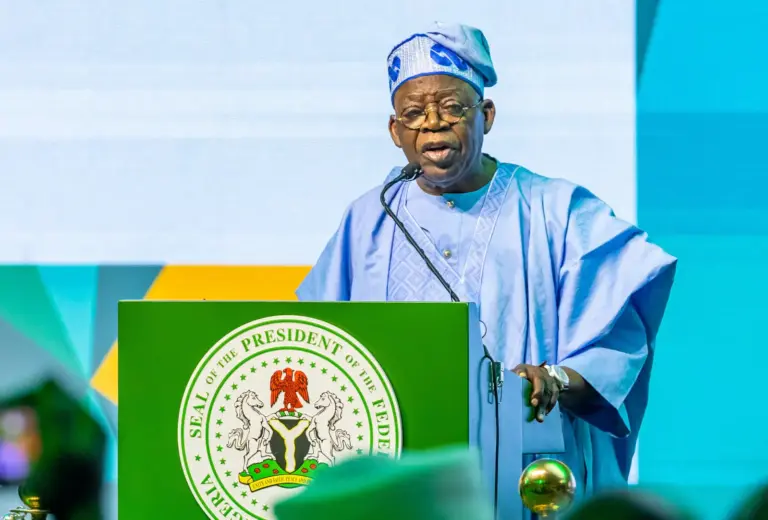
President Tinubu was represented by the Secretary to the Government of the Federation, George Akume.
The minister recalled a recent Federal Executive Council meeting where Tinubu charged ministers and appointees to work for ordinary citizens. According to him, “every agenda of his administration and all the reforms that he has made is solely for the average Nigerian,” adding that the President used the phrase “fire up the base” to underline the directive. He said the summit was not only to celebrate the programme’s achievements, but also “an opportunity to appreciate His Excellency for his dedication and contribution to the digital economy of the Federal Republic of Nigeria, particularly in just over two years.”
The minister listed key decisions taken since Tinubu assumed office, noting that the President “signed into law the National Data Protection Commission Act, which gave Nigeria its first data protection commission, which is now recognised all over the world as one of the very best in Africa.” He described the Act as a foundational reform that has enhanced trust, investor confidence and global standing for Nigeria’s digital ecosystem.
Tijani highlighted Tinubu’s approval in October 2023, of what he called “the largest technology talent accelerator programme in the world in the name of 3MTT,” designed to train three million technical talents for Nigeria and the global market. He linked this to a larger ambition to make Nigeria a net exporter of technology talent, stressing that the initiative was rooted in hard data about global demand for skilled workers.
He further revealed that in May 2024, the President “decided that by the time he’s leaving office, Nigeria will have access to the best internet that is available anywhere in the world,” and consequently approved a landmark investment of “$2 billion in 90,000 kilometres of fibre optic network that will cover the entire country.” Describing it as the largest anywhere in any developing country in the world, Tijani said the project would fundamentally transform connectivity, inclusion and productivity nationwide.
Beyond infrastructure rollout, Tijani said President Tinubu responded to long-standing pleas from telecom operators, whose base stations and lines had suffered years of vandalisation. “For many years, the telecommunication sector had been requesting that their infrastructure should be protected from vandalisation,” he recalled. “In August 2024, our president decided to declare all telecommunications and ICT infrastructure in the country as critical national infrastructure, which means they can now be protected to the same level as military equipment.”
He disclosed that when the administration came in, “the telecommunication sector was already recording losses” and had been unable to review pricing for 10 years. “After a thorough study,” Tijani said: “In January 2025, our president decided to allow these companies to increase their tariffs;” a move he argued has put operators in a position where the companies are today profitable and able to attract significant foreign direct investment into the country.
“Just weeks ago, Tinubu approved the deployment of close to 4000 telecommunication towers in rural communities that are currently unconnected, mostly in the North-East, North-West, North-Central and a few other locations. “This initiative will bring close to 23 million Nigerians that are currently not connected at all into the digital economy.
He noted that tax harmonisation under the administration had further eased pressure on the sector.
“Today, the digital economy in Nigeria is one of the most attractive for investment on the African continent, thanks to the effort of our president,” he asserted.
Turning to the labour market, Tijani said the 3MTT celebration was, at its core, about a President that is clear about the need to empower the base through job creation. He reminded the audience that under the Renewed Hope agenda, “our president says he would like to create a million technology jobs, which is quite significant. When ministers were appointed and the numbers examined we realized that there were over 4.5 million unfilled jobs in the technology sector at the end of 2023 proving that the desire to create a million technical jobs is not actually something that Nigeria could not achieve.”
He said the ministry studied global trends and found that the trajectory that the digital economy was going and its future would imply that there would be about 59 percent of the workforce that would need upscaling.
Citing evidence that about 170 million technology jobs would be created by 2030, over the next five years,” Tijani argued that Nigeria’s demographics confer a strategic advantage. “For a nation where the average age is 16.9, where over 60 percent of our people are under the age of 30, we are in a good position to truly become a net exporter of talent,” he said.
Other News
According to Tijani, this analysis “led to the resolve by the Ministry of Communications, Innovation and Digital Economy to establish the world’s largest technology talent accelerator in 3MTT, with the sole purpose of training three million technical talents, not just for the Nigerian market, but for the world.”
He noted that the plan took shape between August and October 2023; at a time when there was no budget to actually fulfil this dream, but was kept alive by the camaraderie and the energy and the interest of the sector to drive the growth that Nigerians had been yearning for.
He narrated how the private sector stepped in almost immediately. “IHS Tower, which is a company that we should all be extremely proud of, that started out in Nigeria, came forward and decided to put N1 billion into 3MTT,” he said. “But IHS didn’t stop there. It also decided to invest N1.5 billion into the renovation of the damaged tech park in Kano and contributed significantly to one of the best technology hubs in Nigeria today, which is based in Ilorin, Kwara State. IHS is also today investing in another tech hub in Borno State.”
“As we were getting excited,” he continued, “the giant MTN also turned up with N3 billion to support 3MTT and that was followed, of course, by N1 billion from Airtel.” This early funding, he said, “gave us the foundation to produce what you’re seeing in the room today, which are young people from across Nigeria with dreams and aspirations.”
He said the momentum did not stop with local telecoms. “We saw partners like AWS coming up with credit, Google in particular, investing over N2 billion into training technical talents that are focused on deep technology,” he stated. “We’re way turning up with credit that is also worth over $10 million, the alternative bank providing five billion in credit for fellows who are interested in acquiring their own laptops and devices. Microsoft in particular invested $1 million into additional training to help us achieve our goal and Secure ID gave credit to over 3MTT fellows, who contributed to the development of the first government-backed large language model in Africa.
“Without all these partners, we will not be where we are today,” he admitted. These interventions, he said, had enabled the programme to offer not just training, but equipment, platforms and pathways to real work in a rapidly evolving tech landscape.
Explaining the programme’s scale, Tijani recalled that “when we launched this programme in 2023, in less than a month we saw over 1.8 million Nigerians sign up to be part of 3MTT.”
He stressed the nationwide spread of beneficiaries, saying, “Those 1.8 million Nigerians came from every state and every local government of this country. We actually mandated that everyone applying must apply either using NIN or BVN. So, these are uniquely identified individuals.
“This, for us, was already a signal that what we were setting out to do has a demand from our people, and it’s not just a fiction of imagination from public leaders.”
The ministry then adopted a precision approach using a three-phase methodology common in high-tech engineering: first focusing on one percent of the three million target (30,000 fellows), then 10 percent, and finally moving to 100 percent. “With the resources from our partners,” he noted, “we went into training the first one percent, which was 30,000 young Nigerians from across the country, which started in December 2023, and by July 2024, we went into the 10 percent which is what we’re now wrapping up.
“For us, this is not just a political declaration,” Tijani insisted. “This is an opportunity and a programme that we understand that if we carefully deliver on, will lead to significant opportunity for the young people you see in the room, but also for the bottom line of our nation in terms of GDP.”
Providing hard numbers, he revealed that “if you’re looking at the key numbers today, direct jobs in terms of those that we can actually record that have gotten job opportunities in the first batch of the training programme, it is already over 15,000.”
Many, he said, are earning well above the national average. “We’re seeing a lot of these people, some of them their first job, already earning over N250,000 in salary.”
He said 3MTT has “been able to activate over 201 applied learning centres all over the country, because we know that these people needed spaces where they could go to learn. So, we’ve supported over 201 applied learning centres. We have over 600 facilitators that have been working on 3MTT, over 15 e-learning partners. These are companies, most of whom are local companies that create the contents which we use in this programme as well.”
The programme has also invested in community-level coordination and incentives. “We recruited 37 community managers, all paid for and most of them are in the room, all paid for by IHS from all the states and FCT to manage this programme,” he said. “SCC provided laptops that are worth over 1.5 billion naira for a lot of the fellows that we see who performed really well through the innovation challenges. And we’ve given out over 400 million naira as well in prizes to encourage the fellows to perform whilst they are learning.”