Follow Us on Google
•Low patronage puts N5trn investments, 20,000 jobs at risk
Stories by Steve Agbota
Nigeria’s bonded terminal industry is on the verge of collapse. Also at risk are over 20,000 jobs and investments worth over N5 trillion. All fingers point to low patronage.
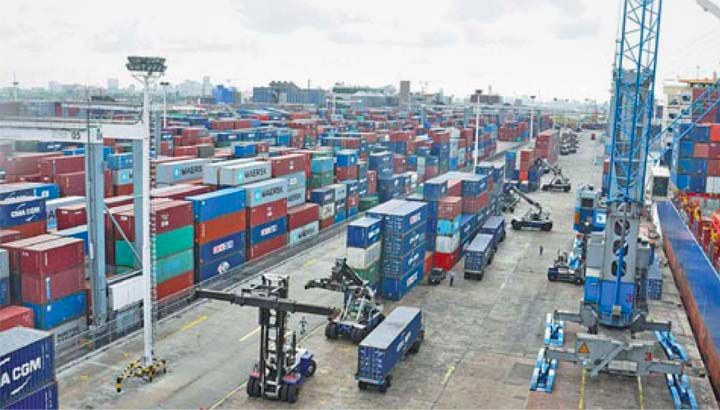
A bonded terminal (also called a bonded warehouse or bonded cargo terminal, depending on its function) is a Customs-approved facility where imported cargo is transferred and stored without immediate payment of Customs duties until the goods are cleared by the importer.
Instead of being cleared at a crowded port like Lagos, the containers are transported under Customs escort to a licensed bonded terminal and importers complete Customs documentation, inspections and duty payments at the bonded terminal.
The operators, currently on ventilators, have endured years of declining fortunes as cargo destined for their facilities continues to shrink, particularly in Lagos, the country’s commercial hub.
Industry players attribute the downturn to the growing reluctance of shipping companies and seaport terminal operators to route cargo through bonded terminals, leaving many facilities idle and financially distressed.
The prolonged slump has forced several indigenous operators out of business, while those still in operation struggle to survive amid dwindling patronage. Stakeholders say the vacuum has increasingly been filled by foreign-owned operators. This has deepened concerns over the future of local investments and employment in the sector.
Daily Sun gathered that Lagos has between 70 and 80 bonded terminals, yet most are operating far below capacity. Industry operators estimate that many facilities are utilising less than 15 to 20 per cent of their installed capacity, while several others have become virtually dormant due to the acute shortage of cargo.
They attributed the situation to the concentration of cargo at the nation’s seaports, leaving bonded terminals starved of business.
Some stakeholders lamented that a number of once-bustling facilities have become so inactive that they now serve little more than open fields for football and other recreational activities.
The indigenous operators raised the alarm that many bonded terminals are closing up and people are losing their jobs because each facility employed up to 400 workers.
The operators blamed the situation on the inefficient local content law that failed to protect the indigenous businessmen in the country, as they alleged that foreigners have taken over their jobs.
“Many of the seaport concessionaires are foreigners. Even the shipping companies bringing cargoes to our ports are foreign-owned shipping lines. Many of these shipping companies and seaport concessionaires have established off-dock terminals in Lagos, where they stem cargoes to the ports.
“They have completely cut off the indigenous bonded terminals from the supply chain; that’s why most of the indigenous bonded terminals are closing shops daily because of non-patronage,” the operators explained.
Daily Sun learnt that in saner climes, the local content law protects indigenous firms, but that does not apply in Nigeria. For instance, in Ghana, the local content law provides that seaport terminals stem at least 30 per cent of the cargoes that come to the ports to the indigenous bonded terminals.
Here in Nigeria, the seaport concessionaires, who are mostly foreign companies, own off-dock terminals in Nigeria and only stem cargoes to their sister companies.
The indigenous alleged that the port concessionaires like APM Terminals, TICT and others are not patronising indigenous bonded terminal operators.
However, some stakeholders expressed different opinions over the continuous importance of bonded terminals in Lagos, with some calling for their gradual wind-down.
The argument comes amid renewed traffic build-up along the Apapa and Tin Can port corridors and growing concerns that many bonded terminal operators may be forced out of business if the current operational trend persists.
Meanwhile, operators insisted that bonded terminals remain internationally recognised extensions of seaports and critical tools for cargo evacuation and port decongestion; some freight forwarders argue that the facilities have outlived their usefulness and should either be restructured or phased out.
The controversy was as a result of the recent decision by the National Association of Government Approved Freight Forwarders (NAGAFF) to commence a nationwide inspection and assessment of licensed Customs-bonded warehouses and terminals over concerns bordering on operational inefficiencies, inadequate infrastructure and poor service delivery.
However, the operators said that the bonded terminal business has collapsed in Nigeria and called on the federal government to intervene by giving indigenous operators plain ground to thrive.
They argued that mother ports now created another corridor, the decking free zone and these ports are now sharing the cargo that would have ultimately come into the bonded terminals. Initially, the creation of a bonded terminal is to alleviate congestion in mother ports.
Speaking on the issue, the General Secretary of the Association of Bonded Terminal Operators of Nigeria (ABTON), Mr Haruna Omolajomo, lamented that bonded terminal operations near-collapse despite investments exceeding N5 trillion.
He argued that more than 40 bonded terminals in Lagos alone possess infrastructure capable of handling approximately 84,000 Twenty-foot Equivalent Units (TEUs), but are currently operating at less than five per cent of their installed capacities.
“Today, I don’t think there are up to 500 containers spread across these terminals. Most are operating below five per cent capacity, and huge investments are lying idle,” he lamented.
He recalled that bonded terminals were established in 2001 after the Federal Government sought private sector support to tackle severe port congestion that had caused significant cargo diversion to neighbouring countries.
He explained that operators invested heavily in developing modern facilities after being encouraged by the government and the Nigeria Customs Service to transform bonded warehouses into full-fledged bonded terminals.
According to him, the first 10 bonded terminals handled over 484,000 TEUs within their first three years of operation, significantly reducing congestion at the ports and facilitating smoother cargo delivery.
“The success recorded by bonded terminals was one of the factors that inspired the government’s port concession programme,” he said.
He also attributed the sector’s current struggles to increasing dominance by foreign operators across the logistics value chain, arguing that indigenous investors face severe financing challenges compared to their foreign counterparts.
He disclosed that several bonded terminal operators have already shut down their facilities, while others are battling to remain afloat under mounting financial pressure.
Also speaking, another bonded terminal operator, Kenneth Ofurum, added that bonded terminals remain highly necessary, particularly as congestion gradually returns to Lagos port corridors.
“Our roads are getting back to the old days. The roads are clogged and the ports are becoming full again,” he stated.
According to him, the poor utilisation of bonded terminals is not due to lack of need, but rather operational practices that discourage cargo transfers from the ports.
He alleged that some operators benefit significantly from prolonged cargo dwell time and demurrage charges, thereby reducing incentives to move containers to bonded terminals.
“Most of the bonded terminals are not fully-utilised. Yet people are still applying for new licences, which shows that there is still a strong need for them,” he said.
He called on the federal government to introduce stronger regulatory measures that would ensure the effective utilisation of bonded terminals whenever congestion begins to build up at the seaports.
Meanwhile, the Chief Executive Officer of Wealthy Honey Investment Nigeria Limited, Dr Kayode Farinto: “But the question is, as of the time we had an influx of bonded terminals, do we actually need that number of bonded terminals that were put in place? The answer is no. The bonded terminals were established for personal aggrandisement, out of trying to extort the situation and to make more money. It’s normal.
“Now, it’s when you rush into something that you rush out. If I want to establish a bonded terminal now, I must have discussed with you, XYZ shipping company, and establish a bonded terminal. I hope you’ll be feeding my terminal. If you are saying no, or you are dilly-dallying, then I should have a rethink before I establish that bonded terminal. We have more bonded terminals than we need,” he said.
According to him, the port is a transit point, where people who want their cargo come in and just go out immediately, saying that a bonded terminal is a situation where the ports are fully occupied to transfer cargo there.
“But the issue is, who wants his goods to be transferred to a bonded terminal? You can’t transfer my goods when we don’t have an understanding. And unfortunately, the bonded terminals are crazy in their invoices. They extort Nigeria, they extort to people. Nobody wants to do that.
“If I know that my cargo is going to APMT terminal, and I’m supposed to pay N10, but it has been stemmed down to XYZ bonded terminal in Okota, and I’m going to pay N12. That’s differentials. Two Naira difference. So we can let it go. But when it is stemmed to XYZ terminal in Okota, instead of a normal N10, I was supposed to pay in a bonded terminal, I’m paying N30. I’d be stupid to allow my container to go there. That is just the problem. They extort Nigerians too much,” he said.
He urged the bonded terminal operators to have a rethink, and they should also review and check their invoices.
Meanwhile, the National Public Relations Officer of the Association of Registered Freight Forwarders of Nigeria (AREFFN), Mr Taiwo Fatomilola, argued that many bonded terminals have become unnecessary.
“Some of the bonded terminals are largely ineffective; they create opportunities for revenue leakages and inadequate supervision of cargoes. According to him, concerns over duty assessments, cargo transfers and regulatory compliance have raised questions about the value they add to the logistics chain,” he alleged.
He further dismissed claims that the current traffic situation around Lagos ports is linked to the under-utilisation of bonded terminals, adding that the traffic in the port corridor is not enough of an excuse for bonded terminals to be patronised.
According to him, the congestion is largely man-made and caused by operational inefficiencies, saying that stronger enforcement of existing port and truck management procedures would address traffic challenges without necessarily relying on bonded terminals.