Follow Us on Google
By Vivian Onyebukwa

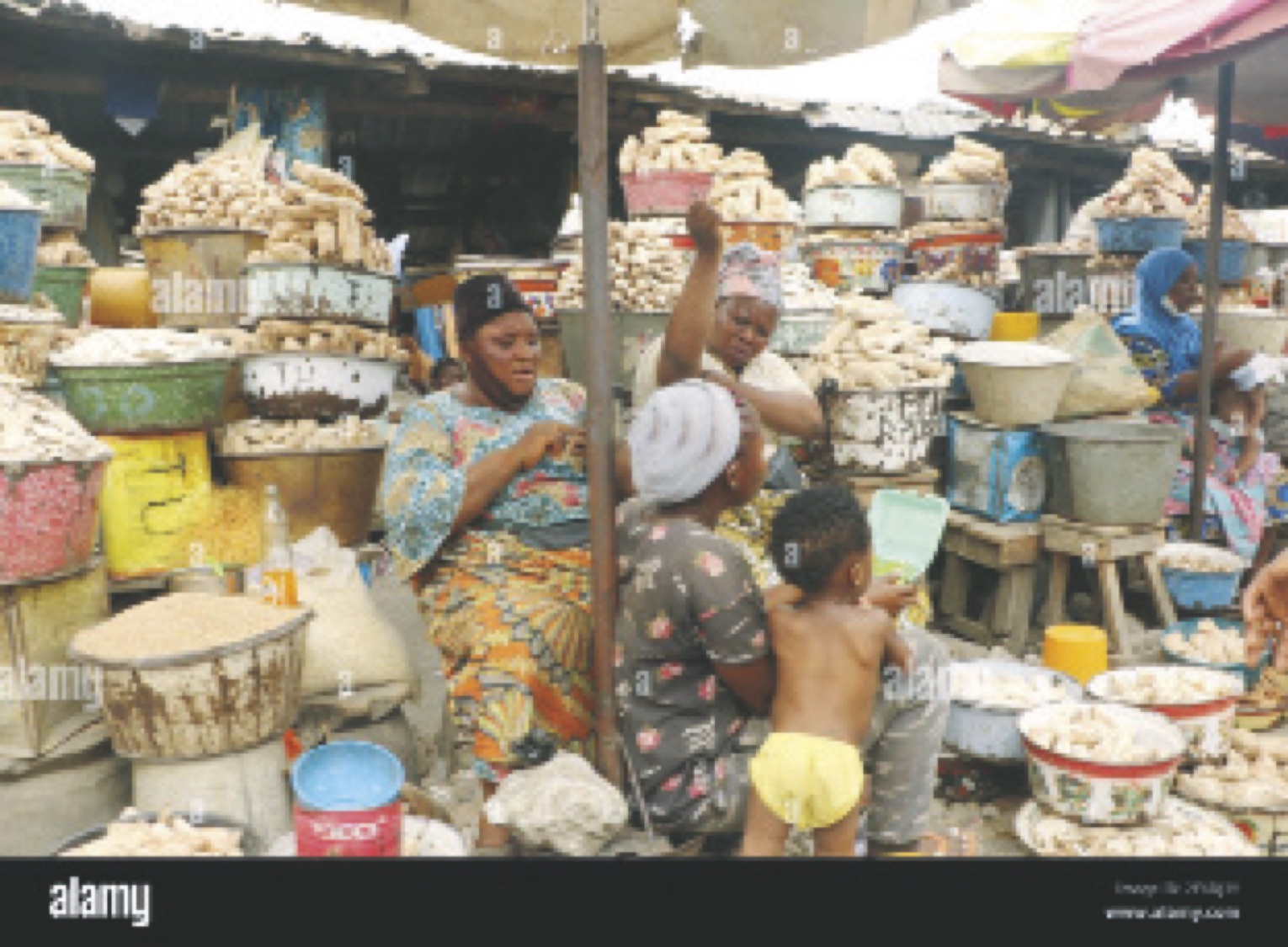
Food sellers in Lagos
The continuous rise in the cost of food items has become a matter of public concern. Nigerians have continued to groan and complain, as millions of households are unable to afford basic items, including food items.

Bags of rice on display
This has led to protests in some parts of the country. On Monday through Tuesday, some angry youths and women took to the streets of Minna, the Niger State capital and Kano to protest what they described as the rising cost of living in the country. Similar protests also erupted in Ondo State.
Saturday Sun went round some of the markets in Lagos to do a survey on the coast of food items. The discovery was shocking.
A bag of rice now cost N70, 000. The price rose from N8,000 few years ago stealthily until it got to the current price. A paint of rice starts from N6,000 to N6,5000 instead of N5,000 it was sold before now, depending on the brand.
A paint bucket of beans now goes for between N4,500 to N5,000 depending on the specie also. It was once sold for N4,000, and a derica cup was N250. Today, a derica of beans is N800.
Garri used to be regarded as very cheap. That has changed, and has also become the food for the rich. A paint bucket has risen to between N1,800 and N2,000, instead of N500 it used be.
Other food items such as groundnut oil, red oil, fresh tomatoes and pepper are not left out in this price hike. Four litres of groundnut oil has risen to N7,500 instead of N7,000 that it used to be, while a bottle is now sol for N1,300 as against N1,000. Same thing goes for red oil.
A mini basket of tomato is sold for 12,000, N10,000, or N9,000 depending on the day. A tomato seller at Ijesha market told Saturday Sun that the days of the week determine the price most times. “Tomatoes are usually cheaper during the early days of the weeks than weekends,” she hinted.
For fresh pepper, the price goes for between N2,000 and N2,500 for a paint bucket.
Yams and plantains grown locally in the country are not cheap either. A bunch of plantain starts from N3,000 to N5,000, depending on the size.
A small tuber of yam which could be sold at N300 then, is nothing less than a N1,400 now, while the big sizes goes for between N2,500 and N3, 000
Bread, regarded as the staple food for the masses, has immensely increased in prices. A loaf of bread that cost N30 is now sold at N1,000 now, while some go for as much as N1,700 per loaf.
A visit to where beverages are sold also revealed a high cost of items. Prices of small pack of different types of refill milk, range from N1,800 to N2,200, as against N1, 500. A customer told Saturday Sun that the price of her baby milk she bought for N3,000 barely a week ago, has risen to N3,500. “Initially I thought he was joking because he is my customer, not knowing that he meant it. Prices of items increase everyday”.
She called on the government to see how the prices of things can be regulated.
A man who gave his name as Bolaji in Ikotun market, Lagos lamented the effects of the high cost of food items on his family, and called on the Federal and State governments to do something urgently to save the situation. “People are dying of hunger. The economy is really bad. Nothing is moving in terms of business. Some sick people cannot afford to buy the needed drugs. It is a terrible situation.”
Ngozi Okafor, a teacher, observed that even vegetables such as Ugu, green, saint leaf, others, are even expensive. “At times I wonder why our local veggies are expensive. It is difficult to prepare vegetable soup now because of high cost of vegetables. One of the sellers told me that the problem is the cost of transportation from where they buy it, to the market.”
Another man at Ikotun market, Lagos who pleaded anonymity stressed the need for the federal government to take action to reduce the hardship being faced by the poor Nigerians. “Things are becoming unbearable. Most workers are still earning the same salary since four years ago. We all buy from the same market. Something drastically must be done to save this ugly situation.”
The government has stated, however, that it is not folding its arms, watching while the masses die of hunger. For instance, soon after arriving back in the country from France, President Bola Ahmed Tinubu ordered an emergency meeting on how to solve the food crises.
Minister of Information and National Orientation, Muhammed Idris, who spoke after the meeting of the Special Presidential Committee on Emergency Food Intervention, directed by President, Tinubu, and chaired by the President’s Chief of Staff, Femi Gbajabiamila, at the Aso Rock Villa, Abuja, said it was a special presidential committee to address the issue of food shortage or lack of enough food on the table of most Nigerians. He stated that the President directed that government needed to step in to stem this tide because the government would not fold its arms and see how Nigerians are suffering regarding the availability of these food items. “So, I want to plead with you to understand with the government. By the time these meetings are concluded, we’ll be able to issue a definite statement on the government’s position in this regard. But all I can say is that discussions are ongoing, and very soon, a solution is in sight for Nigerians”, the minister said.”
Meanwhile, the Lagos State Government has commenced a partnership programme with Niger and Kwara states towards bridging food supply-demand gaps under the “Produce-4-Lagos initiative.”
The initiative is geared towards stemming the food inflation and ensuring youths are actively engaged in agriculture and more importantly on how to scale food production.