Follow Us on Google
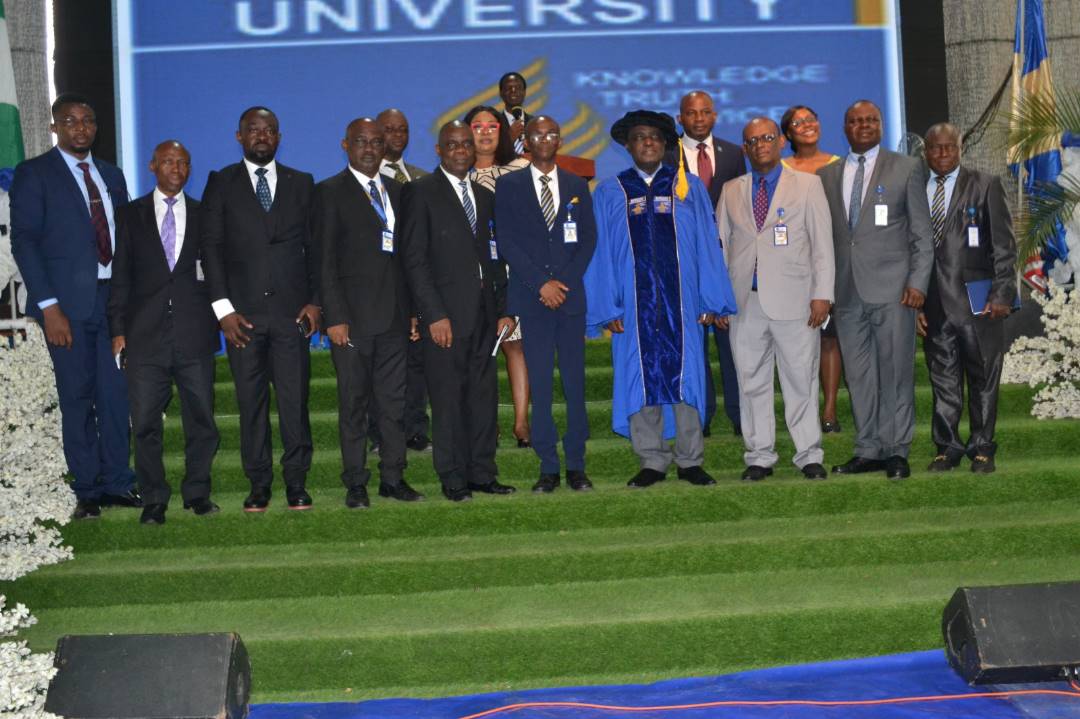
Nigeria’s universities are in a position to provide at least 40 per cent of the solutions to the country’s challenges and the attainment of the Sustainable Development Goals (SDGs).
Former Executive Secretary of National Universities Commission (NUC) Professor Peter Okebukola stated this while delivering the 2023 Convocation lecture of Babcock University (BU), Ilishan-Remo, Ogun State.
In a paper titled: “From Tangible to Virtual Reality: Redefining the Nigerian University System,” Prof Okebukola stressed that the pathway to achieving this 40 percentage was by strengthening research capacities of the universities’ staff through in-country and international training experiences, better resourcing of research laboratories and workshops, and provisions of sizeable grants for quality research.
If these enablers are not in place, he said, Nigerians should not turn round to accuse the universities of irresponsibility to the country’s needs.
Okebukola explained that while the past and present were the tangible, the future was the virtual reality. He said the future of university education in Nigeria needed quick-fix interventions based on a gap analysis conducted over the last two months by his group of scholars.
He said access into university must emphasise more on the primary and secondary schools to get better inputs into universities. Of what use are weak, very weak primary and secondary school products for our universities? he asked.
According to him, if the foundation of Nigeria’s education system was strengthened through better quality primary and secondary schools, many of the quality challenges now being faced at the university level would cease to be.
Strengthening basic education mean, he said, is getting all the out-of-school children into school.
“It means resourcing our primary and secondary schools to better deliver quality education. This includes engaging better-quality teachers in the right numbers, paying them well and exposing them to continuing professional development,” he pointed out.
Prof Okebukola said it was only when there is assurance of an improved basic education being put in place by such actors as local governments, Universal Basic Education Commission (UBEC) and state governments that there can be some guarantee of improved inputs into the university system.
“I am convinced that if by 2024 such guarantees are gradually in place, in another five years, our universities will begin to witness a stream of better quality inputs from the secondary system,” he said.
On the future of quality in the university system, Okebukola noted that “quality is driven by a multiplicity of factors including the curriculum, teacher quality and motivation, curriculum delivery, quality of governance, and quality of resourcing.
“Happily, NUC now has in place the Core Curriculum and Minimum Academic Stadards (CCMAS) with 30 per cent content from each university to reflect institutional uniqueness. This leaves us with several other quality variables which we should attend to with greater vigour in the next five years,” he explained.
He praised the Vice Chancellor, Professor Ademola Tayo and his management team for the progress the university was making.
“In physical development, academic development, quality of staff and quality of graduates, this university has made stunning progress,” he said.
Further, he said, “Prof Tayo has been outstanding; he is likened to still water that runs deep in the horizon of quality university education. He is not a noise-making VC but a performing VC.”
On the university, he said that the data NUC shared with him before coming “confirm that Babcock is easily in the top-tier of the 263 universities we have in Nigeria today. Tangibly, you are the best. Virtually, you are the best. You are currently running 37 undergraduate programmes and none, absolutely none has NUC denied accreditation. Only one is in interim status making your score 97.3 %. This is laudable,” he said.
Earlier, the VC described Prof Okebukola as one of the finest intelligentsia Nigeria is blessed to have.
“Every nation has a message to deliver. Nigeria has a message and mission. Together we can figure out how to assist our country to be greater,” Tayo remarked.