Follow Us on Google
By Damiete Braide
As the literary world awaits the announcement of the 2026 Nigeria Prize for Literature winner later today, October 9, three poets have emerged as powerful voices confronting Nigeria’s troubled past, uncertain present and possible future.
The finalists, James Ngwu Eze, Ogaga Ifowodo and Tares Oburumu, were selected from 223 poetry submissions for this year’s edition of the prestigious prize, sponsored by the Nigeria LNG Limited (NLNG).
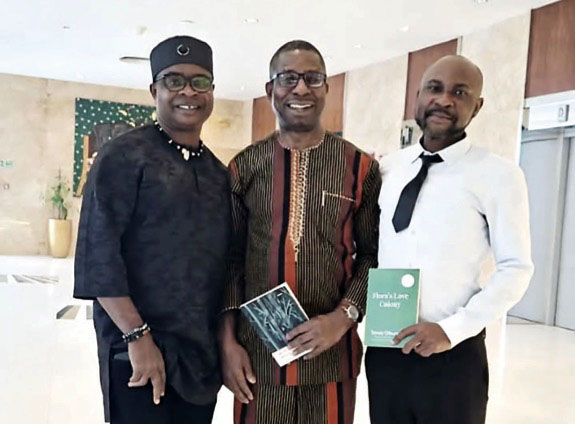
Eze’s Unbind Me Now, Ifowodo’s Why Does God Need a Gun? and Oburumu’s Flora’s Love Colony have brought three distinctive perspectives to the competition, exploring insecurity, religious intolerance, identity, colonialism, freedom, leadership and the enduring struggles of ordinary Nigerians.
The winner will receive $100,000, making the Nigeria Prize for Literature one of Africa’s most valuable literary prizes. The winner is traditionally announced in October, coinciding with the anniversary of NLNG’s first LNG export in 1999.
For the three finalists, however, the significance of the prize goes beyond the financial reward. Their works represent attempts to preserve memories, question established narratives and give expression to experiences that are often ignored or silenced.
For Ifowodo, poetry is first and foremost about craft. The message, he said, becomes meaningful only when it is carried by effective artistic expression. His collection Why Does God Need a Gun? confronts religious extremism, violence and intolerance through a wide-ranging poetic examination of events from Nigeria to the Middle East.
One of its central figures is Leah Sharibu, the schoolgirl abducted by Boko Haram terrorists, who became a symbol of courage and religious persecution. Through poetry, Ifowodo seeks to restore her agency and ensure that her story remains alive.
The collection also reflects on the attack on author Salman Rushdie, the Israeli-Palestinian conflict and the dangers of religious fanaticism. In another section, Ifowodo examines the exploitation of faith by religious figures who prey on their followers.
For him, the central question is how human beings can claim exclusive ownership of truth and use their beliefs to deny others the right to exist. Ifowodo, who described the collection as his sixth, said it took roughly two and a half years to move the poems from initial ideas and impulses into completed works. He said his writing process often begins with an image, phrase or line that gradually develops into a poem.
He remains committed to poetry, describing writing as an integral part of his life. Even after studying and practising law before returning to literature, he said his head and heart ultimately belonged to writing.
Oburumu’s Flora’s Love Colony, meanwhile, turns to history and colonialism. The collection examines the origins of the name Nigeria and the role of Flora Shaw and Frederick Lugard in the naming and amalgamation of the country.
Other News
Oburumu said he was motivated by what he considered a gap in the artistic representation of Nigeria’s history. His research led him to Flora Shaw and eventually to the realisation that the story surrounding Nigeria’s name and colonial formation deserved to be explored through poetry.
The collection traces Nigeria’s journey from the pre-colonial era through the slave trade and British colonial rule to independence and the present day.
Oburumu argues that the patterns of domination have not disappeared. Instead, they have changed form, with political elites and other powerful interests continuing to exercise control over disadvantaged Nigerians.
He also examines the continuing influence of colonial culture, including language, dress and the attraction of foreign lifestyles. For him, the current wave of migration, popularly known as “japa,” reflects a deeper crisis of identity and a desire for mental emancipation.
Eze’s Unbind Me Now takes a more confrontational approach, presenting poetry as a vehicle for anger, protest and collective memory. Inspired partly by Christopher Okigbo’s famous invocation, “O mother earth, unbind me,” Eze said he deliberately set out to write about Nigeria’s pain, insecurity and social contradictions.
The collection captures what he described as a period when violence, poverty and absurdity had become normal features of everyday life. His poems address the killing of civilians, attacks on teachers, human rights struggles and the condition of young Nigerians facing an uncertain future.
Eze said he felt compelled to speak for people whose voices had been drowned by circumstances beyond their control. His poem “Voice of the Streets”, for instance, gives expression to the experiences of ordinary Nigerians, while “Burning Flag” confronts the violence that has scarred the nation.
Yet Unbind Me Now is not simply a catalogue of anger. Eze said he deliberately used strong metaphors, call-and-response structures and elements borrowed from Catholic litany and responsorial forms to make the poems participatory.
He also ensured that many poems moved from intense emotion towards some measure of hope, arguing that poetry should not leave readers trapped in despair.
His concerns extend to the growing desire among Nigerians to leave the country. In Wanderlust, he questions whether migration should simply mean abandoning Nigeria or whether those who leave should eventually return with knowledge, values and resources capable of rebuilding the country.
On the D-Day for the award of the prize, October 9, the three collections stand not merely as competing entries but as distinct literary testimonies to a nation wrestling with its history and searching for a better future.
Whether through Ifowodo’s interrogation of faith, Oburumu’s excavation of colonial memory or Eze’s angry call for freedom, the finalists demonstrate the power of poetry to confront difficult truths and ensure that Nigeria’s present will not disappear without a record.