Follow Us on Google

ADC demands probe of $4.5m contract, Atiku seeks release of President’s unedited interview • Atiku’s US lobbyist disputes Congress endorsement of Obi, NDC candidate denies seeking foreign backing
By Beifoh Osewele
A widening row over American lobbying activities has embroiled President Bola Tinubu and opposition presidential candidates, Atiku Abubakar and Peter Obi, in separate political disputes, raising questions over foreign influence, the use of public funds and claims of international endorsement ahead of the 2027 general elections.
While the African Democratic Congress (ADC) has demanded an investigation into a $4.5 million lobbying arrangement involving the Federal Government, Atiku has challenged Tinubu to release the unedited recording of his interview with American political consultant Diana London and disclose the terms of the contract.
Obi, on his part, has dismissed claims that he sought or secured the endorsement of the United States Congress during his visit to Washington, following a public challenge by an American lobbying firm engaged by Atiku.
The former Anambra State governor and presidential candidate of the Nigeria Democratic Congress (NDC) has insisted that his meetings with American lawmakers and other influential figures were aimed at strengthening Nigeria’s democratic institutions, addressing security challenges and promoting national development rather than soliciting foreign political backing.
“As I expressly noted in my remarks, my visit to the United States was not intended to secure an endorsement, and I did not characterise my meetings as endorsements of my political aspirations by the US Congress or any of its members,” Obi declared yesterday.
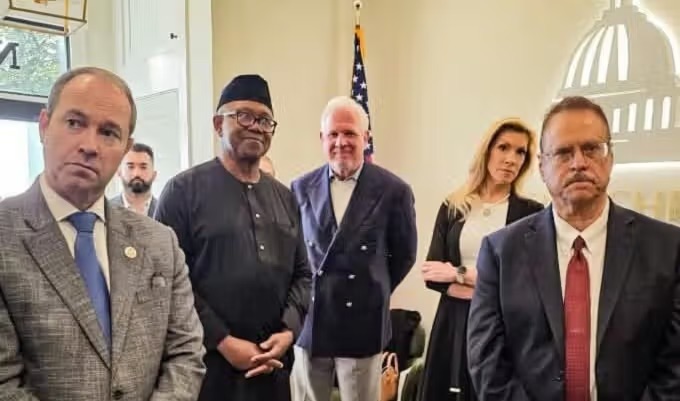
His clarification followed a statement by Karl Von Batten, principal of Washington-based Von Batten-Montague-York, who disputed reports suggesting that Obi’s engagements amounted to an official congressional endorsement.
Von Batten, whose firm is engaged by Atiku, maintained that the event attended by Obi was a private gathering involving individual American political figures and not an official meeting of Congress.
“Congress did not meet with or endorse Mr Obi. The event he attended was private, and no one in the video is a member of the House Foreign Affairs Committee or its Subcommittee on Africa,” he said.
The separate disputes have placed the international engagements of Nigeria’s major political actors under scrutiny, particularly the distinction between paid lobbying, private meetings with foreign lawmakers and official institutional endorsements.
At the centre of the controversy involving Tinubu is an agreement signed in December 2025 between Washington-based DCI Group and Aster Legal, a Nigerian law firm engaged in connection with the Federal Government’s efforts to communicate its security policies to American officials.
Documents filed under the United States Foreign Agents Registration Act (FARA) indicated that the agreement provided for a monthly retainer of $750,000, amounting to $4.5 million for an initial six-month period, with a provision for renewal that could raise the contract’s total value to $9 million.
The arrangement was intended to communicate Nigeria’s efforts to protect Christian communities, address security concerns and sustain American support for counterterrorism operations.
The controversy intensified after London, whose company was linked to the lobbying engagement, recorded an interview with Tinubu at the Presidential Villa, Abuja, and subsequently deleted social media posts praising security cooperation between Nigeria and the United States.
Photographs of the engagement showed Tinubu seated with the American consultant, with Chief of Staff Femi Gbajabiamila also present.
The interview was publicly confirmed by Imran Muhammad, Senior Special Assistant on New Media to APC National Chairman Nentawe Yilwatda, who announced that the recorded conversation would be released soon.
“President Tinubu has held an exclusive interview with Diana London, a prominent American media personality. The interview is anticipated to be released soon,” Muhammad wrote in a social media post.
However, the publicity surrounding the interview has not resolved questions about the lobbying agreement, the source of its funding or whether London’s engagement with the President formed part of the services covered by the contract.
As of last night, no verified statement from the Presidency had been established directly addressing the demands by Atiku and the ADC for disclosure of the contract, relevant payments and the circumstances surrounding the interview.
In a statement issued by its Director of Media and Publicity, Kola Ologbondiyan, the ADC Presidential Campaign Council questioned the government’s priorities, arguing that Nigerians deserved an explanation of the expenditure at a time of widespread economic hardship.
“At a time Nigerians are groaning under hunger, insecurity, failing public institutions, unpaid salaries and an unbearable cost of living, the reported expenditure of $4.5 million — running into billions of naira — on foreign image management raises serious questions about the priorities of the Tinubu administration.”
The opposition party demanded disclosure of the source of the funds, the officials who authorised the transaction, the contractual obligations involved and the services rendered.
It also sought clarification of the role played by the Office of the National Security Adviser in facilitating the arrangement.
“This is not merely a public relations issue. It is a matter of accountability, transparency and responsible governance,” the statement declared.
The ADC called on the National Assembly, the Economic and Financial Crimes Commission (EFCC) and the Auditor-General of the Federation to investigate the expenditure and make their findings public.
The party argued that foreign lobbying could not replace effective governance or address the economic and security challenges confronting Nigerians.
“You cannot polish failure. You cannot lobby away hunger. And you cannot buy credibility abroad when you have lost the trust of your own people at home,” the council said.
Atiku, in a separate statement issued through his Director of Strategic Communication, Phrank Shaibu, also challenged Tinubu to explain the circumstances surrounding the interview and submit himself to similar questioning by Nigerian journalists.
He questioned whether London’s engagement with the President was an independent journalistic exercise or part of a government-sponsored communications arrangement.
The former Vice-President demanded publication of the lobbying agreement, disclosure of relevant invoices and payments, identification of those who authorised the expenditure and release of the complete, unedited recording of the interview.
He argued that Nigerians deserved answers from the President on the rising cost of food, transportation, wages and other economic difficulties rather than what he described as a favourable interview conducted by a foreign consultant.
“Who authorised the $4.5 million payment, and from which public account did it come? At a time when Nigerians are told to endure the pain of fuel subsidy removal, they deserve to know whether the money saved is being spent on foreign publicity,” he said.
Atiku also questioned the presence of a large screen positioned within Tinubu’s line of sight during the recording, suggesting that it might have been used to display prepared prompts.
He challenged the Presidency to release the full recording, including what appeared on the screen, to establish whether the President answered questions spontaneously.
The former VP maintained that Nigerian journalists were capable of conducting rigorous interviews with the President, naming Rufai Oseni, Ojy Okpe, Seun Okinbaloye and Reuben Abati among those who could question him on pressing national issues.
“Tinubu cannot ask families to suffer in silence while millions of dollars are committed to polishing his image. Publish the contract. Show the invoices. Release the unedited interview. Then face Nigerian journalists and answer the people,” Atiku declared.
The lobbying arrangement followed diplomatic tensions arising from allegations of religious persecution in Nigeria and the decision by United States President Donald Trump in November 2025 to designate the country as one of particular concern.
The Tinubu administration rejected suggestions that it was deliberately tolerating attacks on Christians, maintaining that terrorism, banditry and communal violence affected Nigerians across religious and ethnic divides.
The Federal Government subsequently intensified diplomatic engagements aimed at explaining its security policies and strengthening cooperation with Washington.
Against this background, Aster Legal engaged DCI Group under an agreement signed on December 17, 2025, by the Nigerian firm’s Managing Partner, Oyetunji Olalekan Teslim, and DCI Group Managing Member, Justin Peterson.
Further disclosures linked London Global Strategies, a company headed by Diana London, to payments made by DCI Group in connection with the Nigerian engagement.
According to records reported by TheCable, DCI Group disclosed payments of $75,000 and $375,000 to London Global Strategies on December 23, 2025, bringing the total to $450,000.
Although the filings establish a financial relationship between DCI Group and London’s company, they do not establish that the entire $4.5 million retainer was paid to London personally or that her interview with Tinubu was commissioned for that amount.
The distinction is central to the dispute as opposition politicians demand greater transparency over the contract and the nature of the presidential engagement.
In social media posts subsequently deleted, London praised cooperation between Nigeria and the United States, particularly in the area of security.
“The U.S-Nigeria security partnership is delivering results. Peace Through Strength,” she wrote.
She also described Nigeria as an important American ally in Africa and expressed optimism about opportunities for stronger economic and trade relations between the two countries.
The deletion of the posts intensified questions about the engagement, although no verified explanation had been established for their removal.
Meanwhile, the dispute surrounding Obi’s Washington visit also gathered momentum following Von Batten’s challenge to reports suggesting that the NDC candidate had secured the endorsement of the United States Congress.
Von Batten acknowledged that two serving American lawmakers, Marlin Stutzman and Beth Van Duyne, attended the gathering but stressed that neither belonged to the House Foreign Affairs Committee, which oversees aspects of American foreign policy.
“I recognise Congressman Stutzman and Congresswoman Van Duyne, but neither serves on the House Foreign Affairs Committee. They serve on other committees responsible for the budget and small businesses.”
He also maintained that no official of the United States Department of State’s Bureau of African Affairs appeared in the video circulated after Obi’s engagement.
Von Batten said his intervention was not intended to diminish the significance of Obi’s visit but to correct reports suggesting that the American legislature had officially received or endorsed the Nigerian presidential candidate.
“I am not trying to diminish the significance of Mr Obi’s visit, merely to set the record straight since my firm was mentioned,” he said.
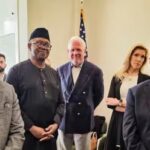
The clarification followed Obi’s announcement on Tuesday that he had arrived in Washington on Monday, November 16, for meetings with congressional leaders and other influential American figures.
The former Anambra State governor identified Stutzman, Van Duyne, former Congressman Todd Tiahrt, Suzanne Bock Grisham and retired United States Army Colonel Albert V. Short among those he engaged.
He said the discussions focused on Nigeria’s development, security challenges, citizens’ welfare and the need to strengthen democratic institutions ahead of the 2027 elections.
Obi also disclosed that he granted an interview to American television commentator Glenn Beck, during which they discussed leadership, accountability and the management of Nigeria’s resources.
Responding to the controversy, Obi maintained that the primary purpose of his visit was to engage American political figures on matters affecting Nigeria rather than seek their endorsement of his presidential ambition.
“The primary purpose of the visit was to engage with congressional leaders and other influential American stakeholders, exchange perspectives, and discuss matters related to Nigeria’s development, the welfare of our citizens and, most importantly, the consolidation of our democracy.”
Obi stressed that particular attention was given to the need for credible elections, accountability and the protection of Nigeria’s democratic institutions.
“I am especially concerned with strengthening democratic institutions, advancing accountability, and ensuring that Nigeria’s electoral process produces elections that are free, fair, transparent and credible. These matters should concern every Nigerian who is committed to our country’s future.”
Obi maintained that constructive international engagements were important to strengthening Nigeria’s democracy and urged political leaders to pursue similar discussions with foreign stakeholders.
He cautioned against sensational interpretations of his visit, insisting that his mission was not to obtain foreign political backing.
“Nigeria’s democratic future is far too consequential to be distorted by sensational headlines or inaccurate interpretations. My mission centred on Nigeria, its people and the future of our democracy—not on endorsing any individual,” he said.
His media office also issued a clarification signed by Indris Zekeri Jnr., stressing that the former governor had neither sought nor claimed the endorsement of the United States Congress or the American government.
The office acknowledged that some American political figures made favourable comments about Obi’s leadership record but maintained that such remarks should not be interpreted as an official endorsement.
It also stressed the distinction between meeting individual members of Congress and being formally received or endorsed by Congress as an institution.