Follow Us on Google
• FG should monitor excess huge state, LG allocations
From Ogbonnaya Ndukwe, Aba
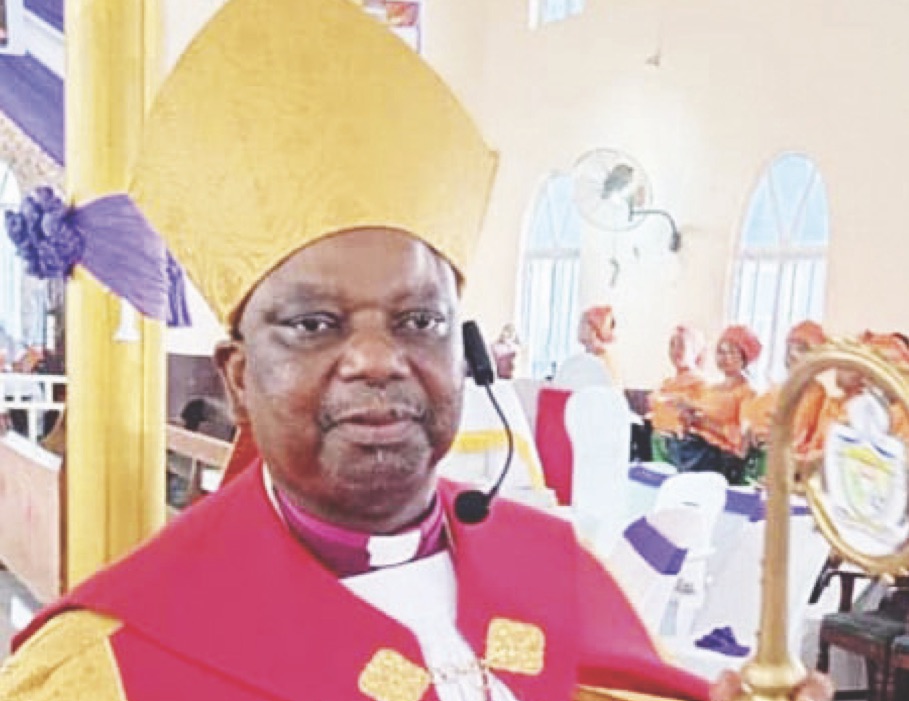
Archbishop of Aba Ecclesiastical Province and leader, Southern Nigeria Bishops Conference (Anglican Communion), Dr. Isaac Nwaobia, has called on states and local governments to utilise the huge allocations they now receive to impact on Nigerians living in hardship and poverty. Thanking God for blessing the country, he said leaders should do well by engaging their conscience as judge while in governance. Nwaobia urged leaders to shun ethnic and religious sentiments for Nigeria to attain nationhood.
Do you agree with President Tinubu’s 65th Independence Anniversary statement that the country is actually moving towards greatness?
I want to thank God for the nation called Nigeria, whatever agreement that led to the amalgamation is not my concern rather, I want to give glory to God for blessing this nation. In the first instance, when one travels round the globe, he or she will see that Nigeria is blessed. We have good weather; we are blessed by green leaves. We have no emergencies in the context of volcanic eruptions. We are blessed with different colours of people of diverse ethnic groups, therefore, thank God for attaining 65 years of independence. Sixty-five years is not a small thing. A man of 65 years should be a grandfather while a woman of same age must have attained menopause. We thank God that Nigeria is sharing in the greatness. For me, I really regret that the country is still grappling with the nitty-gritty of good governance. That ought to have brought a lot of celebrations for a day like this. I am not just talking about the federal government now. I am talking about the 36 states, including the Federal Capital Territory (Abuja) and the 774 local government areas spread across the country, the three-tiers of government. When one considers their activities, he or she will know that we are really in trouble. The presidency, through its organs, is saying they have done well. I don’t know where they are getting the assessment from. Too many things are not there in place for the poor masses. The issue is about hardship and poverty that is everywhere in the country – people cannot afford meals to eat. This is a major challenge. The economy is not growing though it may grow in their hands, in their computers. To us here, they are not being reflected into actions on ground. For instance, a donation of N25 million was made during an event and people clapped and clapped, but when I calculated to find out its dollar equivalent, it came to $16,000. If a family of four from Nigeria is going on vacation to the United States of America, it will not be enough to procure their flight tickets. So, that is the way I judge Nigeria. When labour unions say they have N70,000 as minimum wage, when translated, it comes to $42, and we know sincerely that a plate of food in the USA is about 50 dollars. So, the monthly wage of N70,000 in Nigeria, cannot buy a plate of food in America. Here in the country that is what is paid to people to work for one month. How can that person survive in the midst of healthcare, family, domestic, issues, accommodation and transportation? I came up with this assessment here to show that we are not really there. Nigerians are really gnashing their teeth to survive. It is a problem and difficult to live, in view of the current situation in the country.
Well, the presidency too, has done well to remove the subsidy paid on petroleum products by the federal government and translating the money to the states and local government councils. However, it does appear that there is no follow-up to know if the money being pushed to them is reaching down to the masses. This is another side of the increase in the hardship being suffered by the people. If a local government head was receiving N40 million as allocation last year and now gets between N250 million and N300 million or thereabouts and people are not feeling the impact – they can’t pay salaries, repair or build feeder roads; the question would be on how the people are being accommodated. How do we get the dividends of democracy? We get it through the local councils where we reside. We shouldn’t wait for the presidency to come down to do our feeder roads, rebuild our schools and health facilities. I am thinking that even the presidency is failing in the area of conducting follow-up to monitor what the huge excess monies being pushed to the states and local governments are being used for. This is very important. How do they push money, drop it in the air, without knowing what it is being used for, no accountability? They should follow up to know where the impact of the funds has gone to, what it is being used for.
What would you advise the federal to do in this instance?
I want to advise right now, that the presidency should go back to the drawing board and set up a monitoring team that will follow-up on how the funds are utilised to ensure that they impact the people at the grassroots. I’ll give an example here. When Late Gen. Sani Abacha was Head of State, he set up the Petroleum Trust Fund (PTF) then headed by the late President Muhammadu Buhari. The monies realised into the fund were used as intervention to rehabilitate national and local infrastructure such as roads, health institutions with drugs made available in hospitals across the country. Schools, including major tertiary institutions, were also upgraded with modern facilities and this brought benefits to the people as no part of the country, including rural communities, were left behind. Even scarce food items were acquired by the government and made available at very moderate prices to citizens. What we are seeing in the present dispensation is an urbane arrangement where the rich are getting more money. The politicians, governors, council chairmen and legislators, are becoming richer while the masses get poorer and are left to starve to death. Like I said earlier, Nigeria at 65, we are not yet there.
You want the federal government to play a supervisory role in monitoring what state and LG funds are used for, how they are spent. Does this not infringe on the rights of these other tiers of government – the state and LGA?
It is said that he who pays the piper, dictates the true. If the Federal Government decides to move money, I mean extra money to the second tier and third tier governments, it should develop the responsibility of seeing that the money is spent properly in the areas of benefit to the masses. They should ensure that such funds are well utilised. It is proper to tell the states and LG heads to account for the money, the areas of need they were spent in and the beneficiaries. We need critical infrastructure in rural communities and the local councils are positioned to handle such projects. Our leaders should work according to their conscience which ought to be their judge. They ought not to be people eating and stashing money away while their brothers and sisters are starving. They cannot be left using public money to be maintaining their families, sending their children to schools abroad while their people are enmeshed in hardship.
In an earlier interview you said regional fiscal arrangement will not solve Nigeria’s developmental problems but more voices including prominent individuals and groups are calling for it. What do you say to that?
Yes, let me use the issue of having state police to answer the question. To me, both of them are on the same path as they will be working on regional basis. My disagreement, anyway, lies in the fact that we will see those at the helm of affairs as our brothers, cousins and so on, unlike where there are nationally based. With what is happening now, a man from Zamfara State becomes the Minister of Petroleum Resources which is derived from the Niger Delta. As soon as he gets appointed, his aim might be to channel the proceeds of such office to his people who would be jubilating for having gotten their own share of the national cake while those from the area where the mineral is produced will be gnashing their teeth for being impoverished despite providing the goose laying the golden egg. Also, a situation where our Igbo brother becomes Minister of Agriculture and he goes to Benue, collect the food produced and divert them to his place. In today’s Nigeria, every ethnic group is fighting, angling to outmanoeuvre the rest. This does not make for national unity. Until we begin to live above ethnic groups and religious sentiments, this country will not be free. There’s nothing wrong with having regional governments in Nigeria, but I’m thinking that we are not yet mature for it because the same people misruling us presently are those that will want to govern us in the regions. If we now make the state police for instance, the governors might look at their political opponents and enemies and use the force to harass them. Even the little thugs they call local security outfits are being used to manipulate the masses and knock their enemies and go away with it.
But we have the Federal Character Commission which ought to maintain national spread in office sharing at the national level. Can’t they take care of the anomalies you spoke about?
Like you likely mentioned, the commission was set up to ensure national spread in appointments into federal offices, including sensitive ones. But they have not lived up to the expectations of Nigerians. Certain groups are more favoured in their activities, giving rise to questions if the commission actually exists or was set up for a particular group of tribes to the exclusion of others. They were supposed to manage checks and balances in these areas but when we refuse to do things the proper way our problems continue to multiply. That’s where we are now.
Ahead the 2027 general elections, a Yoruba man has been appointed to replace Mahmood Yakubu as INEC Chairman. In view of what happened in 2023, do you think that the new helmsman will hold his head to conduct a free, sincere election given the fact that the incumbent president is also Yoruba and contesting for a second term in office?
The answer is emphatically no because if I should review my personal experience on the 2023 elections with Mahmood Yakubu as INEC Chairman, that was the worst election ever held in Nigeria. My analysis is that this is a man that looked very innocent, eloquent. An assignment was committed into his hands. He came out to tell us that he will do it. Meanwhile, one cannot forget Festus Okoye, the INEC Information and Political Educator then. They both convinced us, asked for money which was approved and made available promptly to them. After building our hopes for a free, fair and sincere election, they now conducted three elections in one day. Two went out smoothly but on the other, we were told there was a glitch. Now, up till today that glitch has not been explained to Nigerians – what caused it, who were responsible and so on. Even foreign observers who had different opinions on the outcome had been silenced with no explanation on what actually happened. On their part, the authorities, our national institutions have not questioned anyone on what happened nor arrested those involved in the scam. That had dampened the minds of Nigerians at home and in the Diaspora on our electoral process. Whether one calls it FEDECO, NEC, INEC or SIEC in the states, we are all Nigerians and know that they have always compromised in handling this singular, honourable duty to their fatherland. We are though not expecting a 100 per cent success in election handling, but expect at least 70 or 80 per cent in returning results. The other can be attributed to human error amidst frailties involved. But a situation in which one promises the nation to conduct electronic voting and midway turns to impose manual system is an assault to our entire psyche. It is not a good order and bizarre for us as a nation. We are not happy about it. To me, a Yoruba man will not be able to conduct free and fair elections ordinarily. I studied in Yoruba land and know their spirit. I know their attitude and if confirmed, such an individual will not be able to conduct a free and fair election sincerely, without narrowing it to his own area. The only thing is that we should look at the procedure of appointing the chairman. This has to be re-examined. Do we now put the person on trial or do we now pass through the Senate – National Assembly? Also, do we call on traditional rulers or use other traditional means for the gods to tell us who should be chosen, who will be sincerely independent. If our electoral organ is not independent, we are not expecting any positive results.
INEC, as a national institution funded by the people’s money ought to be effective, holding out with pride in its independence. We at this time need to look and re-examine our structure as a nation. It is a disaster that we copied the American Presidential system of government but fall short of institutionalising the organs that distinguish their offices as working for the citizenry, the people and not political office holders. Some other countries including those in West Africa are doing different things, with some using parliamentary while others mix the two to suit their needs. In our clime, we can evolve the two – quasi presidential with legislators becoming ministers who will implement the budgets passed in the Assembly. Such legislators can hold sessions on part time basis or say twice or three times a week. Imagine legislators engaging in what they call oversight visits to stationary government establishment during which money is given them and hotel accommodation expenses paid by heads of such offices failing which they are found to have defaulted and not doing certain things well. It is disheartening that after approving specific budgets for projects’ implementation, the functionaries are coerced by the so-called oversight committees to use part of the money to host and sponsor such visits. This should be discontinued.
Finally, let’s come down to Abia to ask if we should celebrate at this time and why?
We need to celebrate. Yes, not just that Gov. Alex Otti is at the helm and seems to be doing well at the moment. To me, those that held offices in the past had worked for the state, they laid the foundation of the state. In 1979, we had nothing in the old Imo State, there was no House of Assembly, structures began to be built including government offices. Local government councils also started setting up infrastructure with the above, I won’t just stand to condemn our past leaders. From 1999, Abia was just like a newly born baby and with time, one can identify where to find apparatus of government before Gov. Otti came. Having contested election in 2015 and 2019, he saw the weakness of his predecessors in areas they did not do well and decided to fill the gap. He saw the immediate need of Abians which is access roads. The family can build accommodation, drill boreholes for water but good access road to his daily chores is very necessary and that’s what he embarked on and is succeeding. He has also been able to do away with godfatherism in Abia politics and can boldly embark on programmes and projects enunciated by his administration without interference from above. He is looking at the right needs of the people and pursuing them headlong. We expect that the coming year, 2026 will be well for Nigerians. We are not criticising the governments at the federal, state and local governments to destroy them and their leaders rather we are urging them on to continue to do well and look at grey areas to improve and make our society better for all.