Follow Us on Google

By Chinwendu Obienyi
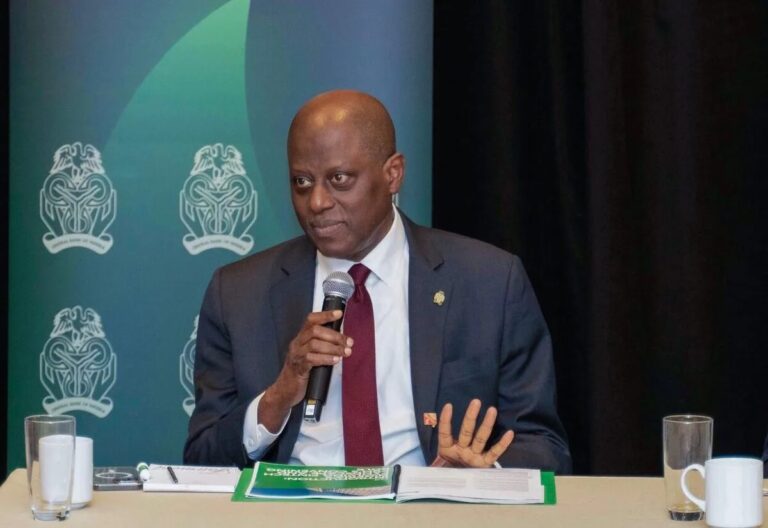
Concerns are mounting as Nigeria’s debt-to-GDP ratio climbs to 51 per cent, sparking fears that the country has exhausted its financial resources to address pressing issues such as inflation, foreign exchange volatility, and unemployment. However, Olayemi Cardoso, the Governor of the Central Bank of Nigeria, holds a different view.
In an interview with Bloomberg monitored by Daily Sun, Cardoso highlighted the critical need to restore confidence in the naira, stabilise the foreign exchange market, and implement consistent and adaptable reforms. He underscored the importance of diversifying Nigeria’s reserve sources and noted that the international market’s positive perception of Nigeria’s economic management was a promising sign that better days are on the horizon.
Currency level
I think it is important to talk about some context in respect to the naira and where we were coming from. You would recall that months ago when I assumed office in September 2023, we really did have a crisis on our hands and the naira was heading in a direction where everyone including the citizens did not like. There was a lot of fear, panic and there was a loss of confidence and trust and we felt it was vitally important that we address those issues of confidence and trust. We felt this was important because as we look at where the naira is today without starting the process of addressing those issues, you would not really come to the right conclusion. There were also FX backlogs that needed to be settled and there was so much level of uncertainty. We basically had to look at the basic things we needed to do to restore confidence and even for local investors not to panic but have confidence in the currency. A number of things were done which included appreciating the fact that there were a lot of distortions within the FX syst§em that did not give people the confidence to invest or keep their monies in Naira as everyone exchanged their currency to dollars. We had to address those with a flurry of different circulars, addressing some to the banks, some to the system and we feel that a number of things have happened. More confidence has returned to the market and a lot of inflows have come back because there was little liquidity at a time and potential players within the market, both on the buy and sell side are more confident in the future. When I talk about the buy side, bear in mind that what used to happen in the past is that people panicked and front loaded their request, this has also calmed down and there is no more inclination to do that as liquidity has come back to the market. Hence, we are relatively pleased with how far we have gotten up to now. In the past two or three weeks after we have seen volatility, we have seen a lot of stability within the market as there has hardly been any movement within the currency. The rates were merged in the past as before we had two different rates but right now, we have more or less one rate and we believe that this is good as it allows companies to plan and again it gives an idea of where the potential road of travel is for people who are in investing in the Nigerian economy, so I am relatively pleased. We do not believe that we are where we want to stay at because we have to continue to work towards that, it is a work in progress and we will do everything to manage the macroeconomic fundamentals that affect that market in such a way that it will improve.
Naira stability
Well, that is a question which I will say depends on a whole host of different issues. I do believe that we have more or less seen the worst in terms of volatility and we are happy that the market is now such that willing buyer and willing seller operate within the market. We are also very alive to observe the way and manner in which the market operates and ensure that it gives the best value that can be accomplished using certain tools. It is also important to mention that the monetary and fiscal authorities work closely together and I believe that that complementarity is what will give us the optimum rate for the naira over a period of time.
Assessment of the fiscal reforms
Well, as you know that these things take time to manifest. For example, even with respect to inflation, the MPC meets to take some decisions and use certain tools and sometimes I feel a little discomfort when I see the outcome especially with the media who sometimes take a view as to where all these decisions will yield fruits and we have to keep explaining that these things take time and sequencing with reforms is also very important as your reform agenda must be properly sequenced to bring the right outcomes. What I do know is that in conjunction with the meetings we have had with the fiscal side and the continuous collaboration that takes place, I believe that Nigeria is on a relatively good track.
Actions
I want to see consistency in what we have been doing and let me be clear on something. No one has monopoly of wisdom, I believe that with reforms, you should be confident enough where you see that certain things are not going in the direction that you expect it to go to be humble and confident enough to say it is not really working, let us treat this in a different way or look at something better to get a greater outcome and I believe that is the view we take and I believe that if we are consistent in continuing to do that, it will be a win-win situation for the everyone.
CBN MPC reform agenda
Again, context is important as the MPC is an independent minded group of people that basically deal with data. So what I will say is that depending on what data they see at a particular point in time will direct their decisions on rate hikes. However, the MPC has been very clear in stating that they see inflation as an impediment to the future of Nigeria and will do everything possible to keep inflation in check and bring it down as reasonably as they can. I do not see that (rate hikes) changing. This is because from what we are seeing, there is a deceleration in inflation rate which is good news and my sense is that with the measures that have been taken in the recent past and the confidence of the MPC members to watch that interest rate trajectory very closely, we should see a continuation of the moderation in inflation rate. Let us watch the numbers but my sense is that the policy committee is determined to ensure that they put inflation under control.
Rate hike looming
Other News
Well, we do need to see what the numbers say but like I said, the recent numbers that came out revealed that inflation is decelerating and there is a moderation in inflation and MPC will do what it needs to do to keep inflation in check.
Toolkits to attract more inflows
I can tell you a toolkit that we will avoid using and we have made it very clear that we do not want to use toolkits that do not follow the orthodox monetary policy stance. We do not want to do that because we believe that with what we have at our disposal, we will use them and we are confident in the ability of checking the scourge called inflation. In terms of liquidity, we have a situation especially on the FX side which is also very critical where we have seen an increase that at the first quarter of this year, we have seen a total inflow of about $24 billion, this is almost about 40-50 per cent more than Q1 2021, so clearly, our measures are having positive impact and we believe that continuation of this trajectory will see liquidity continue to increase. What we need to do is use the tools because I believe that perhaps in the past, it was not used in the manner it was meant to be used and we had a recognition of the huge role that the Nigerian diasporans play in remitting tremendous amount of money into the system over a period of time. We set up a committee which reports directly to me with the goal of doubling the amount of inflows coming from the IMTOs who more or less handle that segment of the autonomous players and already, it is beginning to bring about good results and again, we are confident that with these kinds of measures, liquidity will improve in our FX market.
Capital inflows
Capital inflows are very important and the reason why is that in the case of Nigeria, they pass through from the FX rate into inflation which is quite significant. We believe that this is an area outside of the normal day-to-day operations for NNPC, exporters that will help in closing the gap and so I think it goes a long way in closing the gap. If we are able to achieve our objectives of increasing that supply of FX, it will make a big difference.
Eurobond market
Yes, the CBN supports that and I will tell you the reason behind this. We believe that it is important that in building our reserve position, we should have a diversity of sources, it should not just be the Eurobond market, FPIs, it should be a whole lot of different things. I think as of now, we have access to enough exposure from different areas that can see us through. The problem that Nigeria has from the CBN perspective is that these issues are temporary issues and I believe that as some of the things are kicking, for example, revenue and tax-to-GDP has got to go up and so as these things begin to kick in and some of the focuses that we are having especially doubling remittances, I think that those gaps will be closed.
No need for concessionary financing from the IMF
From where I stand and what I see, we have what it takes from existing sources to close the gap and move the country forward.
Nigeria to access Eurobond before the end of the year
From what I understand what the Finance Ministry is saying, they are watching closely how the market move particularly with respect to interest rates and I guess that at this point in time, the jury is out on that where interest rates are going to head to and I think that this is a reasonable position to take quite frankly that it is important to manage cost and ensure that as you tap into this type of market, you are doing them at a reasonable cost. It is positive that the markets are looking at Nigeria in that way because I will be more worried if for example, we had challenges to access the market. Clearly, that does not seem to be the case as the international markets have seen positive movements in the case of Nigeria, the way it is managing its financial and economic situation.
Role of CBN to FG
Apart from being banked to government, we are also advisers to the government and for us it is important that it does not sit down as a cliché and one of the things we have done is to set up a unit within the CBN whose main focus is to advise the government on issues on a regular basis and we believe that this unit will be a very strong and sustainable way of communication particularly given the fact we deal on data and I think that giving some advice will be useful for the fiscal side.