Follow Us on Google
•Rule of law, judiciary, security, press freedom, legislature, executive, political parties, INEC, citizenry face scrutiny as Nigeria marks 27 years of unbroken civilian rule
By Fred Itua, Juliana Taiwo-Obalonye, Romanus Ugwu, Godwin Tsa, Adesuwa Tsan, Ndubuisi Orji, Fred Ezeh, Okwe Obi, Sola Ojo, Jude Idu, Abuja; Lukman Olabiyi, Lagos; Timothy Olanrewaju, Maiduguri; Femi Folaranmi, Yenagoa; Laide Raheem, Abeokuta; Tony John, Port Harcourt; Tony Osauzo, Benin; Stanley Uzoaru, Owerri
On the 29th of May 1999, Nigeria exhaled. After years of military rule characterised by coups, decrees, suspended constitutions and the suffocation of civil liberties, the country returned to civilian democratic governance with a hope so fierce it felt almost physical. General Abdulsalami Abubakar handed power to Olusegun Obasanjo, and an entire nation permitted itself to believe that a new chapter had begun.
Twenty seven years later, the question that hangs over every conversation about Nigerian governance is a simple but devastating one: what exactly has democracy delivered? The answer, drawn from every corner of the country and every pillar of the democratic structure, is a portrait of a republic that has endured without flourishing, survived without thriving, and persisted without fulfilling the promise that animated its birth.
In this special report, our correspondents drawn from the various states of the Federation, examine the seven pillars of democracy in Nigeria. The report examines the years before Nigeria’s return to democratic rule, the current lived experiences by Nigerians and projections for the future.
The constitution and the rule of law
Before 1999, Nigeria was a country governed not by law but by the whims of men in uniform. General Muhammadu Buhari’s overthrow of the Shagari civilian administration in 1983 inaugurated a decade of constitutional darkness, during which military decrees superseded statute, fundamental rights were routinely suspended and the judiciary was reduced to an instrument of executive convenience.
The annulment of the June 12, 1993 presidential election by General Ibrahim Babangida, widely regarded as the freest and fairest election in Nigerian history, represented perhaps the most brazen assault on constitutional order in the country’s post-independence history. It left a wound on the national psyche that has never entirely healed.
The 1999 Constitution was designed to close that chapter. Enacted to establish a new democratic order guaranteeing fundamental rights and the rule of law, it has since undergone five rounds of alterations. Among the most significant amendments is the “Not Too Young to Run” Act, which lowered the age threshold for elective office and opened the political space to younger Nigerians.
The 2023 Fifth Alteration alone considered 68 proposed bills, of which 46 were approved, covering devolution of powers, financial autonomy for state legislatures and judiciaries, women’s representation and diaspora voting rights. These are not trivial achievements. They represent the slow, painstaking work of a society attempting to improve the institutional architecture of its democracy through legitimate constitutional processes.
Yet, the gap between constitutional aspiration and lived reality remains wide and troubling. The executive and legislature have at various times disregarded constitutional provisions, abused court processes and treated the grundnorm with a casualness that would be unthinkable in more mature democracies.
Judicial independence, particularly in electoral dispute resolution, has faced recurring scrutiny, with the courts periodically appearing to function as extensions of political power rather than independent arbiters of constitutional questions. Some states have granted financial autonomy to their judiciaries, reducing executive influence over court funding, and the National Judicial Council has become more assertive in its supervisory role.
But these are partial gains in a landscape that still requires wholesale transformation. Full financial autonomy for courts, merit-based judicial appointments, transparent processes for the removal of errant judges, and technology-driven case management remain urgent priorities if the rule of law is to mean something concrete in the daily lives of ordinary Nigerians rather than remaining a phrase inscribed in a document that too many of those in power treat as optional.
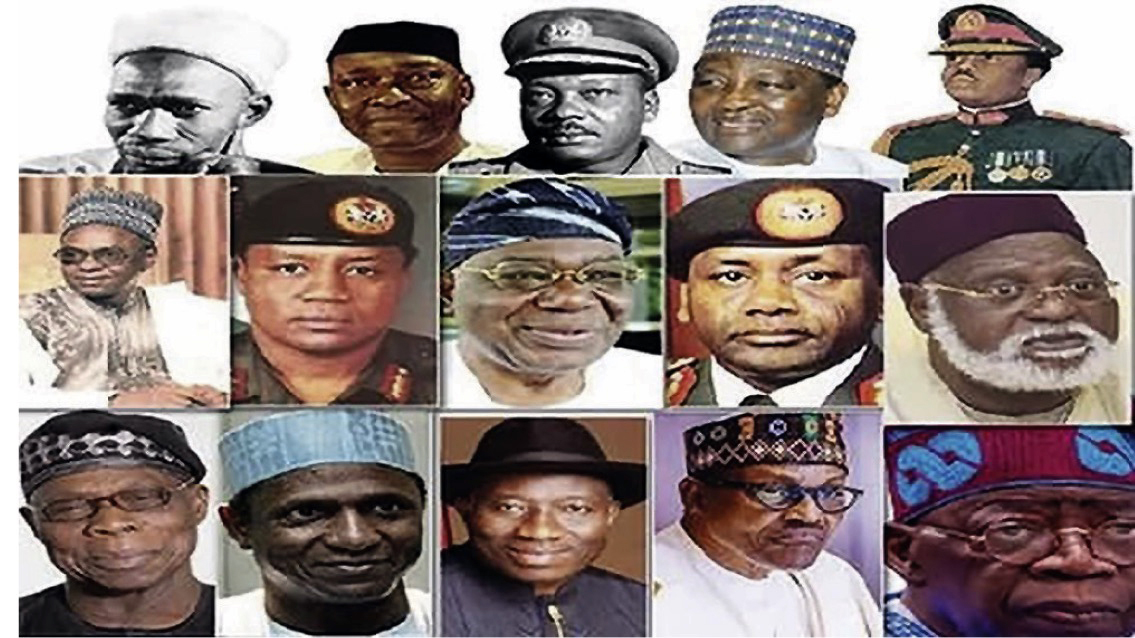
The executive: Five presidents, five experiments in democratic governance
No arm of government has shaped Nigeria’s democratic experience more decisively than the Presidency. Across five administrations spanning 27 years, the executive has been the single most powerful determinant of whether democratic norms advanced or retreated, whether institutions were strengthened or undermined, whether the rule of law was honoured or selectively applied.
Olusegun Obasanjo, who served from 1999 to 2007, stabilised a fragile transition by retiring politicised military actors and making judicial independence a stated priority. His administration negotiated debt relief arrangements that significantly improved Nigeria’s fiscal position and implemented a banking consolidation exercise that transformed the financial sector. Yet, Obasanjo’s era was simultaneously marked by executive overreach of the most blatant kind; anti-corruption drives that appeared selectively applied against political opponents, persistent attempts to influence the legislature and a third-term bid that, had it succeeded, would have rewritten the constitutional rules in the most self-serving manner imaginable. That the National Assembly resisted and defeated that bid remains one of the Fourth Republic’s most important democratic moments.
Umaru Musa Yar’Adua, who assumed office in 2007, brought a markedly different governing philosophy. His emphasis on rule-based governance, institutional respect and the independence of prosecutorial agencies improved the democratic tone considerably. His resolution of the Niger Delta crisis through the Amnesty Programme, which offered unconditional pardon, vocational training and stipends to former agitators, addressed a conflict that had threatened the integrity of the country’s oil-producing heartland for years.
His incapacity and eventual death in 2010 exposed critical gaps in Nigeria’s constitutional provisions for presidential succession, but the eventual resolution of that crisis, imperfect as it was, produced legal clarifications that strengthened institutional protocols going forward.
Goodluck Jonathan, who completed Yar’Adua’s term before winning election in his own right in 2011, presided over a period of relative electoral openness and pursued economic diversification initiatives in agriculture and power. His most consequential democratic act, however, was also his most personal; his concession of the 2015 presidential election to Muhammadu Buhari, a moment that demonstrated to the world and to Nigerians themselves that peaceful alternation of power was possible in Africa’s most populous nation.
That act has rightly been praised as a watershed in Nigerian democratic history. It was, however, set against a backdrop of serious security failures, endemic corruption and a perceived permissiveness towards cronyism that left his tenure’s democratic credentials significantly compromised.
Buhari’s two terms from 2015 to 2023 raised the anti-corruption profile considerably, at least rhetorically, and saw renewed attention to the capabilities and funding of anti-graft agencies. His administration, however, drew persistent accusations of ethnic and religious nepotism in appointments, heavy-handed security responses to dissent and a governing style that frequently sat uncomfortably within democratic expectations.
The violent suppression of the #EndSARS protesters in October 2020 became a defining moment of his presidency, one that eroded the trust of a generation of young Nigerians and cast a long shadow over his democratic legacy.
Bola Ahmed Tinubu, who assumed office in 2023 under contested electoral circumstances, has pursued bold and often painful economic reforms, including the removal of the fuel subsidy, aggressive fiscal consolidation and currency reforms aimed at stabilising the naira and improving revenue generation. He has been credited with making more funds available to state governments, advancing local government autonomy and taking a more decisive stance on insecurity, including enhanced collaboration with international security partners.
These are significant policy undertakings. Whether they translate into democratic legitimacy will ultimately depend on whether the social costs of reform are managed equitably and whether the opacity surrounding key appointments gives way to a more transparent and accountable style of governance.
The National Assembly: From activist chamber to executive lapdog
When the National Assembly convened for the first time in 1999, there was in its early sessions a spirit of genuine institutional independence that surprised many observers. Lawmakers demonstrated an uncommon willingness to confront the executive on contentious national issues, from budget appropriations and ministerial appointments to constitutional amendments and oversight of public institutions.
The high point of that early activism came in 2006, when both chambers combined to resist and defeat Obasanjo’s third-term agenda, a moment that stands as one of the legislature’s finest contributions to democratic consolidation in Nigeria’s history.
Twenty seven years later, the trajectory has been dispiriting. The twin chambers have metamorphosed, in the assessment of a growing number of constitutional scholars and governance advocates, from activist assemblies into institutions increasingly perceived as pliant to executive influence. The 10th National Assembly, operating under Senate President Godswill Akpabio and House Speaker Tajudeen Abbas, has drawn particularly sharp criticism for what critics describe as the subordination of legislative independence to party loyalty and executive convenience.
The swift approval of President Tinubu’s loan requests, the highly controversial endorsement of a state of emergency in Rivers State through a voice vote that flagrantly bypassed the constitutional requirement for a two-thirds majority, and the routine passage of executive-sponsored legislation with minimal scrutiny have all deepened public scepticism about whether the legislature retains the institutional will to serve as a genuine check on executive power.
The proliferation of standing committees, with the House of Representatives expanding from 34 committees at inception to more than 150, has produced a visible growth in legislative bureaucracy without a commensurate improvement in governance outcomes. Critics argue that the expansion has functioned primarily as a mechanism for political settlement among allies rather than a genuine enhancement of legislative oversight capacity.
Beyond institutional weakness, the legislature has also been weakened from within by the spectacular rate of defections that has seen no fewer than 100 members of both chambers abandon the parties on whose platforms they were elected in the past three years alone. That figure speaks, more eloquently than any legislative vote, to the fundamental fragility of party discipline and ideological commitment in Nigeria’s parliament.
The future of the National Assembly as a meaningful democratic institution may ultimately depend on its capacity to reclaim the activist tradition of its earliest years. That will require not merely a change of personnel but a fundamental recalibration of the relationship between legislators, their parties and the executive, underpinned by anti-defection legislation with genuine teeth and a political culture that rewards institutional courage rather than punishing it.
Political parties: Vehicles for power, not platforms for ideology
The Fourth Republic began with about three political parties. Today, 21 parties have been cleared to participate in the 2027 general elections, a figure that represents the latest point in a volatile history that at one stage produced 91 registered parties competing in the 2019 general elections. The trajectory of Nigeria’s party system over 27 years is not a story of ideological deepening or programmatic sophistication. It is, rather, a story of institutional instrumentalism, in which political parties have functioned primarily as vehicles for accessing power and state resources rather than as genuine platforms for political education, ideological contestation and the aggregation of citizens’ interests.
The Fourth Republic opened with the Peoples Democratic Party establishing an early and overwhelming dominance, winning the presidency in 1999 and holding it for 16 years across three successive administrations. The opposition parties of that era, the All Peoples Party, which later became the All Nigeria Peoples Party, and the Alliance for Democracy, were systematically weakened by internal crises that many observers attributed in no small part to deliberate destabilisation by the ruling party.
It was only through the historic merger that produced the All Progressives Congress in 2013, bringing together the Action Congress of Nigeria, the ANPP, the Congress for Progressive Change, a splinter of the All Progressives Grand Alliance and a faction of the PDP, that a genuinely competitive opposition emerged capable of mounting a successful presidential challenge.
Since the APC assumed power in 2015, the same pattern has recurred in reverse. The PDP, Labour Party, New Nigeria Peoples Party and Social Democratic Party have all been consumed by internal crises that have, at various points, appeared to serve the interests of the ruling party far more than those of the opposition’s own members.
In the run-up to the 2027 elections, all four major opposition parties find themselves significantly weakened. The PDP has haemorrhaged all 13 of its governors from the last election cycle, who abandoned the party en masse in the past year due to unresolved internal disputes. The ADC, which was adopted by some opposition forces as a coalition vehicle, is mired in litigation arising from a leadership tussle. The NDC, the newest entrant into the field, remains an untested proposition. The Labour Party, which achieved the extraordinary feat of running a third-party candidate who won 6.1 million votes in 2023, has been gutted by exactly the kind of internal crisis that grounded its predecessors.
Political analysts argue that the fundamental problem is structural rather than personal. Twenty seven years after the return to civilian rule, Nigerian political parties remain largely personalised platforms built around powerful individuals rather than institutionalised organisations with clear ideologies, functional internal democracy and accountable leadership structures.
Other News
The suggestion, increasingly raised by politically exposed persons, that a law institutionalising independent candidacy should be enacted speaks to the depth of disillusionment with the party system. Whether that reform, or any other structural intervention, can transform what are currently little more than transactional vehicles into genuine democratic institutions remains one of the defining questions of Nigeria’s political future.
INEC: Technological progress in a structurally compromised system
The Independent National Electoral Commission was established in 1998 as the institutional instrument through which Nigeria would manage its return to democratic governance. In the 27 years since, it has occupied the unenviable position of being simultaneously one of the most reformed institutions in the Nigerian state and one of the most persistently distrusted. That paradox speaks not only to INEC’s own institutional limitations but to the depth of the structural obstacles that confront any body attempting to conduct free and fair elections in an environment shaped by political violence, executive interference and entrenched electoral impunity.
The commission’s technological achievements deserve to be taken seriously. The introduction of biometric Permanent Voter Cards and Smart Card Readers under the Attahiru Jega administration represented a genuine leap forward in voter authentication.
The subsequent introduction of the Bimodal Voter Accreditation System and the INEC Results Viewing Portal under Mahmood Yakubu added a further layer of transparency to the results collation process, making real-time result uploads theoretically possible and giving civil society organisations a tool for parallel vote tabulation.
These are not cosmetic reforms. In specific electoral contests, they have made a measurable difference to the integrity of outcomes and provided a platform from which evidence of manipulation could be documented and contested.
Yet, the commission has consistently struggled to translate technological capacity into credible outcomes across the full spectrum of its electoral responsibilities. The 2023 general elections, which recorded a voter turnout of only 27 per cent, the lowest since 1999, and were accompanied by violence that claimed 89 lives, demonstrated the limits of technological reform in the absence of broader political will.
The IReV portal, hailed as a transparency breakthrough, functioned inconsistently, and the failure to upload results in real time from numerous polling units became one of the central grievances around which post-election litigation was organised. The commission’s dependence on executive patronage for its funding and its appointment structure, in which the President retains sole authority over the appointment of INEC’s leadership, continue to compromise the institutional independence that its mandate requires.
The path forward is well-understood even if it remains politically contested. First-line charge budgetary allocations would free INEC from the annual uncertainty of executive-controlled funding. Reform of the appointment process, replacing sole presidential authority with a consortium of independent bodies accountable to a broader constitutional framework, would reduce the structural vulnerability to executive manipulation.
Without these reforms, the commission will continue to be a technologically sophisticated institution operating within a politically compromised system, capable of producing credible results in some contests while remaining unable to guarantee them in all.
The Armed Forces and security agencies: When the guardians become a burden
Before 1999, Nigeria’s security architecture operated under an entirely different logic. The military governments that dominated the country’s post-independence history maintained a form of order, often brutal, frequently unjust, but recognisable as order nonetheless. The War Against Indiscipline, introduced under the Buhari and Idiagbon administration in 1984, exemplified the period’s governing philosophy; discipline enforced from above, dissent crushed below, and the appearance of security maintained at the cost of liberty.
That model produced its own pathologies, including widespread human rights abuses, poor intelligence accountability and a security apparatus whose primary function was regime protection rather than citizen safety. But it did not produce the scale of territorial insecurity that has come to define democratic Nigeria.
The contrast with the present is stark. Since 1999, Nigeria has experienced the emergence of the Boko Haram insurgency in the North East, militancy and pipeline vandalism in the Niger Delta, large-scale banditry and kidnapping across the North West and North Central regions, separatist agitations in the South East and a generalised collapse of public safety in communities that were once considered stable.
The emergence of violent extremist groups, beginning with what was described as a self-styled Taliban movement in 2003, marked the beginning of a new era of insecurity that the democratic state has struggled to contain. The factors underlying this deterioration are structural; widespread poverty, mass unemployment, political and economic exclusion, corruption within the security services themselves and the chronic underfunding of institutions whose operational effectiveness depends on adequate resources and motivated personnel.
The achievements of the past decade cannot be entirely discounted. The military has reclaimed significant territory previously occupied by Boko Haram, dismantled numerous terrorist cells and conducted joint operations with police and intelligence agencies that have led to the rescue of kidnapped victims and the neutralisation of armed gangs.
The police have embraced community policing models and digital crime-tracking technologies. International partnerships have strengthened counter-terrorism training and intelligence-sharing arrangements.
These are genuine operational gains. They are, however, gains made on a battlefield that continues to expand because the underlying conditions producing insecurity, poverty, exclusion, impunity and the absence of the state in large swathes of the national territory, remain substantially unaddressed.
Security experts are unambiguous in their prognosis. Without improved funding, genuine accountability for human rights abuses, serious investment in the welfare of security personnel and a broader strategy that couples military operations with economic development and political inclusion, the armed forces and law enforcement agencies will continue to fight insurgency and banditry tactically while losing the strategic contest for the loyalty and security of the Nigerian citizenry.
Civil society and the free press: Watchdogs on a shrinking leash
In the years before 1999, Nigeria’s civil society organisations and independent press operated in conditions of active persecution. Journalists were imprisoned, newspapers were seized, activists were detained without trial and the space for organised dissent was systematically compressed by successive military administrations.
The return to democracy in 1999 opened that space dramatically, and the explosion of civil society activity and independent media that followed was one of the most visible and genuine gains of the Fourth Republic. From resisting controversial legislation to driving the electoral reform agenda, from documenting human rights abuses to providing platforms for voices that the state would prefer to silence, civil society and the press became indispensable pillars of Nigeria’s democratic architecture.
Twenty seven years later, that space is contracting again, and the methods of contraction have become more sophisticated than the blunt instruments of military repression. The Kaduna State Coordinator of the National Human Rights Commission, Dr Tengu Gwar, who described civil society and the media as the pillars of democracy, warned with considerable concern that civic spaces were shrinking by the day as governments increasingly perceived dissenting voices as threats rather than contributions to democratic health.
Recent attacks on journalists, including broadcaster Seun Okinbaloye, have illustrated that the intimidation of the press is not merely a theoretical concern but an operational reality. The Programme Director of the CLEEN Foundation, Dr Salaudeen Hashim, observed that while Nigeria now hosts more than 30,000 registered non-governmental organisations and a rapidly expanding media landscape, repression has become more sophisticated, with insecurity linked to Boko Haram, ISWAP and banditry providing justification for what he described as old military-era tactics, including arbitrary arrests, enforced disappearances and restrictions on peaceful assembly.
The achievements remain real and worth defending. The #EndSARS protests of 2020 demonstrated the extraordinary potential of digital activism and citizen mobilisation to force national conversations that institutions preferred to avoid. Civil society resistance to controversial amendments to the Electoral Act produced legislative outcomes more protective of democratic integrity than would otherwise have been possible. These victories matter. But they are victories won against a current that is running in the opposite direction, and the Executive Director of the Grassroots Centre for Rights and Civic Orientation, Armsfree Ajanaku, was honest in acknowledging that democracy has blurred the adversarial lines that made activism under military rule more straightforward.
Many former activists now operate within government circles, creating complex questions about institutional loyalty and the independence of advocacy. The challenge for civil society and the free press in the years ahead is to resist both the physical intimidation of the state and the quieter seduction of co-optation, maintaining the independence without which their democratic function becomes meaningless.
The citizenry: The people for whom democracy was promised
If democracy has a purpose, it is this- to improve the material conditions and expand the freedoms of the people in whose name it governs. Measured against that standard, Nigeria’s 27-year democratic experiment stands accused. The consensus among ordinary Nigerians speaking from Abuja, Rivers State, Bayelsa, Edo, Ogun, Imo and communities across the country is one of profound disappointment, a shared sense that the promise of May 1999 has been betrayed not once but repeatedly, by successive administrations that entered power pledging transformation and delivered instead a continuation of the same patterns of self-enrichment, institutional neglect and civic abandonment that democracy was supposed to end.
In Abuja, citizens including Olaoluwa Balogun, Joy Mmaduabuchi, Imama Preye, Dr James Olaseinde and Favour Abagi spoke with the directness of people who have exhausted their reserves of political patience. Their complaint is not abstract. It is expressed in the ill-equipped hospitals where drugs are unavailable, in the public schools where children sit on floors because there are no chairs, in the unemployment queues where graduates join their fathers who graduated before them, and in the markets where the cost of the most basic foodstuffs has placed adequate nutrition beyond the reach of millions.
Nigeria has journeyed, in the assessment of those who track global poverty data, from being described as the giant of Africa to being characterised as the poverty capital of the world. That transition did not happen despite democracy. It happened within it.
In Rivers State, 27 years of democratic governance have produced visible improvements in urban infrastructure alongside a widening gulf of social inequality between city and countryside, persistent disempowerment of women who remain grossly underrepresented in political life, and human rights abuses by both state and non-state actors that have continued largely without accountability. In Bayelsa, the bitter paradox of oil wealth and communal poverty has deepened rather than resolved.
The state where Nigeria’s commercial oil production began has communities where environmental degradation, oil pollution and the absence of basic infrastructure define daily existence. As Mr Ebiowei Idumangi observed with quiet devastation, the curse of oil has descended most heavily on those who live closest to it.
In Edo and Ogun States, citizens have watched political energy that should have been directed towards service delivery consumed instead by factional warfare within the political class. In Imo, road infrastructure has improved, but healthcare, public education, water supply and electricity remain inadequate for significant portions of the population.
Across all these states, the citizens’ formal mechanisms for influencing governance, the town hall meetings, budget consultations and stakeholder engagements that democratic theory prescribes, have produced, in Patrick Iwuji’s memorable phrase, no tangible benefit for the people. The democracy that was promised was one of genuine participation. The democracy that has been delivered is one in which participation has been reduced to the periodic act of voting, itself increasingly compromised by violence, manipulation and the simple economic desperation that makes votes available for purchase.
The verdict
Twenty seven years is long enough for a democratic system to have put down roots. In Nigeria’s case, those roots exist but they have not gone deep. The country has sustained unbroken civilian governance across a period that saw peaceful transfers of power, constitutional amendments, judicial activism, civil society growth, technological electoral innovation and the emergence of a genuine, if fragile, tradition of competitive politics. These are not nothing. In a continent where democratic reversals remain common, Nigeria’s persistence is itself a form of achievement.
But persistence is not the same as progress, and endurance is not the same as flourishing. The fundamental bargain of democracy, that those who govern do so accountably, transparently and in genuine service of the governed, remains largely unhonoured across the institutions and across the years that this report has examined.
The judiciary still struggles for full independence. The legislature has retreated from its activist tradition. The executive has oscillated between reform and overreach. Political parties function as transactional vehicles rather than ideological homes. The security architecture is overwhelmed. Civil society is being squeezed. And the citizens, in whose name and for whose benefit the entire edifice was constructed, are poorer, less safe and less hopeful than the promise of 1999 gave them the right to be.
What Nigeria requires ahead of its 30th democratic anniversary is not more constitutional language but institutional courage;;the courage to enforce the laws that already exist, to hold to account those who violate the constitutional order and to make the democracy that is written in the statute books the democracy that is lived in the streets, the hospitals, the schools and the homes of every Nigerian who has waited, with extraordinary and ultimately unjustified patience, for the republic to keep its word.