Follow Us on Google
•Says Chukwu didn’t enjoy fruit of his labour
By Emma Njoku
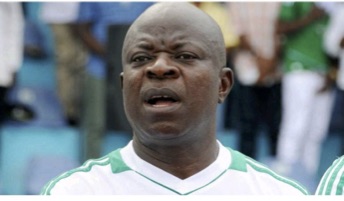
In this interview, ex-Green Eagles’ midfielder, Sylvanus Okpala, revealed how the Nigeria Football Federation (NFF) ignored his offer to help the Super Eagles qualify for the 2026 FIFA World. With only three points after four games in the qualifiers and Nigeria’s chance going up in flames, Okpala, better known as QuickSilver by football fans, said he wrote to the NFF and volunteered to join the then Austin Eguaveon-led technical crew with the assurance that the Super Eagles would finish tops in Group C at the end of the qualifiers. To underline his patriotic zeal, Okpala said, “I told them not to pay me salaries, just let me join Eguaveon and we will qualify for the World Cup; but the football authorities turned deaf ears, instead, they replaced Eguaveon with a Malian coach”. Okpala, who spoke on the sidelines of the “Night of Tributes” held in Lagos, in honour of Nigeria’s five sports heroes who passed on recently, also bemoaned what he described as lack of recognition for ex-internationals who won laurels for the country in their active days in sports. He declared: “Christian Chukwu did not eat the fruits of his labour”. QuickSilver, who spoke on other issues, also paid glowing tributes to the fallen heroes, including Chukwu, Charles Bassey, and Moses Effiong all of whom were his teammates in the 1980 Nations Cup winning squad. Others are former Super Eagles goalkeeper and captain, Peter “Dodomayana” Rufai, and former Africa and Commonwealth boxing champion, Obisia Nwankpa.
Excerpts:
Q: Please may our readers meet you sir?
My name is Sylvanus Okpala, MON, OON.
Q: How would you describe tonight’s event, “Night of Tributes”, which is in honour of five of Nigeria’s fallen sports heroes?
First of all, it’s the first of its kind. It has never happened in the history of Nigerian football or sports as a whole. I must thank Air Peace, particularly the Chairman/CEO of the airline, Allen Onyema, for this wonderful gesture. It means a lot to me particularly, because Christian Chukwu, for example, was somebody I was very close with. Even after we retired from football; when I was living in Enugu, we had to sit every evening from Monday to Sunday. There’s this place we used to meet every evening. Then on Sunday, we went for an All Stars reunion after which we would go home. So I played with him as a player, both in the then Green Eagles (now Super Eagles) as well as in Enugu Rangers International Football Club. I also worked with him as a coach. Christian Chukwu was part of Nigerian football history through and through, people may not know this. After Nigeria had won gold in the football event at the All Africa Games, the generation of players who achieved that feat retired from football, almost all of them, except goalkeeper Emmanuel Okala who continued till 1980. So Christian Chukwu’s set took over in 1974. That was when Africa recognised Nigeria as a football nation. Prior to that time, in the 60s and early 70s, Nigeria was not reckoned with in the game of football. So the transition was from 1974 and it climaxed in 1980 when we won the Africa Cup of Nations. And the tempo was sustained up till 1984. Christian Chukwu was part of that transition, both at club level as well as the national team. Before then Nigerian clubs were not known in African competitions. There was the African Champions Cup now known as CAF Champions League, and African Cup Winners Cup (now known as CAF Confederations Cup). So it was Enugu Rangers International with Christian Chukwu and IICC Shooting Stars of Ibadan with the likes of Segun Odegbami that brought Nigeria Clubs to the limelight. Christian Chukwu was part of that history in 1974/75 when they nearly won the Champions Cup.
Contd. online
From there we progressed and, in 1976, Nigeria won her first medal in football, which was a bronze at the Africa Nations Cup in Ethiopia. It is pertinent to mention that Ethiopia and Sudan were better reckoned with in football than Nigeria before then. In 1977, we nearly qualified for the World Cup, but for an own goal by a Nigerian defender, Godwin Odiye. By then Africa had only one slot for the World qualification, and we were almost there. The team progressed from there and by 1978 Nations Cup in Ghana, they won bronze again; and the same year, they won silver medal in the football event at the All Africa Games in Algiers, Algeria. We moved on to 1980 when we won the Africa Cup of Nations here in Lagos; that was the climax and I was in that Green Eagles team that made history. I joined the team as a young player from secondary school.
Christian Chukwu didn’t stop there. You would recall that in 1985, he was part of the coaching crew that guided the Nigerian U-16 football team to win the maiden edition of the FIFA U-17 World CUP IN China. He was also in the coaching crew that qualified Nigeria for the World Cup for the first time in 1994 and won the Africa Cup of Nations for the second time in Algeria the same year. The Nigeria team went ahead to make it to the second round at the World Cup in America in our first appearance at the tournament in 1994. So Chukwu contributed a lot to Nigeria’s football. That is why I said he’s part of Nigeria’s football history. He was a super legend!
Contd. online
Q: And what would you say about the late Charles Bassey?
We used to call him the Canon. We only met whenever we were in the camp in our days in the Green Eagles. He was a midfielder and he had this cannon shot. He was very good although he didn’t get a chance to play at the Nations Cup in 1980.
Q: What about the late Moses Effiong? What memories do you have about him?
Ooooh! Moses Effiong was a goalkeeper, a very nice guy. He hardly quarreled with anybody. He, too, didn’t get his chance to feature at the Nations Cup in 1980 because we had the likes of Emmanuel Okala and Best Ogedengbe in goal, both of who were ahead of him in pecking order. But of the three goalkeepers Effiong was the best penalty stopper. He was better than Okala and Ogedengbe in stopping penalties. Some goalkeepers specialise in stopping penalties. Effiong was a specialist when it came to saving penalties. We all knew that, nobody could dispute that. It’s unfortunate we lost these guys. We know that everybody will die some day. We are only praying for a long life to see our children and grandchildren.
Q: Do you have any memories of the late boxing legend, Obisia Nwankpa?
Yes, Obisia Nwankpa; we met at the 1980 Olympic Games and I think at the 1988 Olympics, I really can’t remember now. He was a fantastic boxer and he really made Nigeria proud.
Q: It’s rather unfortunate that Nigeria’s sports legends are passing in quick succession and many believe that the system does not cater for the country’s sports heroes. Do you share this view?
Yes, take myself for instance. I sustained an injury on my right leg while on national team assignment. It was during a match at the National Stadium in Lagos between Nigeria and another country which I can’t remember now. As we speak, I cannot bend the leg well, but I can touch my buttocks with my left leg if I want. I can’t try that with my right leg, if I try to force it I would fall down. I also have issues with my ankle. Having put on a pair of shoes for a long time today, I’m going to experience severe pains tonight. That’s the situation we face as ex-footballers; we have one illness or the other. Unfortunately, after giving so much for this country, somebody like Christian Chukwu did not enjoy the fruit of his labour.
Q: Why did you say so?
Why did I say so? You know the issue of whether he was paid or not by the Nigeria Football Federation (NFF). Chukwu and I were very close. As far as I remember, there was no interview granted by Chukwu to any media organisation where he hardly failed to mention that the NFF owed him. He never stopped mentioning it. And when he died, that issue came up again in the media and somebody said there was a panel set up by the NFF to ascertain the veracity of that claim. Eventually, the panel came out to say there was no such thing, that Chukwu was not owed by the NFF.
But my first question was whether Chukwu was invited by the panel at all during their sitting. This is because Christian Chukwu needed to tell his own side of the story. If you did not invite Christian Chukwu, then the whole work done by the panel was a nullity. So, nobody has confirmed that he was invited by the panel. If they now claim that he was invited because he is late, we need to go and ask his wife to confirm that Chukwu ever appeared before any panel over the money he was owed by the NFF. The wife should be able to confirm whether or not Chukwu appeared before any panel because Christian Chukwu couldn’t have left his house for Abuja without telling his wife where he was going and what he was going to do. Then shortly after Chukwu died, and the issue came up again, there was a bombshell. And what was the bombshell? They never knew that Christian Chukwu granted a media organisation an interview barely three weeks before his demise, where he mentioned again that he was being owed by the NFF. That was how everywhere went silent. If they had paid Chukwu, he could have received treatment anywhere in the world for the ailment he suffered, because the money we are talking about is a lot of money. At least he might have lived for another four or five years. Or even 10 years, you never can tell.
Q: But he got help from Chief Femi Otedola some years back when the media reported that he was critically ill?
Yes, thank God for the timely intervention by Chief Femi Otedola, otherwise we would have since lost him. I recall when he (Chukwu) launched his book sometime ago here in Lagos, I was at the event and the entire hall was empty. The only prominent person who attended that book launch was Peter Obi, and he bought about 180 copies of the book. I didn’t see any representative from the NFF. You know it’s only when events are happening abroad that you would see members of the NFF.
Q: Are you saying that our heroes are not appreciated in their lifetime?
Even in death! Take for instance, before Peter Rufai’s death was announced, a certain player in Europe had died in a car crash, one Diogo Jota who played for Portugal and Liverpool. I think Rufai died two or three days later. But the Nigerian media, both the electronic and print, were awash with stories and pictures of Diogo Jota with little or no mention about our own dear Rufai, a former captain of the Super Eagles of Nigeria. Every day when they would talk about Jota, they would devote over 10 minutes to talk about him, but if they wanted to talk about Rufai it would not be more than one minute, a whole former captain of Nigeria. I’m not saying you shouldn’t talk about Jota, but Rufai should be the first news before Jota. If you’re giving Jota seven minutes, Rufai deserves no less. In fact, it got to a point that whenever it was sports news and they wanted to talk about Jota and Rufai, I would switch off my television or radio as the case may be. And I would wonder, “What has happened to Nigerians that they don’t remember their past heroes, a legend like Rufai, who kept at the World Cup?” I’m not saying they shouldn’t talk about Jota, but this is Nigeria. Can they do the same thing for Rufai in Portugal? (…suddenly switches to Portuguese language and later translates in English). I played in Portugal for 11 years, so I have nothing against Portugal. I’ll always support Portugal at any international football tournament except when they’re playing against Nigeria, then, I’ll support Nigeria because that’s my country. But, again, we cannot throw away our own. How can we devote so much time to somebody who never played for Nigeria; he never even visited Nigeria once. And we’re putting him ahead of Peter Rufai. It’s very unfortunate.
Q: Assuming any of your children is into football or any other sports, would you encourage him or her to switch allegiance to another nationality?
None of my children play football. But even if they were into football, I would not decide for them. I would not stop any of my children from playing for Nigeria. But I would lecture my children or grandchildren who are interested in playing football or any sports for that matter, based on my own experience.
Q: And what would be the thrust of that lecture?
That lecture is that he or she has to be very careful. I would tell them to represent their country, Nigeria. However, I would tell them not to expect so much from Nigeria, because I don’t know whether things would change. I will not discourage them from playing for Nigeria, no, I would not do that. However, if any of them prefers to play for another country, I will not stop him or her. They have to make their choice.
Q: One would have thought that given your personal experience, you would advise your children and grandchildren against representing Nigeria.
No, I wouldn’t do that. You see, we’re not beggars. All we’re asking for is some level of recognition. I’ve seen some Nigerian football authorities who recognise Arsenal Football Club of England at the expense of Nigerian teams. They even give recognition to foreign players more than Nigerian players, even though such players have never visited Nigeria. All I’m saying is “give to Caesar what belongs to Caesar”. Accord us some respect!
Q: What’s your opinion on Nigeria’s chance of qualification for the 2026 World Cup?
When we had six matches left in the qualifiers, our destiny was still in our hands. Now our destiny is no longer in our hands. Austin Eguavoen was doing well as the Super Eagles’ manager. Why remove him? I cried out and advised the NFF to leave Eguavoen to prosecute the remaining six matches in the World Cup qualifiers and we would qualify for the World Cup. I said if they doubted me, they should allow me to join Eguavoen as a coach, and we would qualify for the World Cup. I even wrote to the football authorities to allow me to join Eguavoen in the coaching crew. I did it with the late Stephen Keshi. I warned them not to bring a foreigner. I told them that the problem with Nigerian football can only be solved by Nigerians. I went as far as telling them not to pay me salaries. I told them to pay me only camp allowances and match bonuses whenever we won any match, they should not pay me salaries. But I suggested that we would have a written agreement that if we qualified for the World Cup, I would be entitled to an agreed amount of money. All I said fell on deaf ears and they went ahead and brought a foreigner. Then we still had six games in the World Cup qualifying race. Our destiny of going to the World Cup was in our hands. But, today, it’s no longer in our hands. We now not only have to win all our remaining matches, but we need other countries to go and win their matches for us to qualify for the World Cup. You can imagine that.
Q: What would be your advice to the government and football authorities on how to treat Nigerian sports heroes going forward?
First of all, they shouldn’t allow football and sports generally to die. I say so because sport is deteriorating in Nigeria. Again, let me reiterate that we, the ex-internationals, need to be accorded some respect. Everything is not about money, recognition is very important.
Q: What, in specific terms, do you suggest the government should do to cushion the effects of the passing of the sports heroes so honoured tonight, especially on their respective families?
Hmmmh, please I wouldn’t want to go there. It has to be a collective decision by ex-internationals after which we push it from there.
Q: I thought you have a professional association of retired and active footballers; what is the association doing about the welfare of its members, particularly the retired footballers.
Honestly, I don’t know anything about that.