Follow Us on Google
From Aloysius Attah, Onitsha
The selection of a new traditional ruler in Ndiowu community, Orumba North Local government area, Anambra State is causing ripples, leading to protests and tension in the community.

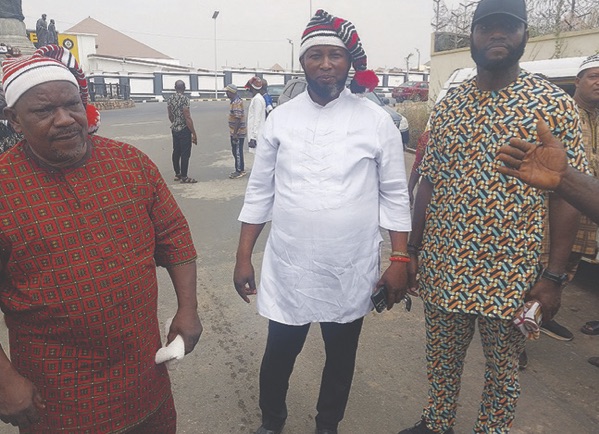
The community members stormed the Anambra State Government House, popularly known as the Light House, Awka, on Monday, to protest what they described as an illegal and imposed process in the purported selection of a new traditional ruler for the community.
The protesters, drawn from the four traditional quarters of Ndiowu (comprising Udoada, Ufere, Okoro and Uche quarters) alongside women and youth groups, expressed strong opposition to the recent declaration of one Chief Chibuzor Okekeifi, a United States-based business mogul, as the Igwe-elect of Ndiowu Community. The declaration, according to them, followed no valid election and violated the community’s constitution, customs, and established rotational succession arrangement.
Chief Okekeifi was recently announced as Igwe-elect to replace the former monarch, HRH Eze O.O. Udeh, who passed away in 2015, thereby ending the 11-year vacancy on the Ndiowu royal throne. However, the protesters insist that the process leading to his emergence was flawed, unconstitutional and imposed against the collective will of the people.
Protesting against what they termed the “illegal selection,” the demonstrators chanted satirical songs and flaunting placards with different inscriptions, such as “Ndiowu Traditional Ruler Stool Is Not for Sale”; “Say No to Imposed Election: Listen to Us Now”; “Respect Our Right to Choose”; “Ndiowu Demands Transparency in Terms of Election”, and “No Election Held on January 12,” among others.
Addressing newsmen on behalf of the protesters, the Chairman of Ndiowu Four Traditional Quarters, Maazị Uchenna Iloh, accused officials of the Ministry of Local Government, Chieftaincy and Community Affairs, as well as the Chairman of Orumba North Local Government of acting outside their constitutional powers in the preparation and purported conduct of the traditional stool election.
He stated that contrary to the claims, no election was conducted on January 12, 2026, at the Ndiowu Town Hall, the only constitutionally recognised venue for such an exercise. He said what transpired amounted to a gross abuse of procedure, deliberate exclusion of critical stakeholders and an attempt to impose a predetermined outcome on the community.
Providing further details of the events, grievances, and demands of the community, Maazị Iloh explained that following due process, the Ndiowu Town Union had earlier commenced preparations to fill the vacant traditional stool through a screening committee in line with the Ndiowu Traditional Rulers Constitution (2024, as amended). He alleged that the Commissioner for Local Government, Chieftaincy and Community Affairs initially fixed November 15, 2025, for the election, but later cancelled it, citing concerns relating to diaspora contestants, stakeholder engagement and short notice.
He further disclosed that on December 24, 2025, the Commissioner issued another letter fixing January 10, 2026, for the election and inviting stakeholders to a consultative meeting scheduled for January 6, 2026. However, he said the President General of Ndiowu Town Union, Mazi Sunday Enemuo, allegedly received the letter belatedly on January 2, via WhatsApp, leaving insufficient time for adequate community mobilisation.
The protesters said it was agreed at the January 6 consultative meeting that a Community General Assembly should be convened on January 10, to deliberate on the commissioner’s proposal to conduct the election on January 12. The assembly, attended by over 200 community members, representatives of the commissioner and the Mayor of Orumba North LGA, Hon. Casmir Nwafor, unanimously resolved that the proposed date was too abrupt and should be shifted to the Easter period, to allow proper planning and inclusive participation.
They alleged that the commissioner’s representative and the Mayor walked out of the meeting, declaring that the election would proceed on January 12, irrespective of the community’s position. The protesters further claimed that the commissioner unilaterally drafted election guidelines that excluded women from voting and imposed secret balloting, in direct contradiction to the community’s 2024 gazetted Ndiowu Traditional Rulers Constitution, as amended, which was signed by the commissioner and which prescribes open ballot Option A4 and full participation of women.
Maazị Iloh emphasised that Ndiowu has, for generations, upheld a rotational succession system among the four traditional quarters and that following the death of the last monarch in 2015, Ufere Quarter, as the next in line by seniority, ought to produce the next ruler. He warned that any process that ignores this order amounts to disenfranchisement and threatens the foundation of Ndiowu’s traditional governance.
Highlighting their demands from the state government, the protesters urged the governor to constitute an independent inquiry into the conduct of the commissioner and the Orumba North Joint Security Force, as well as enforce sanctions against any official found guilty of imposition of election as fraud or abuse of security.
While re-affirming that no chieftaincy election may proceed without a valid, gazetted constitution, the protesters, who described women’s exclusion and gender marginalisation as illegal under both State and customary laws, further prayed the governor to order a new date for election at the Ndiowu Town Hall, with option A4, full participation of women, youth, village heads and all eligible candidates.
Speaking on behalf of Ndiowu women, Mrs. Virginia Orji condemned what she described as the deliberate exclusion and intimidation of women from the said voting process. She recalled that Ndiowu women, including the Umuada and Anụtaradi, played historic roles in building the Ndiowu Town Hall, maintaining peace in the community and facilitating the last succession process in 2015. She described their exclusion from voting as a direct affront to both customary law and Anambra State’s gender-inclusive governance principles.
The women further alleged that security operatives deployed on January 12 prevented them from accessing the Town Hall and manhandled some protesters, despite the fact that no election eventually held. They insisted that women’s participation in community decision-making is central to peace and harmony in Ndiowu.
Reassuring their firm loyalty to the state government and particularly to the Solution Government, the protesters, who recalled how the community massively supported the Soludo administration in the last governorship election, stressed that their demand was not against the government, but in defence of Ndiowu’s constitution, tradition and collective will. They further appealed for the government’s urgent intervention to avert further escalation of the matter as well as restore trust.
Addressing the protesters on behalf of the Anambra State Government, the Secretary to the State Government, Prof. Solo Chukwulobelu, acknowledged receipt of the concerns raised by them, and assured them that the government would carefully study the complaints and work towards a peaceful resolution of the crisis. He noted that the allegations raised bordered on the manner the process was handled, stakeholder exclusion and grievances expressed by women, while also stressing that the government would listen to all sides.
But the State Commissioner for Local Government, Chieftaincy and Community Affairs, Hon. Tonycollins Nwabunwanne, debunked the people’s allegations of imposition, abuse of office, and unconstitutional conduct levelled against his ministry, insisting that the Ndiowu traditional ruler election process was driven largely by the community leadership itself and not by the state government.
The Commissioner said it was the Ndiowu Town Union leadership that formally wrote to the ministry, requesting approval to conduct the election and also proposed the dates at different times. He explained that the first date communicated to his office was November 22, 2025, which later generated petitions from Ndiowu indigenes in the diaspora, who complained of exclusion and inadequate timing, as many of them might not have returned for the yuletide by then.
Following these petitions, he said the ministry intervened by engaging the town leadership, urging them to be inclusive and allow interested contestants, including those abroad who had earlier been encouraged by the community to purchase nomination forms, to participate fully in the process.
Hon. Nwabunwanne disclosed that the ministry later agreed with the community to shift the exercise to December, tentatively fixing it around December 29 or 30, but alleged that the town leadership failed to firm up that arrangement. He said the consequent delay and complaints prompted his office to convene a stakeholders’ meeting, during which all parties, including aspirants, eventually agreed to conduct the election on January 12, 2026, a decision reached collectively in his office and not imposed by the government. He also emphasised that the ministry does not fix election dates for communities, but only works with dates proposed and agreed upon by them.
The commissioner further stated that the government did not disqualify any aspirant, noting that screening and disqualification issues were handled internally by committees constituted by the town union. He expressed concern over allegations that contestants were selectively screened out using disputed criteria, stressing that such actions, if proven, were decisions of the community leadership and not directives from his ministry.
He also dismissed claims that the ministry conducted a “selection,” explaining that when government officials arrived at the venue, contestants were present, arrangements were ongoing, and the Mayor was only there to observe and ensure peace. He also said that the people of the community, including the contestants, participated in the election.
On complaints about diaspora participation and the residency of the declared Igwe-elect, Hon. Nwabunwanne maintained that residence abroad does not automatically disqualify a traditional ruler, noting that some communities in Anambra and beyond have monarchs who live overseas but contribute significantly to their communities and return home frequently. He urged stakeholders and the public to assess aspirants based on their quality, character, contributions and acceptance by their people rather than assumptions about location.
While reaffirming his openness to further engagement, the commissioner stressed that his role was that of a neutral arbiter and peace facilitator, not a partisan actor.
He, however, re-assured that the ministry remains willing to review the grievances presented and concerns raised by the protesters, act where necessary and work with all parties to ensure peace and communal harmony in Ndiowu, in line with the Solution Government’s principles; even as he further urged all sides to avoid actions capable of escalating tensions.