Follow Us on Google
The Niger Delta Development Commission (NDDC) has unveiled a $500 million agricultural initiative to scale up rice and fish production, expand cassava cultivation, provide 680 tractors, and train more than 20,000 youths in agricultural entrepreneurship.
The commission also said the funds would be used for credit schemes for cooperatives, Agric-Zyme organic fertiliser, and community-based natural resource management.
Vice President Kassim Shettima, who spoke during the unveiling yesterday in Abuja, reiterated the federal government’s commitment to agriculture.
Shettima remarked that the Niger Delta Agricultural Investment Fund of 500 million dollars is a commercial, returns-driven vehicle spanning the value chain, from aquaculture and palm oil to cassava, cocoa, rice, horticulture, marine resources, and livestock.
According to him, the government will coordinate the commitments already pledged by the World Bank, the African Development Bank, the Islamic Development Bank, the European Bank for Reconstruction and Development, and other private and commercial financiers.
“Above both stands the Niger Delta Agricultural Development and Investment Council, which I am honoured to chair, with the NDDC as its Secretariat. Beneath it lies a demand-side strategy preparing bankable projects across all nine mandate states.
“It is no coincidence that President Bola Ahmed Tinubu, GCFR, placed food security among the earliest priorities of this administration, because nations that lose control of their food eventually surrender control of their future. His July 2023 declaration of a state of emergency shifted our national approach from the boardroom to the ground, across production, market stabilisation, and food access.
“This is why mechanisation has been the centrepiece of the drive, and why the administration launched the Renewed Hope Agricultural Mechanisation Programme for 10,000 tractors over five years, alongside local assembly plants, and in parallel with the John Deere Tractorisation Programme, the Greener Hope Project, and the Green Imperative Programme.
Other News
“We have complemented these with a value-chain approach that prioritises the processing of staple crops, expanded farmer support through seedlings, fertilisers, irrigation, and finance, including the Presidential Fertilizer Initiative and new agricultural corridors, and livestock interventions such as Livestock Development Centres, aimed, in part, at defusing tensions between farmers and herders.
“The outcomes speak for themselves. Through the sustained dedication of the Minister of Agriculture and Food Security, Senator Abubakar Kyari, we have seen the prices of several essential food commodities fall, by as much as 50 per cent for some.
“This is the harvest of pragmatic reform and deliberate investment, and this gathering promises to widen it further. Your Excellencies, distinguished ladies and gentlemen, we are prepared to explore the potential of each state, because Nigeria’s prosperity is the sum of its parts.
“We stand as partners, ready to guide the priority programmes of the nine states through feasibility assessment, financial modelling, and market validation, so that every worthy idea in the Delta can become a project capable of drawing on these resources,” he said.
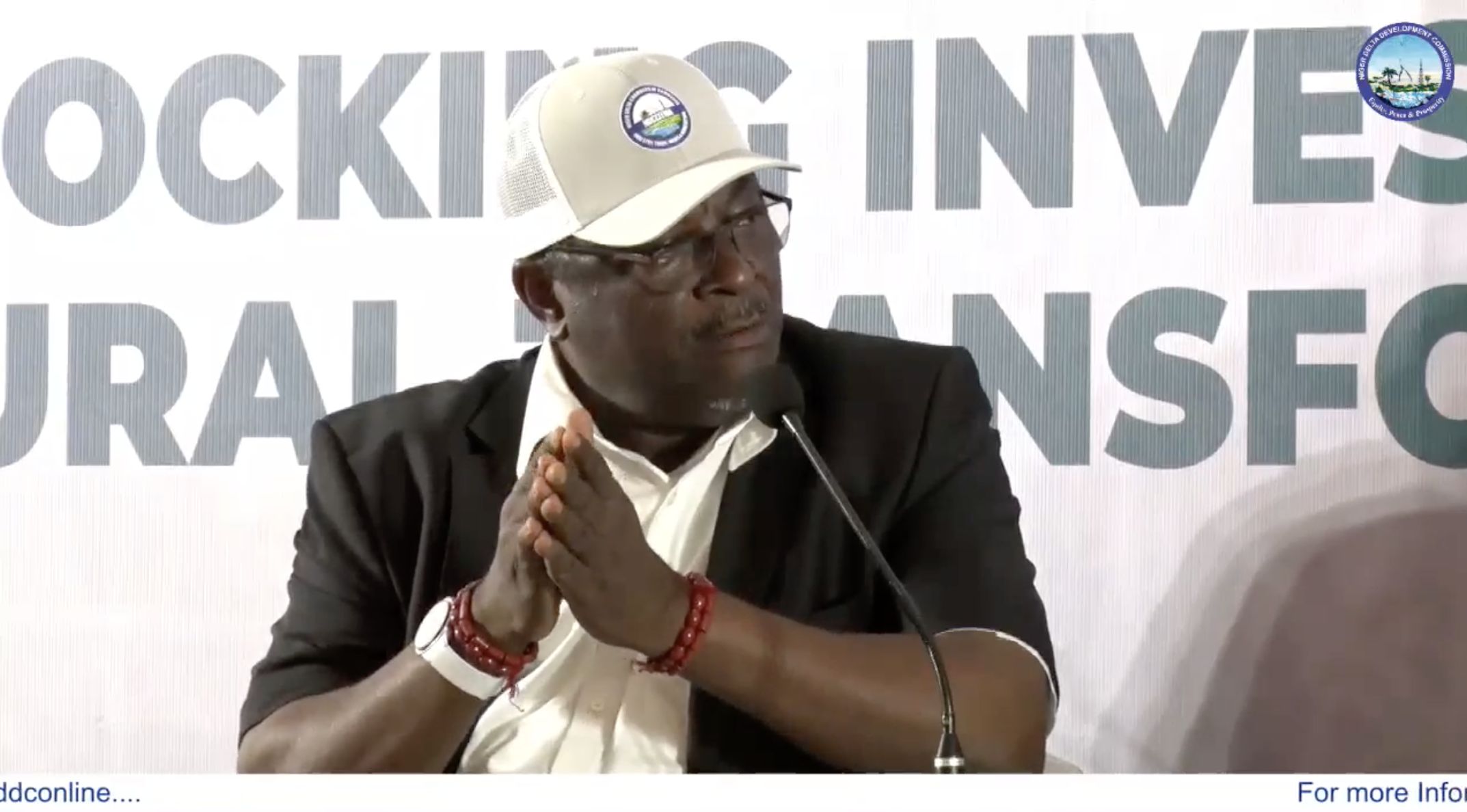
NDDC Managing Director and Chief Executive Officer, Samuel Ogbuku, said the commission remains committed to developing infrastructure such as roads, waterways, and rural electrification to boost and sustain livelihoods.
Ogbuku added that under his watch, the NDDC would continue to build a safer and healthier environment by implementing solar power generation projects and encouraging alternative power sources.
According to him, the NDDC would continue to collaborate with agencies to enhance regional peace and security, in line with the Renewed Hope Agenda of the federal government.