Follow Us on Google

Nigeria’s headline inflation closed 2025 at 15.15 per cent, according to the latest Consumer Price Index figures released yesterday by the National Bureau of Statistics.
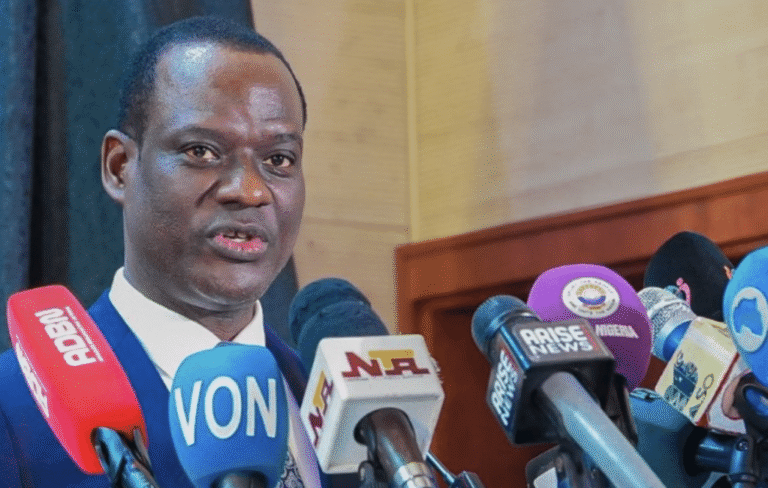
The Statistician-General, Adeyemi Adeniran, said the December report follows the recent rebasing exercise, which updated the CPI base year to 2024 and the weight reference period to 2023.
Adeniran explained that the year-on-year headline inflation rate was calculated using a 12-month index reference period, where the average CPI for 2024 is set at 100. “This approach provides a more accurate view of price movements than relying on single-month comparisons,” he said.
The December CPI rose to 131.2, representing a 0.7-point increase from November 2025. On a month-on-month basis, headline inflation slowed to 0.54 percent, down from 1.22 percent in November.
Food and non-alcoholic beverages were the largest contributors to headline inflation, accounting for 6.06 percent, followed by restaurants and accommodation services at 1.96 percent and transport at 1.62 percent. The smallest contributors were recreation, sport and culture, alcoholic beverages, tobacco and narcotics, and insurance and financial services.
Food inflation showed a notable easing, with the year-on-year rate at 10.84 percent. On a month-on-month basis, food prices fell by 0.36 percent, largely driven by declines in the prices of tomatoes, garri, eggs, potatoes, carrots, millet, vegetables, plantain, beans, wheat grain, grounded pepper, and onions.
Core inflation, which excludes volatile agricultural products and energy, stood at 18.63 percent year-on-year and 0.58 percent month-on-month, down from 1.28 percent in November. “While core inflation remains elevated, the moderation on a monthly basis signals some easing in underlying price pressures,” Adeniran said.
Other News
Among sub-indices, energy recorded the highest increase at 2.74 percent, while farm produce fell by 0.41 percent. Services increased by 0.15 percent and goods by 0.64 percent.
Urban inflation rose 14.85 percent year-on-year and 0.99 percent month-on-month, slightly above rural inflation, which was 14.56 percent year-on-year and declined by 0.55 percent month-on-month.
State-level analyses show that Abia, Ogun and Katsina recorded the highest year-on-year headline inflation at 19.03, 18.80 and 18.66 percent respectively, while Sokoto, Plateau and Kaduna had the lowest at 8.61, 9.05 and 10.38 percent. Month-on-month, Cross River, Abia and Delta experienced the sharpest rises, while Ondo, Gombe and Jigawa saw declines.
Food inflation at the state level was highest in Yobe, Ogun and Abuja, and lowest in Akwa Ibom, Sokoto and Plateau. On a month-on-month basis, Imo, Nasarawa and Yobe posted the largest increases in food prices, while Plateau, Rivers and Zamfara experienced declines.
Adeniran stressed that CPI weights differ across states, reflecting unique consumption patterns, and cautioned against direct interstate comparisons.
“The December figures highlight moderation in staple food prices even as energy and transport costs continue to challenge household budgets,” he said. “Policymakers, businesses and households should monitor these trends closely, as they signal evolving cost-of-living pressures across urban and rural areas.”
The NBS report underscores the complex dynamics of Nigeria’s inflation, showing relief for consumers in basic food items even as energy and service costs drive overall price pressures. Analysts suggest that the month-on-month easing may signal early signs of price stability as the country moves into 2026.