Follow Us on Google
From Jude Chinedu, Enugu
The President of the Nigerian Bar Association (NBA), Afam Osigwe, has raised fresh alarm over the deepening crisis of judicial corruption in Nigeria, warning that it poses a direct threat to democracy, social justice, and public confidence in the rule of law.
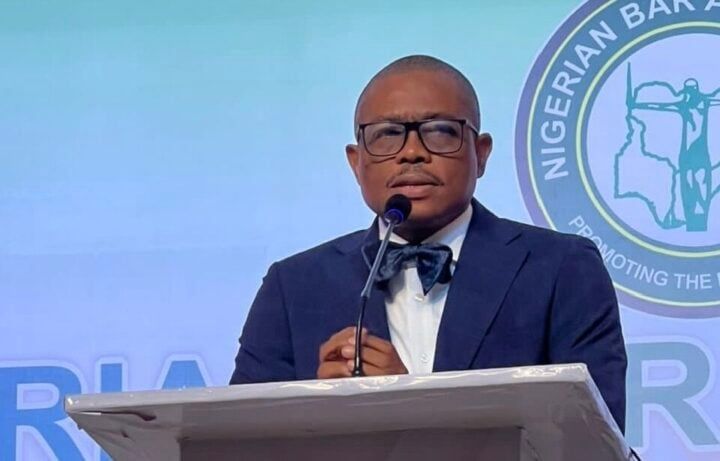
Speaking during the Ralph Opara Memorial Lecture in Enugu, Osigwe said many Nigerians have steadily lost faith in the judiciary due to a growing perception that justice can be “delayed, manipulated, or outrightly purchased by the highest bidder.”
He described judicial corruption as “a moral crisis and a democratic emergency,” insisting that unless urgent reforms are undertaken, the judiciary risks losing its credibility as the last hope of the common man.
“The judiciary, which ought to be the last hope of the common person, is increasingly seen as an arena where justice can be delayed, manipulated, or outrightly purchased by the highest bidder.
“When rulings are allegedly influenced by envelopes rather than evidence, when adjournments are engineered for personal gain rather than procedural necessity, the judiciary ceases to be the last hope of the common man and becomes instead the first refuge of the powerful and the corrupt,” he said.
Osigwe cited findings from recent surveys by the United Nations Office on Drugs and Crime (UNODC) and the National Bureau of Statistics (NBS), which estimated that Nigerian public officials received about N721 billion in cash bribes in 2023, with judges ranking among the top recipients.
He also referenced a Chatham House report which indicated that 61 per cent of Nigerians believe judges are likely to accept bribes to influence their rulings, attributing the perception to political interference, nepotism, and lack of transparency in judicial appointments.
“These expectations are heightened by sociopolitical factors, political interference, the contested relationship between Nigeria’s executive and judiciary, nepotism that contributes to a lack of transparency and merit in the appointment and elevation of judges, and a culture of lobbying for position among judges,” he noted.
Other News
The NBA President recalled past admissions by both the Bar and the Bench that corruption had infiltrated the justice sector, including a 2012 statement by a former NBA President who accused some senior lawyers and retired judicial officers of acting as conduits for bribes in election petitions.
He lamented that more than a decade later, the situation appears to have worsened. “It is profoundly disturbing that judicial corruption not only persists but, in the view of many, has become even more entrenched. The integrity of our judicial system continues to be undermined by practices that erode public confidence and betray the very principles we are sworn to uphold,” Osigwe said.
According to him, the consequences go beyond perception, affecting Nigeria’s international reputation. He cited cases such as Okpabi v Royal Dutch Shell in the UK Supreme Court and the P&ID arbitration saga, where foreign courts entertained matters linked to Nigeria partly due to concerns about delays and the reliability of the Nigerian judicial system.
Osigwe stressed that democracy thrives on an incorruptible judiciary and warned that when courts are perceived as instruments for shielding the corrupt or punishing opponents, “elections lose meaning, governance becomes arbitrary, and the social contract fractures.”
He, however, acknowledged efforts by the National Judicial Council (NJC) to discipline erring judges through suspension, dismissal, and compulsory retirement, but insisted that more decisive action was required, including the suspension of any judicial officer facing credible allegations of corruption pending investigation.
“A judge must have a high moral authority and must live above board. Where a judicial officer is under investigation for prima facie judicial misconduct, such an officer should be placed on suspension because his integrity and status as a judex is at stake,” he stated.
Osigwe called for sweeping reforms in judicial appointments, training, funding, and case management, including automated case assignment to prevent judge-shopping, mandatory ICT adoption in courts, and the establishment of state-based judicial academies to improve professionalism.
He also urged citizens to play their part by refusing to offer bribes, reporting misconduct, and engaging in advocacy for judicial reforms.