Follow Us on Google
By Philp Nwosu
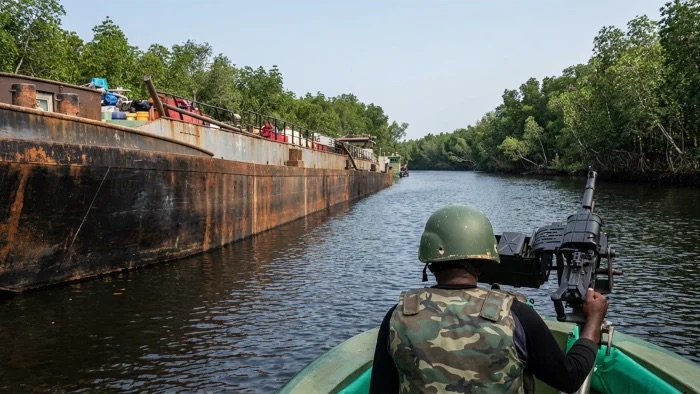
The Nigerian Navy has said its anti-crude oil theft operations contributed significantly to the increase in Nigeria’s crude oil production from 1.2 million barrels per day to 1.7 million barrels per day, according to data from the Nigerian National Petroleum Company Limited (NNPCL) as of April 2026.
Chief of Policy and Plans at Naval Headquarters, Rear Admiral Akinola Olodude, disclosed this while briefing journalists ahead of the Nigerian Navy’s 70th anniversary celebrations scheduled to commence on Friday, May 22, 2026.
He said sustained naval operations had helped boost average crude oil output from 1.258 million barrels per day in January 2023 to a five-year high of 1.71 million barrels per day as of April 2026.
Olodude added that the Navy, in collaboration with other security agencies, had remained actively involved in internal security, counter-terrorism and counter-insurgency operations across the country. He noted that the Nigerian Navy Special Boat Service had been instrumental to many of the operations through strategic raids that contributed to operational successes.
According to him, in line with the Presidential directive to increase crude oil production to three million barrels per day by 2030, with an interim target of 2.5 million barrels per day by 2027, the Navy had intensified anti-crude oil theft and anti-illegal refining operations across the Niger Delta. He described the anniversary as a milestone marking the Navy’s transformation from a modest coastal policing force into “a formidable instrument of national power, regional stability and blue-water prestige.”
Olodude recalled that the Nigerian Navy was established on June 1, 1956, as the Naval Defence Force with 250 personnel and 11 ships inherited from the Colonial Marine Department of the Royal Navy. He said it later became the Royal Nigerian Navy in 1958 before assuming its current name following Nigeria’s transition to a republic in 1963 and the enactment of the Armed Forces Act of 1964.
He also noted that Commodore Joseph Edet Akinwale Wey became the first Nigerian to head the Navy in 1964 and later rose to the rank of Vice Admiral.
Speaking on the Navy’s operational history, Olodude said it played a crucial role during the Nigerian Civil War between 1967 and 1970 through maritime blockades, amphibious operations and protection of vital sea lanes.
He further highlighted the Navy’s participation in international peacekeeping missions, including United Nations operations in Lebanon, ECOWAS Monitoring Group missions in Liberia and Sierra Leone, as well as stabilisation efforts in The Gambia and Guinea-Bissau.
According to him, these contributions to regional peace and maritime logistics culminated in a strategic sealift memorandum of understanding signed with the African Union in 2025.
Olodude disclosed that the Nigerian Navy had constructed five vessels locally since 2010, including ferries, tugboats and seaward defence boats. He added that the Naval Shipyard Limited in Port Harcourt was currently building a 27-metre ferry for the Akwa Ibom State Government, while the Naval Dockyard Limited in Lagos was constructing two 44.2-metre seaward defence boats.
He further stated that the Naval Dockyard recently completed the refitting of three warships for the Beninese Navy between 2024 and 2025 and was currently refitting three additional vessels.
As part of the anniversary activities, he announced a series of events, including special prayers, sporting competitions, project commissioning, sea trips, international maritime exhibitions and the sixth Sea Power for Africa Symposium.
He added that foreign naval vessels from Benin Republic, Brazil, Cameroon, Côte d’Ivoire and Ghana were expected to arrive in Lagos on May 29 as part of the celebrations.
The highlight of the anniversary celebration will take place on June 1 at the Eko Atlantic Waterfront in Lagos, where President Bola Ahmed Tinubu is expected to review an international fleet, commission new naval vessels and inaugurate a combined maritime task force for the Gulf of Guinea.
The vessels to be commissioned include NNS MAMBILA, NNS GURARA and NNS OLOIBIRI.
Olodude reaffirmed the Navy’s commitment to becoming a highly digitised and networked blue-water force capable of addressing emerging maritime threats.
He said the forthcoming Sea Power for Africa Symposium, themed: “Leveraging Technology for Enhanced Maritime Security in Africa,” would focus on integrating advanced technology and skilled manpower to counter fourth and fifth-generation warfare threats.
“The Nigerian Navy remains steadfast in its constitutional role of protecting Nigeria’s maritime interests and ensuring regional stability,” he stated.