Follow Us on Google

Bimbola Oyesola
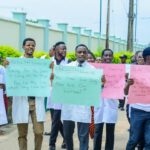
Nigerian workers can for now heave a sigh of relief as President Muhammadu Buhari has assented to the National Minimum Wage Bill. It was a long-drawn battle won by labour amid struggles, protests and shutdowns. But the workers and other stakeholders have said that this may be the beginning of another struggle for the implementation of the new wage.
Since Thursday, when the bill was signed, the ovations have been loud for President Buhari, from organised labour to the organised private sector, non-governmental organisations and other stakeholders across the country.
In separate statements after the Nigerian President signed the National Minimum Wage Bill forwarded to him by the National Assembly, the Nigeria Labour Congress (NLC) and the Trade Union Congress (TUC), both commended the President for doing the needful.
General-secretary of the NLC, Dr. Peter Ozo-Eson, said, “We wish to express our appreciation to Preside—nt Muhammadu Buhari for signing into law the new national minimum wage bill of N30,000.
The TUC, in the same vein, commended Buhari for signing the bill approving N30,000 as the new minimum wage.
President of TUC, Comrade Bobboi Bala Kaigama, said the new wage would in no small measure give workers a sense of belonging.
Similarly, the director-general of Nigeria Employers Consultative Association (NECA), Mr. Timothy Olawale, in Port Harcourt, commended Buhari for what he described as a significant action.
He said Buhari’s assent to National Minimum Wage Bill shows his commitment to the welfare of the people.
Others who commended are the president is the Noble Youths Mass Support Association (NYMSA), an NGO, whose national coordinator, Mr. Godwin Onmonya, said signing the bill showed Buhari’s commitment to the welfare of workers, adding that the gesture would reduce the high cost of goods and living to the barest minimum.
President of Women Arise for Change Initiative, Dr. Joe Okei-Odumakin, also lauded the gesture as a welcome development.
Dr. Samuel Nzekwe, former president of the Association of National Accountants of Nigeria (ANAN), in his commendation, said that the new wage would boost the purchasing power of Nigerian workers.
He advised the Federal Government to create an environment that would enable the productive sector to thrive.
According to him, this is necessary so that the effects of rising inflation can be cushioned through the production of more goods and services.
Past struggles
Like it was a long journey for the workers before the actualisation of the N18,000 minimum wage, before it was passed into law on Tuesday, February 22, 2011, the new wage of N30,000 also had its share of protests, threats, ultimatums and strike before it eventually became a reality.
Comrade Ayuba Wabba, the NLC president, recalled that the demand for upward review of workers’ wage in Nigeria started in 1945, noting that between 1945 when workers staged the famous 45 days general strike for a Cost of Living Allowance (COLA) and 2007, when the demand won by workers for a 25% general wage through the Ernest Shonekan Wage Consolidation Committee was arbitrarily cut down to 15% by Obasanjo, workers had struggled to have wages improved and a national minimum wage legislated upon.
The present National Minimum Wage Committee was inaugurated in November 2017 by Buhari after several calls by the organised labour, but did not commence work until March 2018 with timelines to deliver on its mandate of arriving at a new national minimum wage in August/September 2018, but the date was truncated by government.
The committee was able to round off at its last meeting on October 5, having arrived at a compromise of N30,000, but a few days after the federal government, through the minister of labour, Senator Chris Ngige, denied that there was any figure arrived at.
However, both organised labour and members of the organised private sector (OPS) who together with government formed the tripartite committee said government had been spreading falsehood.
Comrade Alade Bashir Lawal, secretary of the Trade Union side of the Joint National Public Service Negotiating Council (JNPSNC) and the secretary-general of the Association of Senior Civil Servants of Nigeria (ASCSN), who was a member of the committee, said the committee arrived at N30,000 after much argument and confrontations between the representatives of the labour and government.
Initially, government proposed N20,700, which was put in the basket along with the labour proposal of N66,500 and private sector’s N25,000.
Labour was to later reduced its demand to N38,000, while government increased its proposal to N24,000. It was the OPS that played the role of an arbiter and moved the figure to N30,000.
Before the inauguration of the committee by President Buhari in November 2017, labour had in May 2016 demanded a pay raise from the N18,000 national minimum wage to N56,000, and later adjusted it to N65,000.
The OPS likewise had initially proposed a figure of N41,000, but later brought it down to N25,000, taking into account the current economic situation, ability to pay and ability to enhance and create new jobs.
On the other hand, the committee equally got proposals from 21 governors, ranging from N28,000, N31,000 to N41,000.
The federal government had continued to stall the progress when, in January, it got the Council of State to approve a separate wage of N30,000 and N27,000 for federal, state and private sector workers, respectively.
Labour’s reaction was spontaneous, saying such approval was unconstitutional and would not be accepted.
President of the United Labour Congress, Joe Ajaero, said the Council of State was not a negotiating organ, hence had no power to negotiate on behalf of workers, the private sector or governnent.
Noting that the position of the council could only be advisory, he stated that such advice would have been useful if it had been done before the Tripartite Committee’s sitting.
The House of Representatives on January 29, 2019, kept hope alive when it passed into law a new national minimum wage of N30,000.
The Senate kept the workers waiting until March 19 after the elections before it passed the bill approving N30,000 as the new national minimum wage.
Essentials of the law
The President, after signing the bill into law, has charged workers to be more committed and supportive of his administration’s effort to fix the economy and build the poor infrastructure he met on ground.
According to the Senior Special Assistant to the President on National Assembly Matters, Sen. Ita Enang, the implementation takes immediate effect and it is for all workers across the federation with the exception of organisations with less than 25 staff.
Buhari has assented to the Minimum Wage Repeal and Enactment Act 2019.
The assent makes it compulsory for all employers of labour in Nigeria to pay to their workers the sum of N30,000 as minimum wage. And this excludes persons who are employing less than 25 workers, persons who work in a ship, which sails out of jurisdiction and other persons who are in other kinds of regulated employment that are accepted by the act.
The law also gives workers the right to accept salary that is less than N30,000, right to sue employer to recover the balance as well as authorises the minister of labour and any person nominated by the minister of labour or any person designated by the minister of labour in any ministry, department or agency to, on the worker’s behalf, take action in the worker’s name against such employer to recover the balance of the wages.
The new law also ensures and mandates National Salaries, Income and Wages Commission and the minister or labour to be the chief and principal enforcers of the provisions of this law.
Similarly, the law applies to all agencies, persons and bodies throughout the Federal Republic of Nigeria.
On when the Act comes into effect, Enang said, “the effective date is 18th of April, 2019, as Mr. President has assented to it.
Enang explained, “It has been assented to today and it takes effect today, except such other provisions as are contained in the act. But the enforcement and the right to start the implementation of the provisions commences today (Thursday), including such steps that are to be taken gradually under the provisions of the act.”
Implementation
With the law backed up with such provisions to give it teeth to bite, and with an early assurance coming from some of the governors-elect, such as Lagos and Nasarawa, workers may as well consider it a good deal.
Mr Abdullahi Sule, Nasarawa State governor-elect, on Friday, pledged to implement the new wage, after taking office as governor.
Speaking through his media aide, Alhaji Sanusi Aliyu, in Lafia, Sule lauded Buhari for signing the bill into law. He also said that the move was a testament to the fact that, “Our patriotic and beloved President prioritises the welfare of Nigerian workers.”
Sule assured the state’s workers that he would follow in the footsteps of the President by implementing the new wage structure.
In the same vein, the governor-elect in Lagos State, Babajide Sanwoolu, during his meeting with workers before the election, assured them that he would pay whatever was finally approved as the new wage.
Bearing in mind that some states are yet to even implement the N18,000 minimum wage, which elasped in 2015, organised labour, the OPS and other Nigerians have reiterated the need for the federal government to ensure implementation, especially in the states.
Labour, immediately after the President’s assent, called for the immediate implementation of the N30,000 minimum wage both by government and the private sector.
Labour in the same vein tasked the forthcoming 9th National Assembly to ensure implementation in the states.
The NLC said it was calling for the immediate implementation of the law, given the fact that the process has dragged on for nearly two years.
It also urged employers, particularly federal and state governments, to commence immediate negotiations with the appropriate unions on the impact of the new law on the wage structure with a view to timely and judicious implementation.
Kaigama also said that organised labour appreciated the approval of the new wage, but it was also instructive that its gains have been eroded by inflation, adding that prices of commodities have gone up even when employers have not commenced payment.
Kaigama said: “The N30,000 monthly national minimum wage that we are even asking for to a family of six actually amounts to less than N50 per meal per person. It is exclusive of utility bills, school fees, etc.
“Given our extended family system as Africans, we are also expected to once in a while extend hands of fellowship to parents, in-laws, relations, friends who have lost their jobs, brothers and people of the same faith.”
He, therefore, called on the 9th Assembly and well-meaning Nigerians to prevail on governors to pay workers their salaries and pensions to pensioners to avoid crisis in the industrial sector.
The NECA, the umbrella body of employers, equally said that it believed that the implementation date would be the date of assent.
It advised employers to note the date of implementation and seek further clarification when in doubt.
Shedding light on the conclusions of the Tripartite Committee on National Minimum Wage, the NECA director-general, Timothy Olawale, affirmed that “the National Minimum Wage is not a general salary increase, but a wage below which no employer should pay. As such, employers who are already paying above N30,000 are not obligated to comply. In the same vein, we expect other social partners to also respect this understanding, so as not to jeopardise the industrial harmony in the private sector by insisting on implementation by organisations already paying above N30,000.”
He reiterated the commitment of employers in the private sector to the implementation of the new wage.
Okei-Odumakin, who commended the President, however, expressed reservations on the payment, adding that it is coming at a time when several states in the country have battled over the last couple of years to pay the previous N18,000 minimum wage.
She said, “It is my hope that the states and employers within the private sector will commence an immediate implementation of the new minimum wage.
“It is also important to remind ourselves that the N30,000 minimum wage remains insufficient for our workers when we consider the inflation rate in our country and the prevailing economic realities.
On his part, Nzekwe, former president of ANAN, said the effect would also tell on the nation’s recurrent expenditures, but government must work out ways of paying the new minimum wage.
He advised against increasing VAT, which he said was indirectly using the other hand to collect the new minimum wage from workers, which would inflict more pain on them: “(The President) should also ensure that states adopt the salary table released by relevant government agencies. This is our expectations from government while increasing workers’ salary.’
Onmonya commended the national leadership of organised labour for their doggedness throughout the negotiation for the new national minimum wage.
The coordinator also called for a quick release of the minimum wage table to enable workers receive the new pay as quickly as possible.
Ability to pay
Though the government has always blamed its delay on the implementation on the ability to pay, the finance minister has tried to defend government, noting that total cost of the salaries paid from January to December 2018 was N2.618tn, which represents 72.66 per cent of the actual revenue that was generated between January and December to the tune of N3.603tn.
But labour has since refuted the claim that the new wage may put more pressure on the government.
Secretary-general of the ASCSN, Comrade Alade Bashir Lawal, said government would not spend above N200 billion to pay salaries of core civil servants, taking consequential adjustment into consideration.
He said that government could pay workers the agreed N30,000 minimum wage without looking for funds, as it said.
“Government generate huge funds from the Customs, stamp duty payment, VAT, Treasury Single Account and many other sources.
‘’The Federal Inland Revenue Service ( FIRS) says it recorded N5.4 trillion in 2018 and is targeting about N8 trillion in 2019. These are revenue sources that can enable government pay minimum wage,.
“So, already, there is an excess of N3 trillion and 52 per cent of this cannot be more than N200 billion for workers’ salary in a year before the consequential adjustment. The impact is not significant, as there are no workers anymore on levels 1 to 3, those have been contracted.”
Lawal said it was sad that there are leakages through taxes, which was the traditional revenue source of government at all levels, but the federal government could pay minimum wage within the resources it has.
The NLC president equally dismissed claims that the implementation of the new national minimum wage would lead to inflation in the country.
Ayuba said the Central Bank of Nigeria (CBN) has also confirmed that the implementation of N30,000 minimum wage would stabilise the economy, adding that other countries such as South Africa recently approved minimum wage for citizens despite recession.
“The CBN recently made us to understand that the implementation of N30,000 minimum wage will strengthen the economy because this will empower and put resources in the hands of the working class. So, who is fooling whom?” Wabba asked, “Many workers are finding it very difficult to maintain their families and have a decent life. So, it is not a decent wage, certainly, it is a poverty wage. And, therefore, whatever can be done to alleviate the situation of workers will certainly be appreciated.”
Though on some issues, the three labour centres may have their differences, but they were united in the struggle for the minimum wage, especially fighting against what they considered government’s insincerity.
Hence the three centres have vowed to ensure that state governments pay the new wage by deploying all industrial artillery available to them.