Follow Us on Google

By Oluseye Ojo
Iwo Road, a popular interchange in Ibadan, the Oyo State capital, is usually a chaotic symphony of commerce. But these days, the music has a jagged dissonant edge.
The conductors are not just shouting destinations; they are barking new realities. The revving engines sound more impatient, and the commuters, clutching bags like shields, are bargaining with a desperation that probably borders on grief.
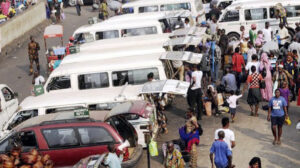
A visit to Iwo Road Terminal One revealed that Ojoo which commercial motorists once plied for N400 has skyrocketed to N800.
A micra taxi driver was sighted shouting ‘Ojoo, Ojoo, Ojoo’. A middle-aged woman approached him and bargained the fare. The woman said ‘Ojoo N400’. The driver responded by saying: ‘Mama, it is N800. We used to transport passengers there for N400. But the hike in fuel price is the issue.”
The woman continued: “I don’t have any other money with me. My son, please collect the N400 from me.’ When the driver said no, a good Samaritan, who was also going to Ojoo, asked the woman to enter, that he would pay her fare.
Also, Ibadan to Akure in Ondo State, which used to be N4,000 is now between N7,000 and N8,000 by bus. But by car, the fare has jumped from N6,000 to between N11,000 and N13,000.
For passengers going to Lagos from Ibadan, the price is determined by the destinations in Lagos, including Berger, Ketu, Ojota, Oshodi, Mile Two, Iyana Ipaja, Obalende, Epe, Ikorodu, and Ikotun Egbe. The fare has risen by at least 40 to 50 per cent or more.
The situation is the same for people travelling from Berger in Lagos to Akure. The fare used to be N12,000, and now it is between N19,000 and N21,000.
But at every motor park, it was observed that a murmur of disbelief constantly rippled through the crowd, followed by the weary but sharp tongue of Nigerian commuters.
One Mr. Sola Akinyemi told this reporter at Iwo Road in Ibadan as he tried to negotiate the fare: “How do you expect us to survive? Salaries have not increased, but the price of everything has gone up. Even, educational institutions have increased school fees. It is a sad thing that our pay is the same, but the world is moving away from us.”
This is a scene playing out in a loop across the federation. From the sprawling motor parks of Lagos, to the quiet streets of the North, a silent thief is at work. The thief wasn’t born in Nigeria, but it has made itself very much at home here.
The thief is the volatile volatility of the Middle East, a geopolitical storm thousands of miles away that is currently dictating the price of a plate of amala in Oyo State,.a plate of pounded yam in Ekiti, ‘fura da nunu’ in Gombe, and so on.
At the Ojoo motor park, the commercial drivers said the increase in fares is not a choice, but a survival tactic.
Ibrahim Bello, a taxi driver, who has been plying the Ibadan to Ojoo route for over a decade, explained: “We don’t like to increase prices. But fuel is everything. If we don’t adjust the fares, we are basically paying the passengers to ride with us. By the time I fill my tank now, my profit for the day has already vanished.”
Bello and his colleagues stated that filling their tanks now costs several thousand naira more than it did just weeks ago.
Also, Yetunde Oladipo, a trader who commutes to Bodija Market, stated: “I now spend almost half of what I earn daily just on the journey. Before, I could move with ease. Now, every trip feels like a financial risk. Sometimes, I just walk half the way to save N200 daily. Within six days, I would have saved N1,200.”
This reporter, who attended the National Executive Council (NEC) meeting of the Nigeria Union of Journalists (NUJ) in Abuja recently, used the opportunity to make enquiries on how Abuja residents have been coping with fuel price hikes.
It was gathered that people in Abuja are really feeling the pressure from fuel price increases, and coping has become a mix of forced adjustments, survival strategies, and lifestyle changes rather than any single solution.
A number of residents of the nation’s capital have cut down their movements by abandoning their cars entirely. One of the most common responses is simply using private vehicles less. Many private car owners now park their cars for days because fuel is too expensive.
It was further gathered that some taxi drivers have stopped working altogether because they could not recover fuel costs. This has reduced traffic snarl in some areas.
Other News
Petrol prices have jumped to roughly N1,200 and N1,350 per litre in Abuja, depending on the station. Commercial drivers responded by raising fares, sometimes daily. People have been paying more, waiting longer at bus stops and motor parks, and travelling less.
To cope with rising commuting costs, some workers now go to the office only a few days a week.
Major daily routes in Abuja, as gathered, have experienced sharp increases, at typical civil servant routes, which explains why many workers are now struggling the most.
For instance, fares from Lugbe to Wuse, which used to be N800 are now between N1,000 and N1,200. Then, Nyanya to the Federal Secretariat (Central Area), which was N500 before the fuel price hike, is now about N700. Also, Masaka to City Centre, has jumped from N700 to N1,200.
It was further gathered that the hardest hit are people who commute from Satellite towns to the city. The survey showed that Kubwa to Berger, which used to be N500 is now N1,000.
Also, the inter-area movement within Abuja is also affected, as Berger to Karmo is now N700 and it used to be N500.
Sources also revealed that government buses are also available in some areas. They are said to be cheaper but are limited. The buses ply Berger to Nyanya for between N150 and N200 and Wuse to Kubwa for the same price range; Zuba to Area One between N200 and N250; and Berger to Gwagwalada: for between N300 and N400.
“These are far cheaper, but the buses are not enough buses. Then, there are always long queues for those that want to board the buses. Apart from all these, they also ply limited routes. If the government can increase the buses to cover many other areas, it will be a good thing for us,” said one Mr. Mohammed Uche, at the junction of Shehu Shagari Road in Kado, Cadastral, Abuja.
The survey further showed that traders pass logistics costs to consumers, which has been making households to spend more on basics. Then, across households, people are reducing non-essential spending
Sources also said based on the fact that incomes have not risen at the same pace, many Abuja residents are essentially absorbing the shock through reduced mobility and lower living standards.
The chairman of NUJ in Oyo State, Akeem Abas, also bore his mind on the issue. He said: “The increasing fuel pump price in Nigeria is a cruel irony of the modern age. Nigeria, a giant sitting atop vast reserves of crude oil, remains a hostage to the global market.
“Every rocket fired in a distant desert and every tanker diverted in the Strait of Hormuz sends a seismic shockwave through the Nigerian economy. When Middle Eastern tensions flare, global oil prices leap.
“For Nigeria, this translates into higher landing costs for petrol. On paper, it’s a statistic on a Bloomberg terminal; and on the ground, it’s a pump-to-plate catastrophe.
“Fuel is the DNA of the Nigerian economy. It is the beginning and the end of our cost structure. When the price of the liter changes, the price of life changes.”
The shockwave did not stop at the motor parks. It followed the articulated trucks into markets like Bodija and Ogunpa in Ibadan. At Bodija, the bags of rice are sitting longer than usual. Mrs. Kudirat Lawal, a grain wholesaler, points to her stock with a frown.
“The transporters have doubled their charges because they say fuel is gold now. If it costs me more to bring the rice from the farm or the depot, I must add it to the price. A bag that was N75,000 before the fuel price increase is now N85,000 or more. I am not being greedy; I am trying not to drown,” she stated.
The survey also revealed that staples are no longer stable. Prices of tomatoes and pepper have jumped as haulage costs from the North have also skyrocketed. The garri, which was once the poor man’s food, is becoming a mid-tier luxury. Meat and fish are said to be the first casualties of a shrinking budget.
In a modest barbing salon in Ibadan, Tunde Ajayi clipped a customer’s hair while using a small generator to power the clipper and a fan.
“The generator outside is my lifeline. But feeding it is now more expensive than feeding myself. I have had to raise the price of a haircut, and customers are angry. They think I am being unfair, but they don’t know how much I spend on buying of fuel for the generator to work. What about servicing and engine oil for the generator,” he wondered.
Then, from welders and tailors to cold-room operators and sachet water vendors, the story is the same. Many are shortening their operating hours. Some are desperately looking into solar power, but with the initial setup costs being so high, it remains a pipe dream for most.
How does a family of five navigate a world where income is a flat line and expenses are a vertical one? The opinion poll conducted revealed that people are skipping meals or reducing portions to cut cost, and neighbours, who used to drive solo, are now clipping together to share fuel costs.
It was further gathered that more Nigerians are relying on buy now, pay later arrangements with local kiosks.
“I owe my provision seller for the last two weeks. It’s a cycle. I pay the old debt and immediately start a new one. I am also indebted to the owner of the Keke Marwa (commercial tricycle) that I am riding because it is on a hire purchase arrangement. I must not fail to pay in instalments, otherwise, the tricycle would be taken away from me,” an operator, Akorede Saheed, said at Mokola, Ibadan