Follow Us on Google
By Bimbola Oyesola, 08033246177
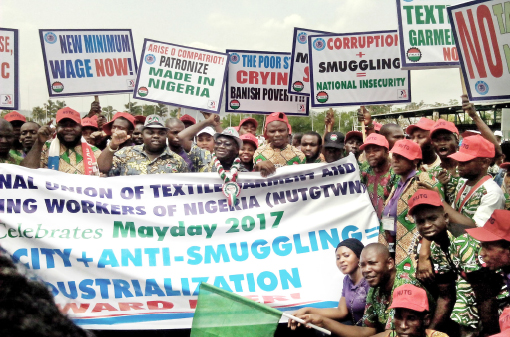
Last Monday, May 1, the Workers Day, would go down in history, as the day Nigerian workers rose to defy the status quo. It was the day that workers told those in authority that they could no longer continue to pretend that all is well, when they are actually suffering.
With the turn out of event at the Eagle Square in Abuja on Monday, no one should be left in doubt that Nigerian workers are not happy with the system. It was a clear statement that the burning issue as far as the workers are concerned is improved welfare through actualisation of a living wage.
The Nigerian workers indeed vent their anger, anguish, disillusionment and distraught on the system toying and dilly dallying over the review of the Minimum Wage.
The National Minimum Wage of N18,000 signed into law in March 2011 was due for review after five years and both the Nigeria Labour Congress (NLC) and the Trade Union Congress (TUC) had last year submitted a proposal for N56,000
Besides the fact of legitimacy, which calls for the review after five years, the present excruciating economic situation with the galloping inflation has reduced Nigerian workers to mere paupers. So what the workers wanted to hear on May Day was not rhetoric, but when the N56,000 proposed by labour over a year ago would become a reality.
According to the NLC President, Ayuba Wabba, the level of penury at which Nigerian worker presently lived was further accentuated by the exchange of naira to the dollar. He noted that in 2011, the value of N18,000, which was $112 has been drastically reduced to mere $45.
It is also noteworthy that the hourly Minimum Wage in America of $7.25, which translates to about N2,900 at the exchange rate of N400 to a dollar, shows that a worker in America would earn in a day far above what his Nigerian counterpart will earn in a month.
Workers resistance
So on May Day, the workers had turned up in numbers to celebrate the day, unlike in the past their spirit was low, although they tried to hide this with their colourful attires.
However with the arrival of all the dignitaries and government officials, which include the Senate President, Bukola Saraki, Speaker of the House of Representatives, Yakubu Dogara, Minister of Labour and Employment, Senator Chris Ngige and others, the May Day programme had commenced around 11 a.m.
But the event had turned awry as the workers refused to listen to the representative of the Minister of Labour, nor the Minister of Labour, who himself represented President Muhammad Buhari from addressing them.
For the first time in the history of the trade union movement in Nigeria and since the struggle for the actualisation of the new wage, Nigerian workers made a valid statement of their evident dissatisfaction with President Muhammadu Buhari Government; over the issue of minimum wage, workers’ welfare and general poor condition of Nigerians.
The workers shouting No! No! No! Minimum wage! Minimum wage! Ole! Ole!! Ole! had gone berserk at the Eagles Square venue of the rally, masquerade took over the rally, dancing back and front, in front of the dignitaries and the podium.
The workers in their thousands had advanced on to the podium and all efforts made to pacify them by the labour leaders, including the former President of Nigeria Labour Congress (NLC), and Governor of Edo State, Adams Oshiomhole, failed.
Not even the reinforcement by the Nigeria Police, the anti-riot Police van blowing heavy siren drove to the rally ground could calm down the protesting workers, but rather the workers besieged it, slept across its way and dared it to overrun them.
“How many will you kill? You can start killing us. This is intimidation at the highest level. We are ready to be killed, you can continue.” The workers had shouted”
As the tension increased, the dignitaries and government officials including the Senate President, Speaker of the House of Representatives, Labour Minister, Adams Oshiomhole and others were left with no choice but to discreetly left through the back door.
Addressing the few workers left behind after the ugly incident, the NLC President said the political leaders should see the incidence as a clear signal that Nigerian workers have been pushed to the wall and could no longer continue to pretend otherwise.
Calling on the government without any further delay to constitute the tripartite minimum wage negotiating committee, Wabba said this must be with a time line.
He warned that for the on-going fight against corruption to be won on a sustainable basis, civil servants must be paid appropriate wages.
“While not making excuses for those engaged in corrupt practices or the corruption pandemic in our system, the truth however is that where the monthly wage of a worker is as low as N18,000.00 under the current economic situation, workers with the least inclination to steal public funds become vulnerable. Therefore our campaign for a living wage is one of the best insurance against corruption in the public service”, he said.
The Trade Union Congress (TUC) President, Bobboi Bala Kaigama, also emphasised the need for government to stop procrastinating and set up the Committee that will negotiate and arrive at the new National Minimum Wage for the country in the next few months.
Some of the workers interviewed said their suffering was too much, and emphasised that they left the ground dejected last year when the Buhari government failed to announce a new minimum wage but promised to work on it.
The workers had complained that another year has passed and nothing was done on the issue of minimum wage, adding that they can no longer be deceived by the government while continuing to groan in poverty.
Positive reaction
The incidence no doubt has generated positive response as the employers in the private sector, represented by the Nigeria Employers’ Consultative Association (NECA) has charged Government without further delay to immediately constitute the tripartite committee and convene a meeting to start off the discussions on the New Minimum Wage.
The Director General of NECA, Mr. Olusegun Oshinowo noted that: “the unfortunate incident was needless and avoidable if government had pro actively done the needful”.
He noted that there was indeed an understanding that the National Minimum Wage would be due for discussion after five years.
“In effect, the 2011 agreement, ordinarily, should be open for discussion in 2016. Government should not have waited for workers’ repeated clamour for discussions before acting in good faith”, he said.
Oshinowo averred that “there is a time-tested and enshrined procedure for the discussion of the National Minimum Wage, which is premised on the principle of Social Dialogue and Collective Bargaining among the Tripartite.
According to him, this entails the setting up of a National Minimum Wage Committee comprising representatives of the Federal Government, led by the Office of the Secretary to the Government of the Federation, State Governments, usually represented by three State Governors, Employers in the Private Sector under the aegis of Nigeria Employers’ Consultative Association (NECA) and Organised Labour as represented by NLC and TUC”.
On the sore issue of the timeliness of a review in view of the hard hitting economic recession, Oshinowo admonished that “the issue of procedure should be separated from the substance or subject. Hence, the imperative to respect procedure should take precedence over substance. It is the responsibility of the Committee to sort out the issue of desirability of review or sustenance of status quo in the event that timing for upward review is inappropriate”.
In the same vein, the House of Representatives sitting a day after the crisis, also stressed the need for the workers to earn not only the new minimum wage, but a living wage.
The Speaker, Yakubu Dogara said the National Assembly remains committed to the passage of the National Minimum Wage Bill when presented by the executive, adding that increasing workers’ salary had become necessary in view of the rising cost of living in the country.
The Labour Minister, though refused to believe that the protest could have been orchestrated by Nigerian workers as he blamed the crisis on the infiltration of the rally by non-workers and the faction in the labour movement.
He however assured the workers of government and President Buhari’s commitment to the issue of national minimum wage.
No doubt that a stitch in time saves nine, leaders of the organised labour have stressed that government should see the May Day crisis as a warning as the issue of minimum wage and the appalling living condition of the workers have now become a time bomb which may go off anytime.