Follow Us on Google
By Fred Itua, Abuja
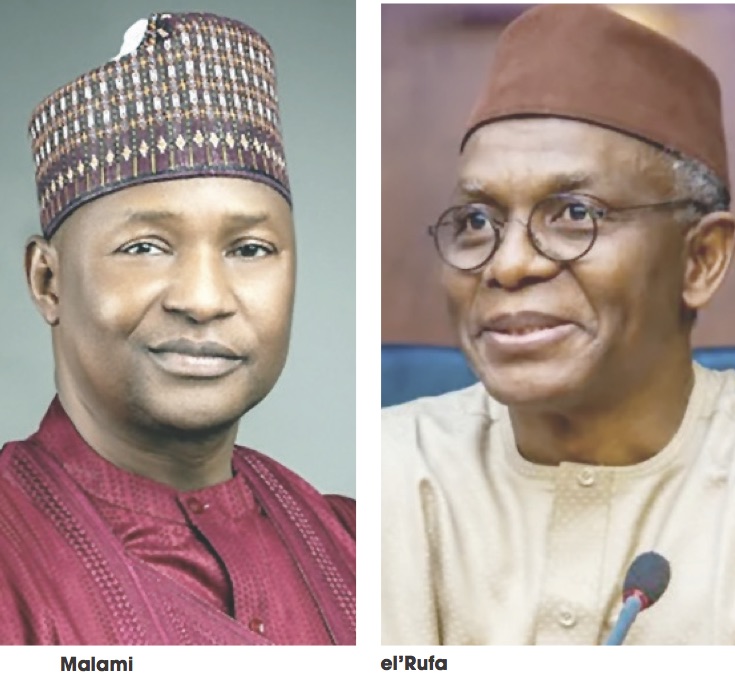
There is a particular cruelty in Nigerian political fortune. It does not abandon those who fall from grace; it revisits them with the full accumulated interest of every decision they made when they held sway. The unfolding travails of Abubakar Malami, former Attorney-General of the Federation and Minister of Justice, and Nasir Ahmad el-Rufai, former Governor of Kaduna State and erstwhile Minister of Federal Capital Territory, offer perhaps the most instructive contemporary case study on how the architecture of political ambition, when carelessly constructed, becomes the very structure that eventually crumbles its architect.
That both men now occupy positions of considerable political vulnerability; el-Rufai navigating the wreckage of a failed bid to join the Tinubu cabinet, an aborted defection drama, and the open hostility of the political infrastructure he once commanded; Malami confronting allegations, investigations, and the systematic dismantling of the institutional influence he carefully cultivated over eight years, is not coincidental. It is consequential. The thread that connects their present discomforts to their past choices is not invisible. It is, for those with the patience to trace it, almost perfectly.
Malami’s tenure as Attorney-General of the Federation during President Muhammadu Buhari from 2015 to 2023 was, by any objective measure, one of the most expansive exercises of ministerial authority in Nigeria’s recent history. Malami was not a passive occupant of office. He was an active, sometimes aggressive architect of the legal and political landscape during the Buhari years.
He issued controversial opinions on constitutional questions, inserted himself into matters that strained the traditional boundaries of the office, and accumulated influence that extended well beyond the Ministry of Justice into the bloodstream of federal governance.
For observers, Malami’s handling of the anti-corruption agenda, the flagship programme through which Buhari’s administration sought its historical legitimacy, drew particular scrutiny. Critics, and stakeholders within the administration itself, observed a pattern in which the prosecutorial apparatus appeared selectively deployed: vigorous in some directions, curiously restrained in others. The Economic and Financial Crimes Commission (EFCC) operated under conditions in which Malami’s interpretations of law and jurisdiction carried enormous practical weight.
Malami’s legal opinions became instruments of political consequence.
Malami, a product of the Northwest’s political establishment and a man of demonstrable ambition, according to political analysts, spent his ministerial years building a parallel architecture of influence. One that served him enormously while the Buhari sun illuminated high, but left him exposed the moment the political atmosphere changed. His bid for the Kebbi State governorship in 2023, which ended in primary defeat, revealed the central vulnerability of power borrowed from proximity to a departing principal.
The political capital he had accumulated was largely non-transferable because it was never truly his. For political observers and pundits, the allegations and investigations that have subsequently swirled around him- reports of properties, assets, and financial arrangements that draw attention to the gap between ministerial remuneration and apparent accumulation, are the compound interest on decisions made when impunity seemed permanent.
“The most dangerous thing about the illusion of untouchability is not that it is false. It is that it is temporarily true, and the temporary truth is seductive enough to cause people to act as though it were permanent,” a political analyst, Dr. Lemmy Ughegbe summed it up.
On the flip side, observers see el-Rufai differently. For them, he presents a more complicated, and in some ways more tragic, political portrait. Unlike Malami, who accumulated influence through institutional proximity, el-Rufai built his political identity on the foundation of intellectual capital, technocratic credibility, and a carefully cultivated reputation as the man willing to say what others would dare.
As FCT Minister during President Olusegun Obasanjo, el-Rufai executed the Abuja Master Plan with a ferocity that made him simultaneously admired and despised. As Governor of Kaduna State from 2015 to 2023, he implemented reforms of genuine ambition, restructured the civil service, confronted religious education orthodoxies, engaged with infrastructure investment, while he presided over a security deterioration in Southern Kaduna that became one of the most contested humanitarian and political controversies of the Buhari era.
His admirers saw a reformer constrained by circumstances. His critics saw a man whose management of ethnic and religious tensions was insufficiently impartial, and whose political calculations in those tensions produced irreversible consequences.
El-Rufai was a prominent figure in the coalition that brought Bola Tinubu to power in 2023. His expectation of a senior cabinet appointment, specifically, it was widely reported, the Ministry of Power or a comparably prestigious portfolio, was, by most accounts, reasonable given the weight of his advocacy and the currency he expended in the campaign.
What he received instead was a conspicuous public snub: his name was notably absent from the ministerial list, a silence that thundered across the political class. The subsequent drama, his reported flirtations with the opposition, including conversations with the Labour Party and PDP structures, confirmed that the wound was deep and the response was reactive rather than strategic.
Other News
“A politician of his acknowledged strategic intelligence should have understood that the post-election period is precisely when the debts of coalition-building are settled, and that the settlement is determined entirely by the creditor, in this case, Tinubu, and not by the debtor’s perception of what they are owed.
“His public positioning during the election campaign, which at points carried the tone of a man doing Tinubu a favour rather than a man choosing a principal he was committed to serve, almost certainly registered in the political accounting that followed. Nigerian presidents, and Tinubu more than most, do not forget the texture of loyalty. They remember not just who supported them, but how, and with what degree of enthusiasm and self-abnegation,” Dr. Ughegbe noted.
The deeper miscalculation, however, is structural and dates further back. El-Rufai spent the latter Buhari years cultivating a political persona that was sometimes explicitly critical of the Buhari administration of which he was nominally a part; a posture that earned him applause from commentators but unease among the political class, which values predictability and solidarity above intellectual honesty.
His famous observations about Northern political behaviour, his pointed commentary on economic mismanagement during Buhari, his visible disagreements with the direction of policy, all of these burnished his image as an independent thinker but raised, in the minds of potential future principals, the unsettling question: if he was willing to publicly undermine one patron, what guarantees exist regarding the next?
Pundits further argue that the cases of Malami and el-Rufai, read together, illuminate a set of structural truths about the nature of political miscalculation that transcend their individual circumstances. The first is that Nigerian political power is almost always derivative rather than autonomous, the pundits argue. Those who occupy positions of institutional authority as ministers, as governors, as senior party officials, derive their influence from proximity to a source of primary power, and the longevity of that influence is, at best, depends on the longevity of that source.
“The minister who governs as though his authority is inherent, rather than delegated, sows the seeds of his own post-tenure vulnerability. Malami governed as though the AGF was a sovereign office; the post-Buhari reality has demonstrated that it was always a tenanted one,” another commentator, Dr. Austin Eigbe noted.
In Nigeria, it is often argued that the political debts incurred during the exercise of power do not expire with the tenure. The belief is that every institutional decision that tilted the balance, every selective prosecution, every jurisdictional expansion, every political alliance cemented through the exercise of ministerial authority, creates a corresponding entry on the debit side of a ledger that does not close when the minister hands over his briefcase.
“Nigeria’s political ecosystem has a long institutional memory, even when it has a short official one. The individuals and interests that were disadvantaged accumulate their grievances patiently, in the knowledge that political fortune is cyclical and their moment of leverage will return,” Dr. Eigbe said.
Another argument advanced by pundits is that, the cultivation of a personal brand as a public intellectual, a reformer, or a critic of the system is not a substitute for the more fundamental currency of political loyalty, and that the two are not always compatible. For them, el-Rufai’s intellectual capital has not insulated him from political consequences; in certain respects, it has amplified his vulnerability, because the same articulateness that made him formidable in the ascent makes him a more visible and more quoted figure in the descent.
Like in other climes, Nigerian political history is replete with figures who believed, at the apex of their influence, that the rules which governed lesser careers did not apply to them. The Malanis and el-Rufais of each political generation are not aberrations. They are, rather, the recurring expressions of a structural pattern; a political culture that rewards audacity in the accumulation of power but provides no sustainable mechanism for the graceful management of its loss.
In the past, the fall from grace was often cushioned by the same opacity that attended the rise. However, the optics are different today. In a media environment of social saturation, the accounting is done in public and in real time.
The travails of Malami and el-Rufai are, ultimately, not primarily stories about two men. They are stories about a system, one in which power is personal rather than institutional, in which accountability is retrospective rather than concurrent, and in which the miscalculations of the ascent are guaranteed, by the very structure of the system, to materialise as consequences in the descent.
In conclusion, pundits have offered some advice. They opined that for the next generation of political actors watching these cases unfold, the message is neither comfortable nor ambiguous: the choices made at the height of power are not left behind when power departs. They travel forward with their author, patient and precise, arriving eventually at exactly the moment when he is least equipped to receive them.
In Nigeria, as in all serious political systems, yesterday is never truly past. It is merely deferred and it carries with it, consequences that are never forgiven.