Follow Us on Google
By Joshua Ocheja
I have long highlighted the role of intelligence gathering in our national security architecture in several forums.
It is as crucial as pulling the trigger, and the brainbox for successful security operations. The Department of State Services (DSS) is a crucial component of the security value chain, and the recent terrorism convictions secured by the agency are worth highlighting.
What makes it interesting is the fact that it proved its case beyond a reasonable doubt on the involvement of these individuals in terrorism-related offenses.
Even if the agency can’t commend itself in the public, I think congratulations are in order from some of us conversant with the nitty-gritties involved in pursuing terrorism-related cases in a civil court to a logical conclusion.
The case of the Owo Church massacre was a sad one. In June 2022, 40 worshippers were murdered in cold blood, and over 100 persons were injured in what has remained a sad epoch in our annals.
At the time, the identity of the assailants was unknown. As the country mourned, the DSS went to work. And the end result was the conviction of four persons earlier apprehended by the Service and tried in a Federal High Court in Abuja.
The convicted persons were picked up from different locations in far-flung areas across the country despite the ambiguity surrounding their identity.
According to available information, the suspects joined the Al-Shabaab terrorist group in 2021 and operated a cell in Kogi State.
They held meetings in Kogi and Ondo States in 2022, where they planned the Owo church attack. How the DSS went about the investigation was not in the public space.
I recall that at the time when the arrests were made, some still doubted, but the evidence provided in the nine-count charges before the court and the subsequent conviction secured is commendable and should send a strong signal to criminal elements operating under various guises.
This brings us to the role of the DSS in national security and how it has fared in recent times. The aforementioned cases in this article are instructive in the sense that the DSS was able to prove its charges beyond a reasonable doubt in a civil court.
The law and the operations of security agencies are sometimes at loggerheads in the urgency of the dispensation of justice. However, the Terrorism (Prevention and Prohibition) Act, 2022, has proven to be a game-changer by creating the framework for prosecuting terrorism-related offenses.
For example, jurisdiction is vested in a Federal High Court, it criminalizes logistics by third parties, with strict sentencing guidelines including life imprisonment and the death penalty for offenses where a terrorist act directly results in death.
This is why the DSS could secure three convictions over a short period. The first was the Owo Church incident, the second was the death sentence by a Federal High Court sitting in Katsina State on a female arms courier arrested by the DSS, and the third was the judgment passed by a High Court in Kogi State on a man for kidnapping and murdering his neighbour, who ran a hotel in Obajana in Kogi State.
This trinity of events, as coincidental as it appears, portrays a triangle. It is the triangle of intelligence gathering, arrest, and prosecution.
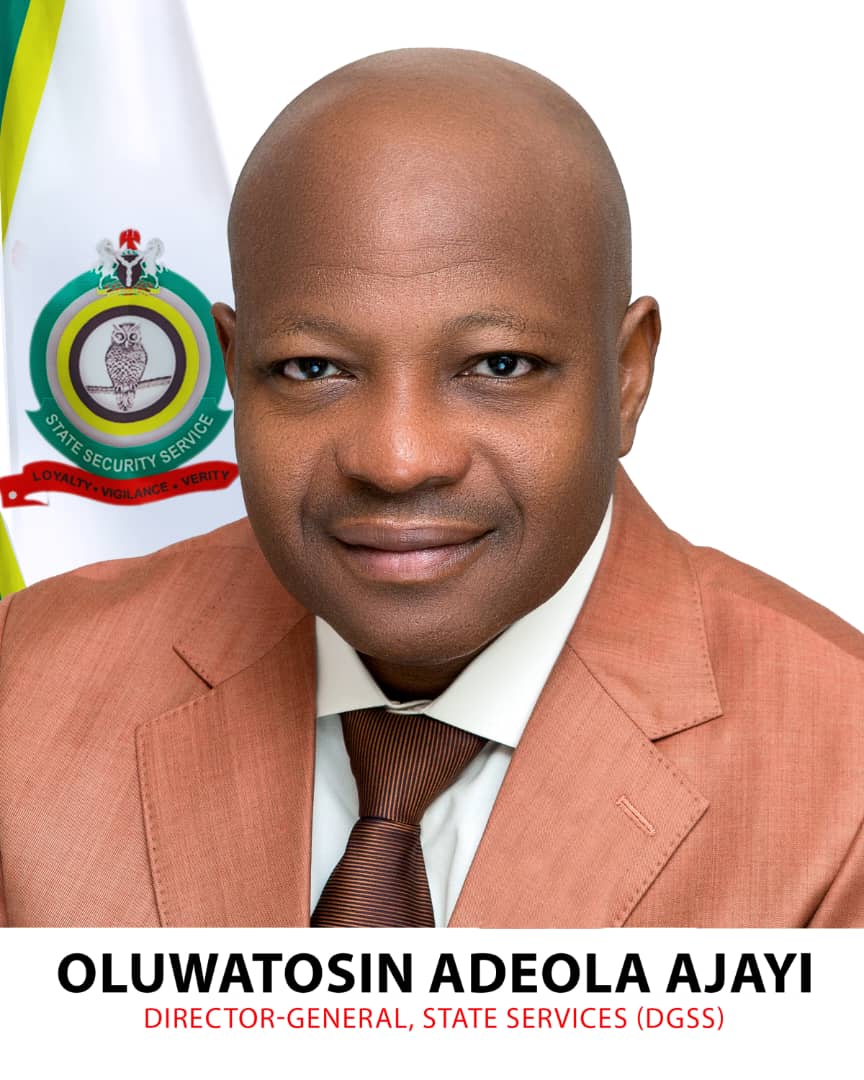
This is where I will commend the operational strategy and focus of the DG of the DSS, Adeola Tosin Ajayi, since his appointment in August of 2024.
Have we noticed that the operations of the DSS are rarely in the public domain since Mr. Ajayi came on board? What is now in the public domain are outcomes as captured in the recent terrorism-related convictions.
I am forced to ask if this is a deliberate regime or a mere coincidence. I will go with the deliberate regime for two reasons. The first reason is that the DSS is a covert organization. Its operations are massive but shrouded in secrecy.
This is why its slogan is “Loyalty, Vigilance and Verity”. The owl image in its logo is instructive. The owl is a silent bird that can see clearly with its tubular eyes even in total darkness. Its neck can rotate 270 degrees, and with asymmetrical ears to identify where a sound is coming from effortlessly.
There is also a new trend that was not given adequate coverage in the media, in my opinion. It was merely reported as a news item, without highlighting its strategic importance.
It was the case of the DSS accepting responsibility for some erroneous past actions. Worthy of mention is the case of Mrs. Chineze Ozoadibe, who was wrongfully arrested on suspicion of her alleged involvement in illegal bunkering.
After a thorough review of the case, she was released and awarded N10 million as compensation. There are several other cases in this regard, and the position of the DG-DSS indicates that, as humans, DSS operatives are fallible. He indeed hit an uncommon spot in the annals of the operations of the DSS.
The DSS reviewed and verified past operational errors, released wrongfully detained citizens, and consequently awarded millions of naira in compensation to the affected persons.
In my opinion, this strategy is not an error of judgment. It is an attempt at winning the hearts and minds of the people. The DSS is not meant to be a dreaded organization as portrayed in times past, but a respected organization whose operational actions are geared towards the preservation of the dominance of intelligence in internal security operations.
Intelligence is the driver of all security operations. This further explains loyalty, vigilance, and verity. It is meant to be painstakingly covert until it is suitable for public consumption. This is what Mr. Tosin Ajayi has done differently in recent times at the DSS.
This trend reminds me of my childhood years, when the operations of the DSS were not in the public space, and when you couldn’t tell the difference between a DSS operative and an ordinary civilian.
I can bet that several covert operations are ongoing. We can only get to know when they are made public. At the end of the day, it is always about loyalty, vigilance, and verity.
Joshua Ocheja holds a dual Ph.D. in Military History and Public Policy; he is an alumnus of the Nigerian Defence Academy.