Follow Us on Google

Moses Itauma came into the ring carrying something far heavier than his 21-year-old frame could possibly carry. He was carrying the expectations of Nigeria and Britain, the excitement of a new generation of boxing fans and, perhaps most dangerously, the comparison with the legendary Mike Tyson.
The boy was being sold to the world as the next great heavyweight sensation. For eight rounds, he looked every inch of it. Then, suddenly, dramatically and almost cruelly, the dream ran out of fuel.
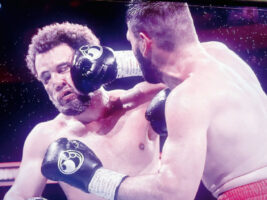
Filip Hrgovic, the granite-chinned Croatian who appeared capable of absorbing everything the young Englishman could throw at him, dragged Itauma into the deep waters of a heavyweight championship fight. And when the young man’s tank finally emptied, Hrgovic was there. Waiting.
By the ninth round, Itauma was barely able to stand. His corner threw in the towel and referee Howard Foster stopped the contest. The young fighter was subsequently taken from the ring on a stretcher and rushed to hospital. Thankfully, he was later discharged.
It was a shocking ending to a fight that, for long stretches, seemed almost impossible for Itauma to lose.
The Croatian veteran later revealed that he had noticed Itauma tiring almost from the opening round.
“I knew he was going to gas out,” Hrgovic said.
According to reports, Itauma had never gone beyond six rounds professionally and had not even sparred the full 12-round championship distance before this fight. That may have been the hidden story behind the spectacular collapse.
The young lion had never been required to hunt for that long.
“HE BEAT ME IN EVERY ROUND”
And then came one of the most remarkable admissions from the man who had just won the world championship. Hrgovic did not pretend that he had dominated the fight. He did not rewrite history. He gave Itauma enormous credit. The Croatian said Itauma was “the best” opponent he had faced and acknowledged that the young fighter had been winning the rounds. But he also said experience, stamina and the pace of the fight eventually worked in his favour.
And, in a moment that revealed something of the man behind the fighter, Hrgovic attributed his victory to his Christian faith. His message was essentially that he had been given strength by Jesus Christ when the fight appeared to be slipping away from him.
For a man who had been battered for much of the night, it was a deeply personal explanation for a remarkable comeback.
And his magnanimity did not end there.
“I am the present. He is definitely the future,” Hrgovic said of Itauma.
What a strange night for the young man. The man who had just destroyed his world-championship dream was also telling the world that he believed in his future.
This is where the gurus of boxing appear to agree. Itauma has the talent. Nobody seems to dispute that.
Before the fight, respected analysts Andy Lee and Barry Jones had praised his speed, movement, intelligence and ability to operate with unusual agility for a heavyweight. Lee, who had seen Itauma spar Joseph Parker, particularly admired his tactical ability and mental qualities.
But there was one unanswered question: how would he cope with adversity in a long, punishing fight?
Now we know.
The answer is: he has to learn.
Frank Warren, Itauma’s promoter, has argued that the young fighter needs to learn from the experience, particularly the importance of pacing and having a plan when the early knockout does not arrive.
Former heavyweight champion Frank Bruno offered perhaps the most poignant perspective. Bruno remembered his own first defeat and described Itauma’s loss as a learning experience, expressing confidence that the youngster could return stronger and wiser.
British heavyweight Richard Riakporhe, meanwhile, described the conditioning problem as “scary” and stressed the importance of preparing properly for 12-round championship fights.
The message is unmistakable: talent is not enough. Speed is not enough. Power is not enough. Even winning eight rounds is not enough.
In heavyweight boxing, you must have enough fuel in the tank to survive the night.
THE MOST PAINFUL LESSON
Perhaps the greatest lesson is not that Itauma lost. It is how he lost.
He did not lose because he lacked courage. He may actually have had too much of it.
He kept throwing. He kept pursuing the knockout. He kept trying to remove a man who had already demonstrated that he could not be removed.
And that is where youth can become its own enemy.
Hrgovic, with the wisdom of a 34-year-old veteran, understood something Itauma did not yet fully understand: sometimes the best punch is the punch you do not throw. Sometimes you win by making the other man fight harder than he wants to. Sometimes patience is a weapon.
Hrgovic did not need to win the first eight rounds. He needed to survive them.
Other News
And he did.
THE HUMAN BEING BEHIND THE BOXING GLOVES
Then came the image that perhaps hurt more than the stoppage itself: the young man being carried away on a stretcher.
For all the talk of Tyson comparisons, world titles, unbeaten records, knockouts and superstardom, suddenly there was no “next Mike Tyson”.
There was simply Moses.
A 21-year-old young man who had given everything he had. A son. A brother. A young fighter whose dream had collided violently with reality.
And that is the human side of boxing that is sometimes forgotten in the noise of promotion.
The fans want heroes. Promoters want champions. Television wants drama.
But inside those gloves is a human being.
Thankfully, Itauma’s post-fight medical checks did not reveal the catastrophe some feared, and he was subsequently discharged from hospital. That should matter more than the defeat.
Was the dream shattered?
No.
It was interrupted.
There is a world of difference.
At 21, Itauma has something far more valuable than an unbeaten record. He has time. He has speed. He has power. He has the boxing intelligence that experts identified before this fight.
And now, for the first time, he has something that cannot be taught in a gym: failure.
Every great fighter eventually meets it. Some are destroyed by it. Others are educated by it.
Look at the history of heavyweight boxing and you will find champions who suffered painful defeats before reaching their greatest heights. Frank Bruno himself lost before eventually becoming world champion. Wladimir Klitschko suffered early-career setbacks before ruling the heavyweight division for years.
So perhaps Saturday night was not the death of the next heavyweight king. Perhaps it was his first real lesson in how to become one.
Let us give Filip Hrgovic his due.
He was magnificent.
He showed a champion’s chin, extraordinary resilience, patience and belief. He became Croatia’s first heavyweight world champion, completing one of the most dramatic comebacks boxing has seen in recent times. He earned every bit of his celebration.
But Hrgovic himself seems to understand the bigger picture.
He is the champion of today.
Itauma may yet become the champion of tomorrow.
And that is why the boxing world should resist the temptation to write the young man’s obituary after one defeat.
Saturday night was not the end of Moses Itauma. It was the night Moses Itauma met the hardest teacher in boxing: reality.
The teacher was merciless.
The lesson was painful.
But if the young man is wise enough to learn it, Saturday’s humiliation may one day become the foundation of his greatness.
For now, Hrgovic has the belt.
Itauma has the scars.
And perhaps, just perhaps, the future of heavyweight boxing has just begun its real education.