Follow Us on Google

• I faced pure hell in medical school, but today, I’ve fulfilled my dreams
• I made up my mind to go to school because I didn’t want to end up a beggar
By Agatha Emeadi
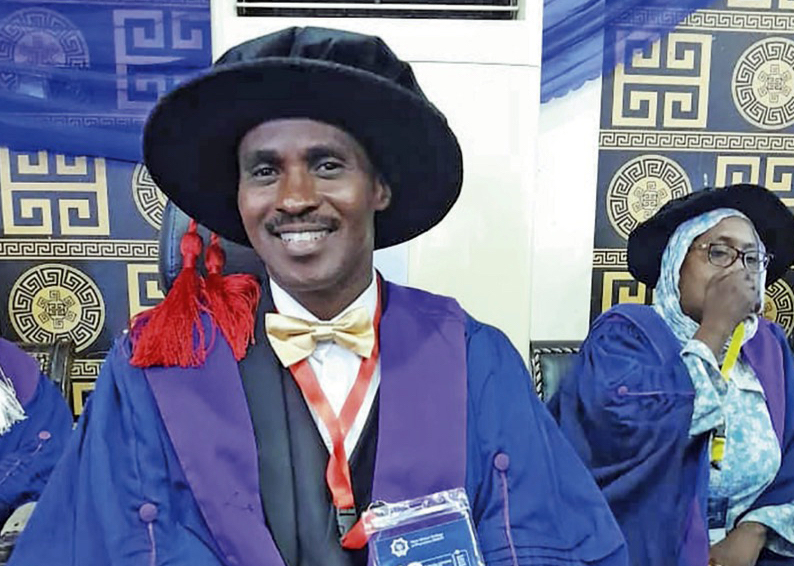
Dr. Joshua Hanny is a Consultant Histopathologist at the Department of Pathology, University of Uyo Teaching Hospital (UUTH) Uyo, Akwa Ibom State.
While growing up, he was struck with polio myelitis, a situation that deformed his leg and made it impossible for him to stand.
He recalled that his classmates in primary school were supportive of him and would ferry him to school while placing him on their backs. But later in life, he noted, he experienced massive discrimination from his lecturers while pursuing his medical studies. In his words, he went to hell and came back.
“The road to achieving my dream of becoming a medical doctor was rough and tough; not because I was not academically sound, but for my weak legs. It got so bad that the Association of Christian Lawyers in Calabar, Cross River State chapter, got involved in my case.”
But he recalled that in spite of the discrimination and other hurdles, he managed to become a medical doctor after eight years of abuse and frustrations in medical school.
In this interview, Dr Hanny x-rayed the darkest part of the situation he faced, among other issues.
What happened to you? Why are you in a wheelchair?
Well, let me explain myself better. I am Dr. Joshua Hanny, and I’m from Oron in Cross-Rivers State but was born in South West Province of Cameroun. I attended Government Primary school Mabeta in Cameroun.
From your question; well, to be honest, I do not really have any definite diagnosis of what happened to my legs. What my mother told me was that when I was a toddler trying to walk; then, I fell sick and was rushed to the hospital. All efforts to treat me back to normal did not succeed and at the end of it, I was not able to walk till date. But through my medical knowledge, I think I suffered Polio Myelitis.
We returned to Nigeria as a family and I started my secondary school in Akwa Ibom State. But I must not fail to mention that while in Cameroun, I went to primary school with the support of my Nigerian friends named Edet Henshaw, Eyo Effiong Jackson and Masong Johnson Uya. They were the little angels that helped me to school and home. We were all Nigerians living in the same settlement in Cameroun then. Some of them are still around, while some have died. As secondary school started for me, I used to crawl to school because I had no wheelchair then. My parents could not afford one. So I moved the way I could afford; that was crawling was the way I moved. Till date, I can crawl into places that wheelchairs cannot enter.
How were you able to study medicine and surgery with this condition?
I lost my father when I was in JSS3. But my mother is still alive. After my father’s death, I could not proceed to school immediately. I spent some time at home before getting back to school, but the grace of God was upon my life. This is because help came from philanthropists and church members who supported my secondary school education. While my fees were paid, I was going to school by myself, moving in my usual way without a wheelchair.
Initially, I wanted to study Computer Science, but I could not gain admission from the first Joint Admissions and Matriculation Board (JAMB) exams that I wrote. I went to University of Calabar to do a remedial study but the effort was frustrated by someone.
What was that determination that pushed you to keep moving, despite your physical challenge?
I went back to study Medicine and Surgery since I could not get Computer Science. My JAMB result was fantastic, likewise my O’level results. In that celebration, I quickly went to my pastor who rallied church members and they raised money for me. Some of our neighbours rejoiced and supported me financially. That was how the journey started at the University of Calabar for me. I used to crawl from my hostel to different lecture venues and sometimes to the library. We had a very tall building that housed the library. The medical library was at the second floor. There was no lift. We used the stair case to access the floors. I would crawl to climb the staircase and get to the medical library to study. The energy was there then.
What were the challenges you faced in school trying to build a career path?
When I started Year One, it was general studies for all newly admitted students. So I was not spotted by any medical lecturer then. Life was peaceful and I scaled through and got into proper medical school where I did physiology, anatomy etc. After my first (Bachelor of Medicine (MBBS) examination, we went into Clinical Medicine. So, we had a course on Introductory Psychology that was taught by a particular psychiatric lecturer whose name will remain anonymous. Then, my modus operandi in school then to dress very well, crawl to school and get seated in class before any lecturer walks in without noticing my physical challenge. On this fateful day during my fourth year, I went quite early but the lecturer was not around immediately. Normally, students loitered around the class while waiting for him. I joined them. Suddenly, we spotted the lecturer coming and students ran inside the class, I could not rush with them. I waited patiently and crawled in slowly. The lecturer saw me very well and when he came inside the class; I became the entire lecture for the day. His harsh words still resonate till date. “Why was this kind of person admitted into medical school?” He was so angry and said he would petition the school for admitting a student who is physically challenged. He practically walked me out of the class that day. “Leave my class. Medicine is not for your calibre of people.” I left and was so devastated. I wept and cried out my heart. But I made up my mind I would not back out. Honestly, I was actually going to change programme because it was really hot for me.
From a successful trajectory, I had passed all my general courses in Year One, including my medical sciences excellently. Then, this is my Clinical Medicine that is being toyed with. I mourned for some days and summoned courage back to the college. I made a complaint to some lecturers who were good to me. Some were concerned and advised that I should not worry. But little did I know that was just a tip of the iceberg? Some of the university authorities tried to encourage me but I felt like changing to Social Sciences where I would not be embarrassed because of my physical condition. Some told me, if you gained admission to study Medicine & Surgery and have excelled to Year 4, it is the finger of God and not ordinary. Therefore, if you turn away because of discrimination or were sent out of class, it might not be the best decision. You might not be a happy man in life after all. Yet, I summoned courage to continue.
Interestingly, while I thought that day’s encounter was just the personality of the lecturer or a one-man-issue, little did I know that the man went round and convinced most of the medical lecturers who agreed with him that because of my legs, I should not be a medical doctor. Then the medical lecturers petitioned the college, saying the college was not supposed to have admitted someone who is physically challenged in the first place. The college replied them saying ‘there was no rule that says a candidate who gained admission should be discriminated based on physical condition.’ The medical lecturers agreed to force me to change from Medicine to another course. On several occasions, I was summoned to the Faculty meetings where they tried to persuade me to change my programme. I argued that I had not failed any of my examinations; again, I had been doing things that physically-fit students did. The college said even if they graduated me, I would not be able to practice medicine and cited emergency scenarios. I told them that Medicine has a lot of specialties. Not all doctors work at Accident and Emergency (A&E) unit.
Other News
Did these responses clear the air?
Honestly, I regret not being a surgeon. I have just realised that if I had wanted to be a surgeon, I would have achieved it. It was a matter of creating an enabling environment with modern gadgets by acquiring a high adjustable electronic wheelchair that carries and lifts me to everywhere I want to be. Only if I knew earlier that such gadgets existed then.
The fight was not over. It became more serious when I was asked to change my course. I refused vehemently because I had no problem in medical study. They insisted and I stood my grounds. They said, they would force me out. They wrote to the Senate, complaining that the college did not have facilities to train people with my type of disability to become medical doctors. They did all sort to discourage me, including physical abuses in class. If I go with other students for compulsory ward round, sometimes, they walk me out, other times; it was verbal abuses from my supposed medical lecturers.
While all these were going on, were you not missing classes, tests and assignments?
Yes, I was missing them because when the heat was much, I would recline in my room. When I picked up courage, I would continue. But I can also tell you that what pushed me further was my Christian disposition. When I went to my pastors, they would encourage me to fight on and not to relent at all. It got so bad I involved the Christian Lawyers Association, Calabar chapter and reported the matter. The lawyers took the matter up, came to our faculty and met with the Dean. The lawyers told him that their client reported discrimination because of his physical inability. They, in fact, threatened that further discrimination on their client would attract international human rights lawyers. I thought that would have ended the matter. The struggle continued earnestly.
Initially, they were scared and resorted to failing me in all the examinations I wrote. It was a collective decision by my lecturers, but God saw me through. They felt I had become wise by involving human rights and Christian lawyers and therefore decided to use internal mechanism to deal with me. It is a known fact that in medical school, once a student fails exam twice, the student will be asked to withdraw from the course because the person cannot cope. But they knew too that on that side, I will defeat them.
In the same vein, when I write exams, I will see funny result, below 40 per cent, which is not my real result. I remember one gynaecology course that I took, I was scored 11 per cent. When my friends who usually checked brought 11 per cent in a certain course, they even told me, Hanny, we know this is not your result.
How did you write your Steeplechase examination in fifth year?
If you are very conversant with medical school, Steeplechase examination is a practical examination with different stations. Each station has a task like a specimen, medical equipment, test results, medical pictures. There will be questions attached to each station. All the candidates will enter at the same time; each will be in front of one station. There is a specific time to answer the questions e.g. 3 minutes. At that 3-minute, the bell will ring and everyone moves at the same time. The person on station one, moves to two, two to three and three to four in that order. And I am expected to move that quickly in my condition. That same psychiatric lecturer who started the challenge never allowed me to write the examination because of my disability.
He told me ‘Can’t you see that people will be moving fast from one station to another. Though I have been writing this exam from my year three, he refused me to write on this particular date and I left. Next, when the results came out, I saw 4 per cent. I carefully got a photocopy of the pasted result from the board and petitioned him. I copied the DVC Academics, DVC Administration, College Provost and everyone I could because I was not allowed to write the exam. So how did I score 4 per cent?
When they saw that it was becoming tough, they quickly organised an exam for me to write alone. Then, my story has spread within and beyond the campus.
Again, the Chaplain of Redemption; the student fellowship I attended on campus, became aware and was following the matter up. By this time, I had a good number of Christian lecturers on campus that were aware of my persecution and started fighting on my behalf. That was how my lecturers started treading with caution.
On another occasion of my persecution, a lecturer pasted a typed examination question paper on the wall and asked students to stand in line with their papers in their hands to copy the question, then go and write. When I saw that arrangement, I knew I was the target because I could not raise my head to read what was pasted far above my head. I waited for everybody to write their exams. While at a spot waiting and watching, a woman went to the wall and removed the questions paper and brought it to me where I was on the floor to write my own examination. I later got informed that the woman was the lecturer’s wife.
Finally, how were you let off the hook to graduate and attend the oath-taking ceremony?
God always knew how to arrange things. They swore that I will never graduate from the college, but God was greater than all of them. When they could not hold me down again through failing examinations; I graduated after eight years instead of six years with my classmates. Then they said the Medical and Dental Council of Nigeria (MDCN) would not recognise me and would not give the licence to someone like me to practise medicine on the day of oath taking. I waited for that day to see how the MDCN President would treat me. When we were called to come out, I was in a wheelchair which students in a fellowship collectively bought for me. I rolled out to join others for the oath taking ceremony. The MDCN President saw me and came down; and personally hugged me, shook my hands and congratulated me in my wheelchair in the presence of my persecutors. They watched me in admiration. It was an awesome day in my life and that of my loved ones. My Church members, family, friends and well-wishers gathered to celebrate the physically challenged who fought a battle and won. I went through hell in medical school because of my physical inability.
Have you encountered any of those lecturers since you left school?
When I graduated, I came back to the University of Uyo Teaching Hospital (UUTH) for my residency. Most of them also came back from University of Calabar to Uyo, and we saw one another and worked together. Some have retired.
Did any of them ever apologised to you?
None, but when I see them, I greet them as if nothing happened.
How has it been being a consultant histopathologist?
Well, even the post graduate training was not without its challenge and peculiarity. As a pathologist, one is expected to do autopsy and other things that could be done conveniently while standing erect. In a wheelchair, it poses its challenges. That was the point and some wanted to capitalise on that to discourage me from being a consultant. In my usual nature, I stood my ground. Pathology has a sub-discipline, I told them it is not a criteria. The little challenge was there but not as heavy as during my undergraduate days. Again, Steeplechase is another examination from West African College of Physicians to qualify as a consultant because of its rigorous nature of moving from one station to another, I wrote it three times before I passed. I adapted and strategised myself to pass it. Today, we all meet at consultants meeting, and speak together. At this level, there is no more discrimination and the battle is over.
What was the driving force that has kept propelling you?
I made up my mind to go through school because I do not want to be a beggar. I wore the I-can-do-spirit as my watchword and I was driven to heights through determination.
Are you married?
Yes, I am married with three children and have achieved my goal as a consultant histopathologist who does what most physically-fit persons do, including driving. I can drive from Uyo to Calabar. I also drove from Ife to Ibadan when I was taking a course there.