Follow Us on Google
By Damiete Braide
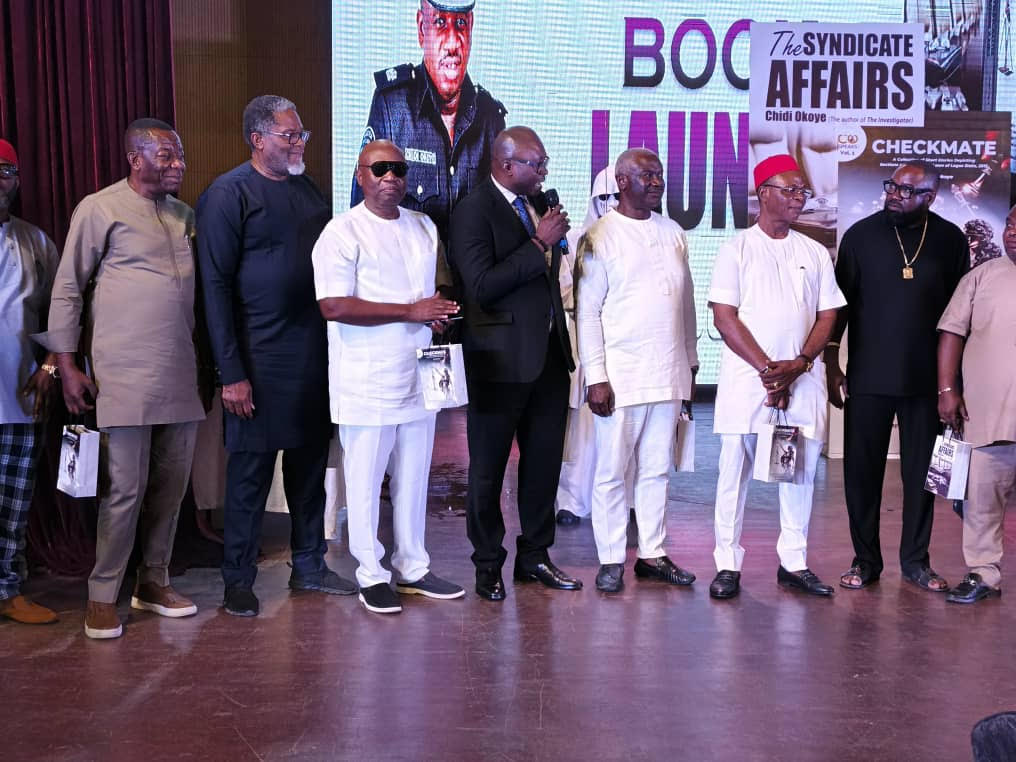
The prestigious Oriental Hotel on Victoria Island, Lagos, became the epicentre of intellectual brilliance and national inspiration last Friday as Superintendent of Police (SP) Chidi Okoye, officer, artist, author, and patriot, officially unveiled his latest literary works titled Checkmate and The Syndicate Affairs. The grand evening was attended by literary minds, senior officers, art lovers, family members, and book enthusiasts who gathered in large numbers to witness what many described as a rare union of law enforcement and literature.
The event opened on a profound note, as the Chairman, Mr. Michael Onouha delivered a deeply moving tribute to the author. He spoke with conviction, describing Okoye as “a man of great value” whose intellectual discipline and integrity stand as a model for the Nigeria Police Force. “The Nigeria Police Force is proud to have such a man serve. He remains an inspiration to other officers and members of the Force,” he declared to thunderous applause. Michael emphasized that voices like Okoye’s are crucial in reshaping how Nigerians perceive security agencies, not merely as instruments of force, but as guardians of knowledge, conscience, and cultural memory.
Chief Onouha, representing the traditional custodians of values and leadership, further elevated the moment. He reassured the gathering of his unwavering support for the author, expressing his belief that “Nigeria will be great through men of his kind.” He praised the attendees for their presence, urging the collective to continue supporting transformational thinkers within the Force. “I believe the author will one day hold a significant position in the Force that will inspire and grow our nation,” he said, adding that SP Okoye “is a living light not just to the Force, but to the entire society.”
The night then transitioned into the literary heart of the event as Professor Akingbeye stepped forward to review the first book, Checkmate. His analysis was nothing short of reverent. He described the work as “written in simple, fluid language” and praised its intimate grasp of criminal law. “It is difficult to believe that the author is not a lawyer,” he remarked with admiration. The professor explained that Checkmate is a collection of short fictional stories grounded in the complexities of Lagos criminal law and reinforced with references to the Administration of Criminal Justice Act (ACJA) 2015. He commended the book not just as entertainment but as a practical educational resource for law students, police officers, crime reporters, and the general public seeking to understand the real mechanics of justice.
If Checkmate impressed the room, the review of The Syndicate Affairs delivered by veteran journalist and critic Dr. Osa Mbonu-Amadi electrified it. He began by noting how rare it is to find fiction written by a serving police officer in Nigeria, particularly at such a cinematic level. He called the book “a bold creative adventure” that exposes the moral combat within the Force, the clash between officers of integrity and the criminally inclined. The novel’s lead character, Detective Sketch Dikko, was hailed as a symbolic redemption figure, “a kind of man who, if multiplied within the Force, would make ‘police is your friend’ a reality, not a slogan.”
Dr. Mbonu-Amadi described the work as “unceasingly gripping,” comparing its pace and visual strength to global action thrillers. He emphasized that from the prologue to the final chapter, the reader is transported into real, high-risk operations through vivid narration. The tension is balanced by humanity, specifically through a romantic subplot involving Funmi, an intelligent and graceful student of the University of Lagos, which gives emotional dimension to the otherwise dangerous world of crime-fighting.
The reviewer praised Okoye’s bravery in confronting Nigeria’s darkest social issues through literature. From gang rape and drug trafficking to extortion, fraud, and the weaponization of blackmail, the book exposes the layered moral decay that thrives when criminals infiltrate institutions meant to fight them. Yet, rather than demonizing the police, the novel offers balance, affirming that while there are “bad eggs,” there are also courageous officers risking their lives daily to uphold justice.
At this moment, the atmosphere reached a defining peak as AIG Adegoke Fayoade, addressed the audience. His pride was unmistakable. “Our job is so time-consuming that many of us barely have time for our families, but this young officer found time to write,” he said, visibly moved. He praised Okoye as humble, relentless, brilliantly analytical, and “the kind of officer who leaves no loophole when assigned any case.” The AIG went further to urge him to attend law school, stating, “The way he writes, you would think he is already a lawyer.”
Fayoade used the moment to challenge other police officers to emulate Okoye’s drive. “We have a lot to write as police officers. Our experiences are valuable to the nation.” He declared the evening proof that police officers are not just enforcers, but thinkers, historians, culture shapers, and nation builders.
SP Chidi Okoye, who had earlier authored The Investigator, is multi-talented, an artist, a quantity surveyor, and a compelling storyteller. Through Checkmate and The Syndicate Affairs, he has not merely written books, he has reopened national trust in the power of narrative to correct perception and inspire systemic growth. His works are not just fiction, they are mirrors, warnings, and patriotic appeals to conscience.
The launch concluded not as a mere book unveiling, but as the beginning of a new national conversation. It was a celebration of intelligence within uniform, proof that storytelling is itself a form of policing, and a reminder that the fight for a better Nigeria requires not only guns and badges, but pens, imagination, and truth.
—————————–