Follow Us on Google
By Bianca Iboma-Emefu
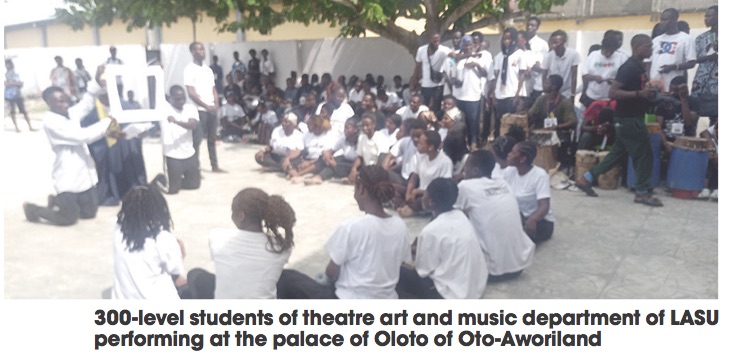
Amid the pain of fuel subsidy removal by President Bola Ahmed Tinubu’s administration, 300-level students of the Theatre Arts and Music Department of Lagos State University (LASU), Ojo, have carried out an advocacy campaign to enlighten Lagos communities of Ojo, Ijanikin and Oto-Awori on the benefits of the policy.
Although the students believe that the advocacy movement would help sensitise various communities on the prospects and opportunities associated with the decision made by the current administration, they appealed to the government to sustain the citizens by creating other incentives that can minimise the subsidy removal pain experienced by citizens at the moment.
Senior lecturer at the Department of Theatre Art and Music, LASU, Prof. Tunji Azeez, said the theatrical performances in the communities were in line with the students’ community transformation project known as Theatre For Development (TFD), an annual workshop for 300-Level students of the Theatre Arts and Music Department.
Azeez stated that the three-day theatre for development workshop, tagged: “Effects of fuel subsidy removal on Nigerians and the economy,” was basically aimed to sensitise the citizens as well as seek measures to mitigate the impact of fuel subsidy removal on the economy.
He added that the students, through their live performance of drama, dance and music, demonstrated the price hike of transportation and commodities that has intensified the hardship of citizens.
“The impact fuel subsidy removal has been on Nigerians, especially on the poor masses, who are at the receiving end from both government and criminals who take advantage of the hardship to dislodge and terrorise the masses for means of survival,” he said.
However, he explained the need to confront the daunting economic challenges as the cost of most goods and services have tripled, whereas the income of many citizens has remained the same. He wondered how the students would cope with the surge in prices.
“Nigerians cannot pay for the price of decades of political and economic mismanagement of the subsidy scheme. The authorities must finally respond to longstanding demands by devising a means, as a matter of urgency, to address the hardship faced by the poor masses.
“The Nigerian authorities must urgently put in place measures to protect the rights of people most affected by the removal of the fuel subsidy and prioritise addressing widespread hunger, higher unemployment and the rapidly falling standard of living.”
He appealed to well-meaningful Nigerians as well as the government to take up developmental project and invest in infrastructures, foundations and other public facilities in order to better the lot of Nigerians.
He further said: “When they have access to health care, transportation and other basic facilities, the burden would be reduced. These efforts would help fight poverty and the subsidy removal would be understood by the common man.
“We can see the effects of poverty on the faces of our people. Poverty is not hereditary, it is from society. Government position is to eliminate poverty.”
Azeez highlighted the burden on Nigerians and urged government to review it and make provisions to better the lot of the people.
On his part, the team lead and lecturer at the department, Mr. Kotin Hungbo Ovisemeho, said that the 300-level students of department embarked on the community project through performing arts to sensitise citizens on any issue and have done this for 21 years.
Ovisemeho said that they have been using drama for enlightenment, educating, entertaining and equally do advocacy, especially when they discover a particular problem associated with a local government area or local council development area in the state: “We ensure that we take performing arts to such environment in order to sensitise them.”
He asserted that the removal of petrol subsidy should encourage an efficient use of resources and offers incentives to explore alternative and more sustainable energy sources, rather than hardship.
“Theatre for development is a practice whose impact has been felt and documented globally and a universally tested approach for education, entertainment, and empowerment, and this tool has been employed by the theatre arts unit of the university to address democracy, good governance and behavioural change for 21 years.
“Through this initiative, of using drama to advocate topical issues in society, people need to consider their actions, especially as it relates to the pricing of goods and services. For instance, the elimination of subsidy brought challenges and opportunities. What we need to do as an institution is to constantly educate people and appeal to their conscience not to inflate prices spontaneously to avoid severe hardship,” Ovisemeho pointed out.
He educated the citizens on the need to be patient with the administration’s removal of subsidy as the move would have a positive impact in the long run.
“The current hardship faced by Nigerians is temporary as the president is working hard to ensure that the looming fuel crisis comes to an end in Nigeria.”
Stressing the focus of the art, he said it was meant to create social awareness for the citizens, especially market women and the transport unit. “They have to understand the burden for government to sustain fuel subsidy. People’s view is for government to harness available opportunities, to better their lots and not increase the poverty. We need to tap from their rich potentials, awaken their consciousness on global issues that will enable them to maximize their potential for personal economic and communal development.”
Oba Josiah Olanrewaju Ilemobade Aina assured the students that every request they have made would be considered by the government as they are going to inform President Tinubu on the students plight and measures to tackle the challenge would be initiated.
He said: “President Tinubu’s current decision may seem difficult and hard but it is to improve the standard of living. Tinubu is ready to serve the nation with his depth of knowledge and experience.
“The burden of sustaining fuel subsidy, year-in and year-out, has become quite heavy. Subsidy has made it difficult for government to have adequate funds for provision of basic social amenities and critical infrastructure.
“Tinubu is a very decisive leader. I want to urge everybody, especially the youths of this country to be patient with him. He is focused; God has endowed him.
“We should keep praying for him every day. The president is getting stronger and wiser to handle the affairs of the nation.”