Follow Us on Google

By Ngozi Nwoke
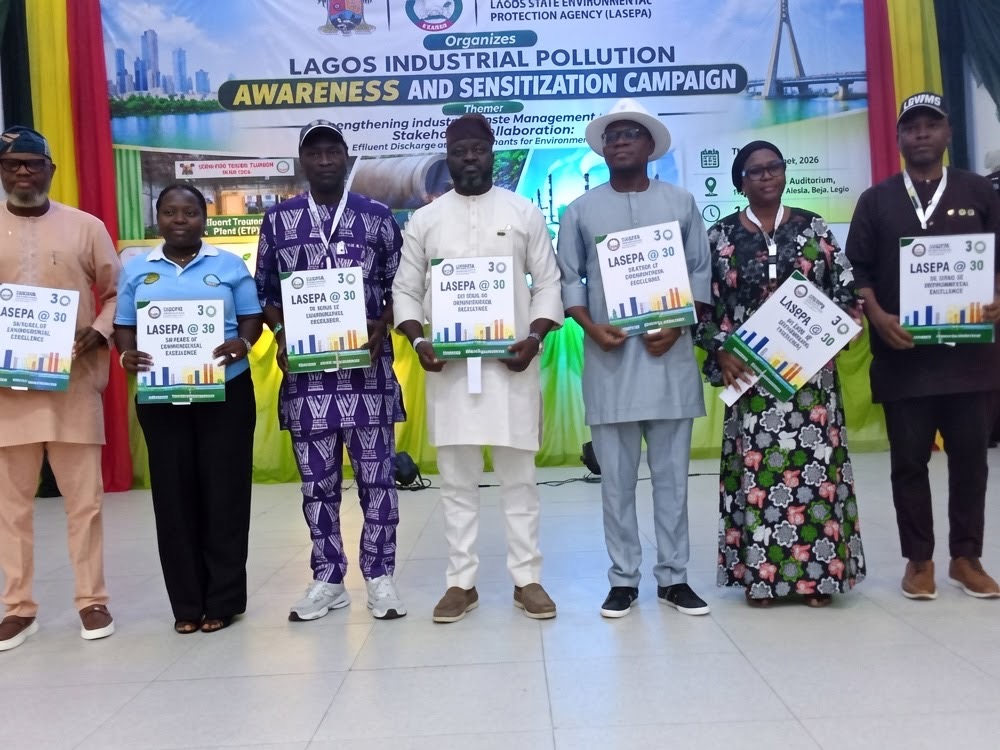
The Lagos State Environmental Protection Agency (LASEPA) organised a Lagos Industrial Pollution Awareness and Sensitisation Campaign with the theme: “Strengthening Industrial Waste Management through Stakeholder Collaboration”.
Speaking at the event, the General Manager of LASEPA, Babatunde Ajayi, said there were clear benefits for industries that managed their waste responsibly.
“There is a good reward for pollution abatement, for managing your environmental waste responsibly as a business, an industry or a factory,” he said.
“You become an example to others in your category of business. The regulators are listening, the regulators are watching, and the regulators know when you are doing the right thing. There is evidence of whatever you do.”
Ajayi noted that LASEPA’s approach to compliance was based on continuous monitoring rather than self-regulation.
“There is nowhere in the world where you achieve compliance by goodwill or by relying on people’s conscience. It is continuous monitoring, and we are not going to stop,” he said.
He added that the agency had digitised air pollution monitoring and was piloting water pollution technology.
“We are testing and piloting the use of drones to survey and test water bodies across Lagos to identify where industries are discharging effluent and polluting our water bodies. We are innovating with technology and we will continue to visit these facilities,” he said.
Also speaking, the Chairman of the House Committee on Environment and Public Utilities, Lagos State House of Assembly, Mr Adebola Rasheed Shabi, commended LASEPA for the initiative.
“When you talk about industrial waste management, you are talking about solid waste, liquid waste and gaseous waste. With our attitude in this part of the world, we are not so careful about the ecosystem, especially with liquid waste.”
He explained that the law mandated industries to install effluent treatment plants before discharge.
“The sludge sometimes ends up in landfills. In some cases, such as with food industries, it can be used as fertiliser. But if it is from pharmaceutical or chemical industries, it cannot, and it must go to the landfill,” he said.
He warned that untreated effluent affected aquatic life and water transportation and could lead to eutrophication, which depletes oxygen in water.
On solid waste, Mr Shabi said Lagos would see significant improvement within three months as investors came in to manage waste.
“PSP operators will no longer go directly to landfills. They will take waste to transfer loading stations where it will be segregated. Only non-recyclable waste will end up in landfills,” he said.
Other News
The Special Adviser to the Governor on Environment, Mr Olakunle Rotimi-Akodu, said the sensitisation was part of LASEPA’s regular collaboration with industrial and commercial entities.
“Lagos is known for huge commercial and industrial activities, and a lot of waste is generated from this sector. We must ensure waste is disposed of effectively and that all entities comply with state standards.”
He urged stakeholders to stop cutting corners.
“Don’t comply by day and discharge effluent at night. Don’t release poisonous gases when people are asleep. Give true reports to government agents. If we are all sincere, Lagos will continue to be safe and liveable.”
The Managing Director of Envaco Limited, a LASEPA-accredited consulting firm, Ibrahim Salau, said the campaign highlighted shared responsibility.
“The government cannot do it alone. We had representatives from CDCs, CDAs, academia, civil society and industry. We all have a role to play to abate pollution.”
He called on residents to stop dumping refuse in drains and to report infractions to LASEPA.
“Pollution must be addressed by the polluter. The approach is reduction at source, containment and treatment, and ensuring that what is discharged meets compliance requirements.”
Also, Akin Apata of the Unified Polythene and Allied Products Manufacturers Association of Nigeria commended LASEPA and called for government support for industries.
“We are the gateway to manufacturers and sellers of polythene products in Lagos and beyond. We will partner with LASEPA to sensitise our members on wastewater and air pollution management,” he said.
He appealed for technical and financial support for new industries to build waste treatment facilities.
“The cost of compliance is direct. The cost of non-compliance is paid by the people through their health.”
He also called for stronger collaboration between CDC, CDA and enforcement agencies to ensure PSP operators work effectively.
The campaign brought together regulators, industry leaders, community associations and civil society groups to reinforce Lagos State’s commitment to cleaner air, water and land.