Follow Us on Google
By Lukman Olabiyi
Lagos State, Nigeria’s bustling commercial hub, is renowned for its vibrant economy and dynamic population. With over 21 million residents, the city faces significant transportation challenges, including traffic congestion, long commute times, and environmental concerns.
In response, successive administrations have embarked on ambitious projects to overhaul its transportation network through an innovative inter-modal transport system.
The concept of inter-modal transport in Lagos is not new. Recognizing the inefficiencies of a road-centric transport system, the state government envisioned a multi-faceted network combining road, rail, and water transportation.
The goal is to create a seamless, efficient, and sustainable urban mobility system that could alleviate traffic woes and improve the quality of life for residents. To manage this transformation, the Lagos State Metropolitan Area Transport Authority (LAMATA) was established, tasked with integrating various modes of transport and ensuring connectivity and accessibility across the metropolis.
In addition, the Lagos State Traffic Management Authority (LASTMA) was created to manage traffic effectively, and Lagos Traffic Radio, the country’s first traffic radio station, was launched in May 2012. The Lagos Drivers’ Institute was also established in June 2008 to improve and moderate driving culture in the state.
Under Governor Babajide Sanwo-Olu, who took office on May 29, 2019, significant efforts have also been made to realize the state’s ambition of attaining an inter-modal transport system. His administration is anchored on the T.H.E.M.E.S agenda, which stands for Transportation and Traffic Management; Health and Environment; Education and Technology; Making Lagos State a 21st Century Megacity; Entertainment & Tourism; and Security & Governance.
Governor Sanwo-Olu’s administration has embarked on an infrastructure development programme aimed at easing traffic congestion and improving connectivity across the state.
Under his leadership, significant efforts have been made to improve the road transport infrastructure. Several critical roads have been rehabilitated and expanded to ease traffic flow while, works are still ongoing on some.
Notable among these projects are the Agege-Pen Cinema Bridge, Lagos-Ogun boundary roads Phase II, Lekki Oniru Traffic Circulation projects, a network of 31 roads in Ojokoro, Aradagun-Epeme-Iworo-Ajido, Somolu road network, Oba Sekunmade Road, Agric Isawo Road, Ikorodu, St. Finbarrs and Iwaya Roads, Lekki-Epe Expressway from Eleko Junction to Epe T junction, and the Lekki Regional road project.
Other News
Other projects include the Ojo and Abaranje road network in Alimosho, Reverend Braithwaite in Epe, and the 3.89-kilometer-long Ojota-Opebi Link Bridge among others.
The Lagos State Public Works Corporation had also maintained over 632 inner roads covering more than 192 kilometres, in addition to over 24 public infrastructure to ensure the comfort of Lagos residents. Additionally, the Bus Rapid Transit (BRT) system has been expanded with new routes and additional buses to serve more commuters efficiently. The launch of LagRide introduced 1,000 units of Sport Utility Vehicles (SUVs) and 500 units of First and Last Mile (FLM) buses, enhancing transportation options. The injection of 560 high-medium capacity buses for standard routes, the employment of over 2,000 LASTMA officers to manage traffic, and the deployment of traffic lights and CCTV cameras in strategic locations have further improved service delivery and reduced travel times. The Traffic Management Intervention Plan (TMIP) was also introduced to optimize the utilization of carriageways, pedestrian walkways, parks, and garages.
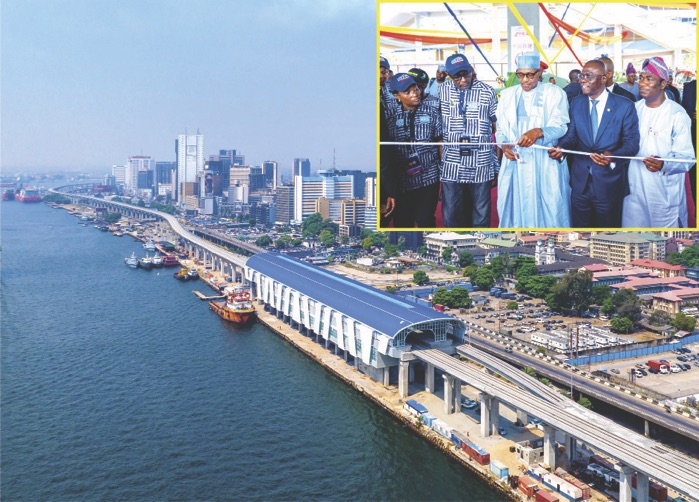
A significant milestone in achieving an inter-modal transport system is the inauguration of the Blue and Red Lines rail projects. The Blue Line runs from Marina to Okokomaiko, covering a distance of 27 kilometers and designed to move over 500,000 passengers daily.
The Red Line runs from Agbado to Marina, a 37-kilometre rail project integrated with existing national rail networks, facilitating smoother intercity travel.
Leveraging Lagos’s extensive waterways, Governor Sanwo-Olu prioritized water transport as a key component of the inter-modal system. Several new ferry routes were introduced, connecting areas like Ikorodu, Lagos Island, Lekki,Ajah, Badagry, and Victoria Island.
Ferry terminals were also upgraded, equipped with facilities that enhance safety and passenger comfort. The Lagos State Waterways Authority (LASWA) has implemented stringent safety regulations to ensure smooth operations.
To enhance the efficiency of the inter-modal transport system, technology plays a crucial role. An integrated e-ticketing system was introduced, allowing commuters to use a single ticket across buses, trains, and ferries.
This system simplifies fare collection and reduces the hassle of multiple ticket purchases.
Despite significant progress, the journey towards a fully integrated inter-modal transport system is not without challenges. Funding constraints, bureaucratic hurdles, and the need for continuous maintenance of infrastructure pose ongoing issues.
However, Governor Sanwo-Olu’s administration has reaffirmed its commitment to overcoming these obstacles.
Through these comprehensive efforts, Lagos is on the path to creating a transportation network that meets the needs of its dynamic population, reducing congestion, and improving the overall quality of life for its residents. The vision of an inter-modal transport system in Lagos is becoming a reality, promising a more efficient and sustainable future for the city’s commuters.