Follow Us on Google
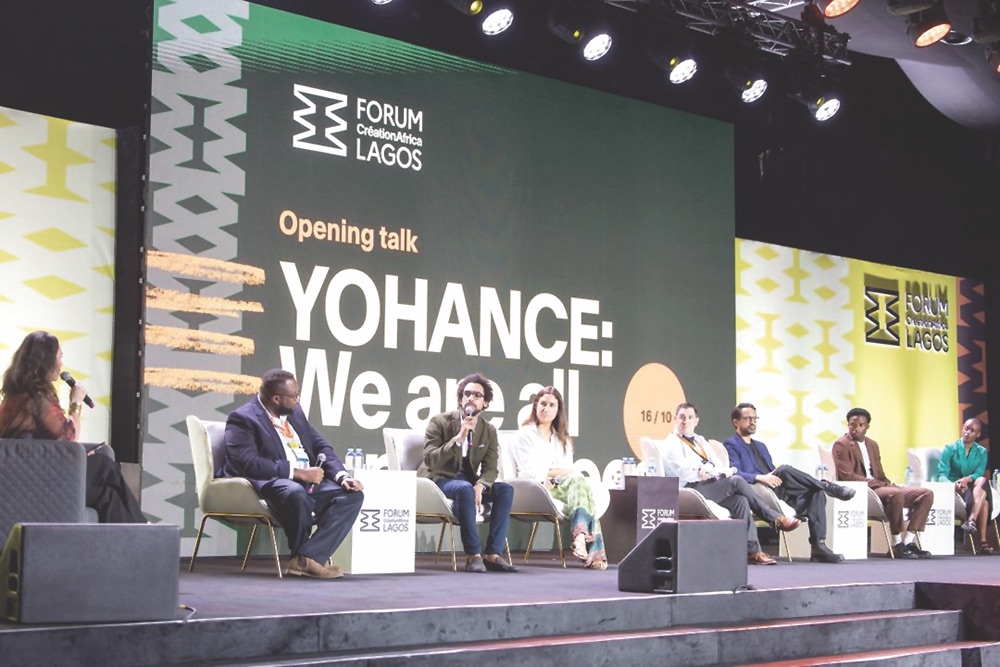
The energy inside the Federal Palace Hotel on Lagos Island was electric over the weekend as the city played host to Forum Création Africa, a landmark gathering that united some of the brightest creative and digital innovators from across the continent.
The forum, the largest of its kind dedicated to Africa’s cultural and creative industries, drew over a thousand participants from 42 countries, marking a bold new phase in Franco-African cooperation driven by culture, technology and sustainability.
From filmmakers to fashion designers, from animators to artificial intelligence developers, delegates arrived not merely to network but to also rewrite the narrative of Africa’s place in the global future. For many, the gathering felt less like a conference and more like a cultural and technological renaissance unfolding in real time.
French President Emmanuel Macron, who addressed the forum virtually, described the choice of Lagos as host city for the first African edition of Création Africa as “an obvious decision.”
“Lagos is not only a creative powerhouse in Africa, it is a global reference for cultural innovation,” Macron said. “You have gathered in this vibrant city to explore new perspectives, foster collaborations and spark creative energy.”
Macron emphasised that Création Africa is more than another cultural showcase, it is an accelerator for shared innovation between Africa and Europe.
“It’s a powerful opportunity to bring people together across borders, across languages, and to shape the stories of today and tomorrow. Stories that reflect our evolving societies,” he said.
He revealed that the forum was guided by MansA, Maison des Mondes Africains, a major new cultural institution based in Paris dedicated exclusively to promoting contemporary African creativity.
Delivering the opening address, Elizabeth “Liz” Gomiz, Director of MansA, spoke in unapologetic terms about Africa’s new role in the world’s cultural future.
“Africa is not waiting to be seen, it is already setting the rhythm,” she declared. “From fashion to gaming, from VR to AI, African creativity is rewriting the code of global culture.”
She emphasized that Création Africa is not merely a conference but an economic and strategic platform. “We see creation not as decoration,” she said, “but as a lever for global innovation. Culture is not an afterthought, it is the engine of transformation.”
Gomiz argued that culture is soft power no longer: “Culture produces meaning, and meaning produces power, the power to shape perception, to move markets, to define reality.”
Her concluding line drew applause across the hall: “The next revolution will not be televised, it will be designed, coded, filmed, composed, and it will be African.”
Among the standout exhibitions was Heritage in Motion, presented by Zara Odu of the Roundabout Community, a digital and physical hub focused on circularity, sustainability and future-forward African innovation.
“The value of African innovation lies in going back to our roots,” she said. “Our indigenous techniques, hand-weaving, textile recycling, natural dyeing, are not relics. They are technologies.”
She emphasised that African craft systems are inherently sustainable and scalable, not nostalgic. “African craft has always been innovative,” she said, “not through machinery, but through deep material intelligence and adaptability.”
Her message resonated strongly with technologists, especially in panel discussions examining the role of artificial intelligence in creative economies. The consensus was firm: AI should not erase African originality, but extend it.
Beyond cultural solidarity, France used the forum to reaffirm its economic and technological commitments to Nigeria.
Other News
In a conversation, Jean-Noël Barrot, France’s Minister for Europe and Foreign Affairs, described the Lagos forum as a turning point.
“France is at the forefront of creative industries in Europe, and Nigeria leads in Africa,” he said. “There is much we can achieve together by bringing our talents and entrepreneurs into the same space, as we have done today in Lagos.”
Barrot explained that the relocation of the forum from Paris, where the first edition was held last year, to Lagos was a promise made by President Macron to President Bola Ahmed Tinubu.
“When Macron met Tinubu in France last year, he promised Lagos would host the next edition. Today, that promise has been fulfilled.”
France’s commitment extends far beyond cultural exchange. Barrot highlighted the Omi Eko Project, a €410 million initiative co-funded by France and the European Union, aimed at modernising water transportation in Lagos.
The project will deploy 75 electric-powered boats and open 15 new water routes, significantly reducing travel time, curbing emissions and building resilience against rising sea levels.
“This project will deliver decarbonised water transport for Lagos, helping the city resist climate threats while cutting 41,000 tonnes of CO₂ per year,” Barrot said.
Additionally, he inaugurated the renovated French School of Lagos, built to serve both French and Nigerian students, a symbol, he said, of shared educational and cultural values.
One of the forum’s most urgent conversations centred on artificial intelligence. African creators, technologists and policy leaders called for African languages, histories and values to be embedded in emerging digital systems, before it is too late.
“AI must not be another extractive pipeline,” one panelist warned. “It must amplify, not overwrite, African imagination.”
“France, Nigeria and Europe share a common vision rooted in innovation and regulation, to protect citizens while empowering creators,” he said. “We must build our own tools.”
The forum also marked the opening of the largest ever exhibition on the life and legacy of Fela Anikulapo-Kuti. First staged in Paris, the exhibition finally arrived in Lagos, the birthplace of the Afrobeats legend.
It was both symbolic and strategic: a signal that African icons should not only be exported to the world, but institutionalised on their own soil.
From Nollywood co-productions to AI language models rooted in Yoruba syntax, from sustainable fashion to VR tourism, the Forum Création Africa Lagos proved that Africa is not auditioning for the future.
As Barrot affirmed before departing Lagos: “From culture to economy to infrastructure, our cooperation is accelerating and delivering tangible results. This is the future of France–Nigeria relations, creative, digital and collaborative.”
With Lagos now firmly on the map as a global engine of cultural and technological imagination, one thing became clear as the forum closed:
Africa is not emerging, it has arrived. And Lagos has just sent that message loudly to the world.